
On this page
Kokin Denju no Tachi
- It is the tachi 銘豊後国行平作 (mei Bungo Koku Yukihira saku), called 古今伝授の太刀 (Kokin Denju no Tachi). It was designated in 1934 under the old law and has been a National Treasure since 9 June 1951; its leather-wrapped mounting, 革包太刀拵 (kawazutsumi tachi koshirae), is included in the designation. It belongs to the Eisei Bunko foundation, in Tokyo.
- Its name dates from 1600: Hosokawa Yūsai, besieged at Tanabe, gave it to Karasumaru Mitsuhiro. It passed to the Nakayama in 1894, went to auction in 1929 and shortly afterwards was bought by Hosokawa Moritatsu.
- It has a groove at the base on both faces: on the omote, a kurikara in gyō style; on the ura, a figure in relief. The six-character signature is on the ura and inside the groove, and the NBTHK translation gives it as the only example of its kind. Some see Bishamonten in the figure.
- The measurements do not agree: the State record gives a blade of 79.9 cm and a sori of 2.9, and the English translation of the NBTHK, 89.2 cm. Sesko gives 80.1 and 2.8. This last one is a misprint: its own measurement in shaku gives about 80 cm.
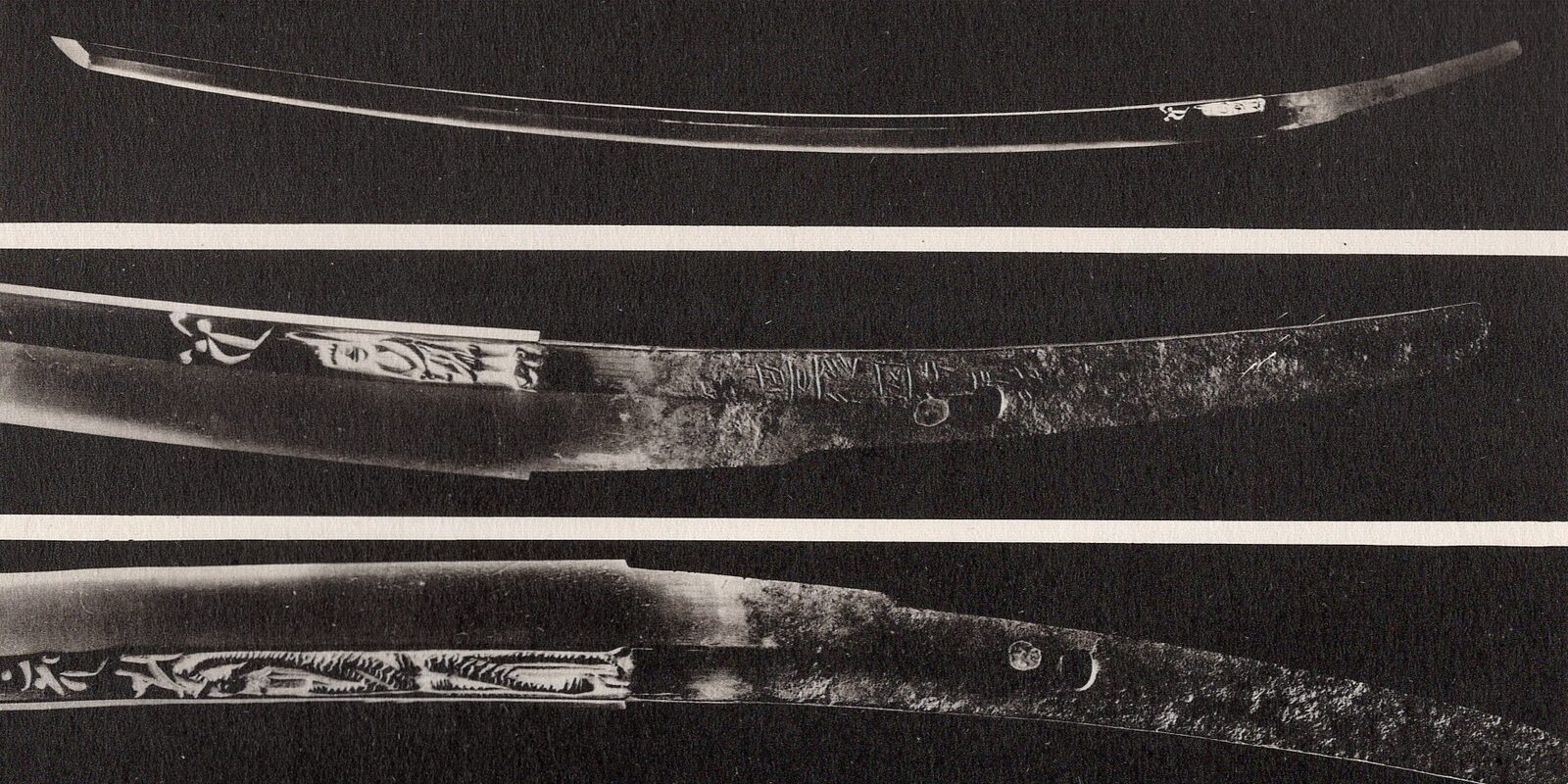
In the State database and at the Tokyo National Museum
| Work | Designation | Where it is |
|---|---|---|
| Tachi 銘豊後国行平作 (mei Bungo Koku Yukihira saku), the Kokin Denju no Tachi | National Treasure, 1951 | Eisei Bunko foundation (永青文庫, Eisei Bunko), Tokyo |
| Tachi 銘豊後国行平作 (mei Bungo Koku Yukihira saku), 65.7 cm | Important Cultural Property, 29 August 1950 | Tokyo National Museum |
| Tachi 銘豊後国行平作 (mei Bungo Koku Yukihira saku), 79.0 cm | Important Cultural Property, 12 June 1975 | Tokyo National Museum |
| Tachi 銘行平作 (mei Yukihira saku) | Important Cultural Property, 29 August 1950 | City of Nagoya |
| Tachi with a Muromachi-period lacquered mounting of autumn grasses; blade 銘豊後国行平作 (mei Bungo Koku Yukihira saku), 76.4 cm | Important Cultural Property, 14 November 1953 | Sano Museum, Mishima |
| Tachi 銘豊後国行平 (mei Bungo Koku Yukihira), 68.0 cm, with a kenuki-gata mounting of the 18th and 19th centuries | Not listed in ColBase | Tokyo National Museum |
| Tachi 銘豊後国行平作 (mei Bungo Koku Yukihira saku), with an itomaki-tachi mounting | Not listed in ColBase | Tokyo National Museum |
Of the two at the Tokyo National Museum, the 1950 one is slender, of itame with masame and suguha with ko-gunome and ko-midare, with a large yaki-otoshi; it bears a kurikara on the omote, a bōhi and, on the ura, a bonji and a cherry blossom. The 1975 one bears a bonji and a Buddhist figure of strange form. That the tachi in the ColBase photos is the 1950 one is likely, but it has not been checked.
In the Kyōhō meibutsuchō
- The 地蔵行平 (Jizō Yukihira) of Hosokawa Tadaoki is in the 享保名物帳 (Kyōhō meibutsuchō), in the section of burned swords, 焼失之部 (shōshitsu no bu): it burned in the great Meireki fire, in Edo, in 1657.
- There is another Jizō Yukihira, that of the Takamatsunomiya house, which is an Important Cultural Property and is today at the Tokyo National Museum. It has not been possible to find out which of the museum’s two designated tachi it is.
- The figure engraved at the base is read as Jizō, Bishamonten, Fudō or En no Gyōja depending on the author; the museum takes it to be Bishamonten, from how it interprets the bonji.


