Sugata
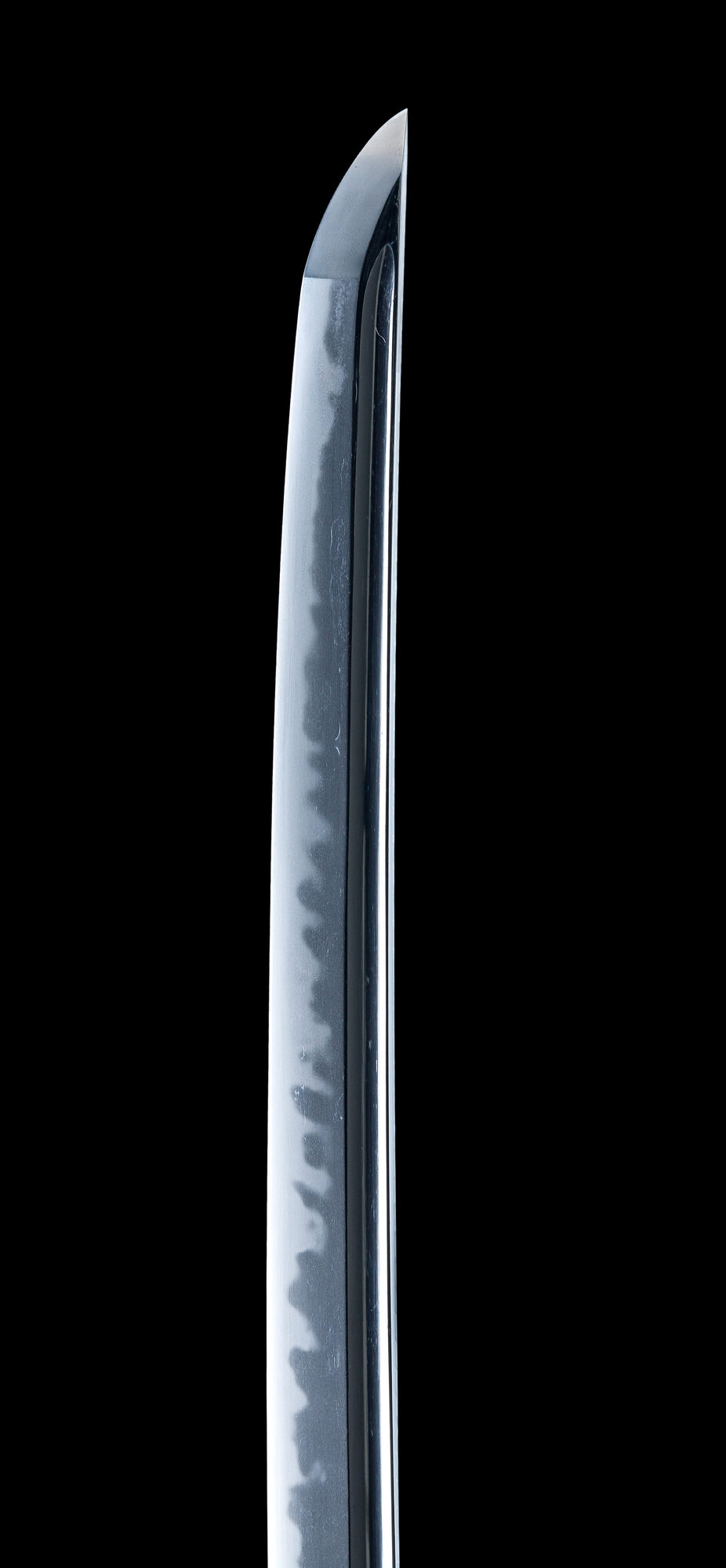
According to the Japanese Sword Index, the katana of the first generation have little curvature, great width and an ō-kissaki; in his Takahira period, a chū-kissaki and a medium width that narrows towards the point, the shape the second generation followed. Markus Sesko gives as an example of the Keichō-shintō shape a katana of his of 1604, of 65 cm and 0.4 cm of curvature.
The katana by Matasuke of 1664 that the NBTHK discusses has the shape of the Kanbun era.
Jihada
The Japanese Sword Index describes a mokume mixed with masame and with ji-nie; Markus Sesko places Kanewaka among the swordsmiths with masame. The NBTHK sees in Matasuke’s katana a somewhat tight itame, masame in the shinogi-ji, abundant ji-nie, fine chikei and a dark colour, and says of the first generation that his hada is not as marked as that of Horikawa Kuniyasu.
The Tokyo National Museum describes in its katana by the third generation a steel with mixed masame, and the Tokyo Fuji Art Museum, in the Takahira of 1622, a well-forged itame.
Hamon
According to the Japanese Sword Index, ō-notare midare and ō-gunome midare, wide, with gunome that tend to become square, the 箱乱れ (hako-midare); thick sunagashi in the valleys; sometimes a rough, pointed midare, and also suguha-chōji with gunome ashi. The hako of the first generation is more irregular, and that of the second and third more square and defined.
The NBTHK dates the change: on the large blades of the Keichō era, the first generation hardens a shallow notare with togariba and gunome, and the midare with square sections appears around the Genna and Kan'ei eras (1615-1643), when the shapes also change. In Matasuke, hakoba-midare with ear-shaped gunome and ko-notare; afterwards, a simple hakoba or a large, exaggerated midare. Markus Sesko cites Kanewaka and Takahira for the square element of the hamon, and Kanewaka for the yahazu-ba, with the Seki school of Echizen.
The Tokyo National Museum describes in the katana by the third generation a deep nioiguchi and a notare hamon with ko-nie, and the Fuji Art Museum, in the Takahira, a gentle gunome of nioi and nie that reaches almost to the shinogi. For the Tokyo National Museum, the one by the third generation comes close to the work of the first and second.
Bōshi
According to the Japanese Sword Index, a small midare-komi with ko-maru and a turn-back, sometimes in the Mishina manner; the ko-maru is common from the second generation. That of the first is undulating and sharp-pointed, with kaeri; as Takahira, notare-komi with ko-maru and a discreet turn-back. The NBTHK sees the straight bōshi with ko-maru and turn-back more often in the later generations.
Horimono
The Japanese Sword Index records bōhi and futasuji-hi, and on the first generation skilful engravings: ken, goma-bashi, a dragon coiled around a sword within a frame, pine, bamboo and plum, and the Buddhist triad. The later ones hardly engraved. The index believes the most elaborate engravings were probably by specialists, perhaps from Echizen.
Nakago and mei
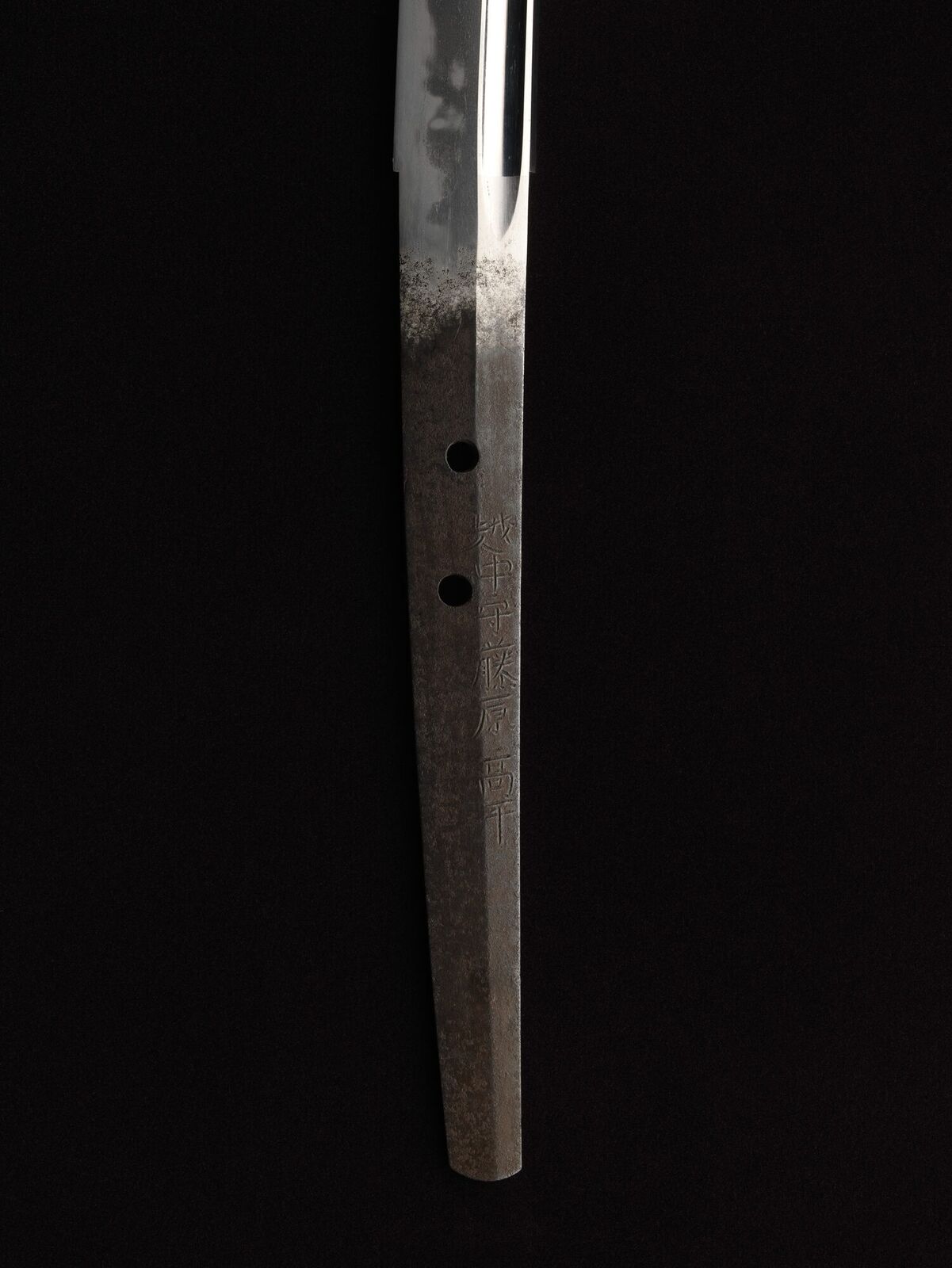
According to the Japanese Sword Index, the tang ends in a gentle kuri-jiri, with sujikai or katte-sagari file marks and a square mune. Kashū is written with the character 賀 (ka); there are short signatures, but the long ones are the most common, and 造 (tsukuru) was used by the first generation and rarely by the others. The shape of the character 若 (waka) serves to distinguish the first from those who followed him.
The katana of 1622 in the Metropolitan Museum bears 越中守藤原高平 (Etchū no Kami Fujiwara Takahira) on one side and 元和八年六月日 (Genna hachinen rokugatsu hi) on the other, with two holes.
How to tell the generations apart
What the sources bring together: the Takahira signature belongs only to the first generation, between 1619 and 1628; with Kanewaka, the first uses 造 (tsukuru) and a shape of his own for 若 (waka), and his blades of the Keichō era are wide, with ō-kissaki and notare with togariba; the clean hako-midare and the straight bōshi with ko-maru point to the second and the third, and the exaggerated hako to the later generations.