On this page
From Mino to Kanazawa
The Japanese Wikipedia and Kotobank say that the first Kanewaka was born in Mino, had the surname Tsujimura (辻村, Tsujimura) and that around 1605 (Keichō 10) the Maeda of Kaga called him to Kanazawa. His technique came, according to Kotobank, from Shizu Kaneuji, and the family claimed descent from Shizu Saburō Kaneuji.
The Japanese Sword Index gives the earlier genealogy: a Shirōemon Kanewaka worked in Mino from 1532, and his grandson, Tsujimura Yomonosuke, who lived in Inuyama, in Owari, moved to Kaga around 1604, according to the records, with his son, the first Kanewaka. Maeda Toshiie had made Kanazawa his seat in 1583 and needed swords.
The record of the Takaoka City Museum on Bunka Isan Online tells it the same way: from Mino to Inuyama, in Owari, and from there to Kanazawa, called by the Maeda.
From Kanewaka to Takahira
The Japanese Sword Index orders his signatures by date: the oldest dated blades, of 1604 (Keichō 9), read 兼若 (Kanewaka) or 兼若作 (Kanewaka saku); those of 1607 and 1609, 賀州住兼若作 (Kashū jū Kanewaka saku); from 1611 to 1619, 賀州住兼若造 (Kashū jū Kanewaka tsukuru). The last with that name is of the ninth month of 1619 (Genna 5), and the first signed 越中守藤原高平 (Etchū no Kami Fujiwara Takahira), of the first month of Genna 7, in 1621. His last work is of the second month of 1628 (Kan'ei 5).
The Japanese Wikipedia and Kotobank place the title and the change of name in 1619. A tantō signed 越中大掾藤原高平 (Etchū Daijō Fujiwara Takahira) leads the Japanese Sword Index to think of a brief period with the title of daijō. The Japanese Wikipedia gives his death in 1628, with a question mark.
The sons and the generations
The Japanese Sword Index gives the first generation four swordsmith sons.
| Swordsmith | What is on record | Dates |
|---|---|---|
| Shirōemon Kagehira, the eldest | Active from 1620; according to the Japanese Sword Index, he may have signed as the first or the second Kanewaka | Blades from 1628 to 1656 |
| Arihira, the second | Echigo no Kami | |
| Matasuke (又助, Matasuke), the third | The second Kanewaka | 1613-1677 |
| Kiyohira, the fourth | Worked in Odawara | Around 1650-1694 |
| Shirōemon, son of Matasuke according to the same source | The third Kanewaka; inherited the name in 1677 | Died in 1711 |
For the NBTHK, Matasuke was the first Kanewaka’s third son and the second Kanewaka of the shintō. A katana of 1664 (Kanbun 4) signed “Kashū jū Kanewaka, Tsujimura Matasuke, aged 53” shows, according to the NBTHK, that in the Kanbun era the third, Shirōemon, was already signing for his father: the signature appears to be his.
The sources disagree on two points. Aged 53 in 1664, counted the Japanese way, Matasuke was born in 1612, not in 1613. And the name Shirōemon is borne by the first, according to the Japanese Wikipedia and Kotobank, and by his eldest son and his grandson, according to the Japanese Sword Index. The same index doubts that Matasuke, who was seven years old when his father took the name Takahira, signed Kanewaka so young.
The Maeda swordsmiths
The Heibonsha encyclopaedia, on Kotobank, gives the Kanewaka as an example of the swordsmiths that a lord kept in his service: the Maeda of Kaga had them, and the family kept name and technique until the end of the Edo period.
According to the record of the Takaoka City Museum, the first was called Kaga Masamune (加賀正宗, Kaga Masamune), and in Kanazawa it was said that whoever owned a Kanewaka would be given a daughter in marriage even if his stipend was low.
Images
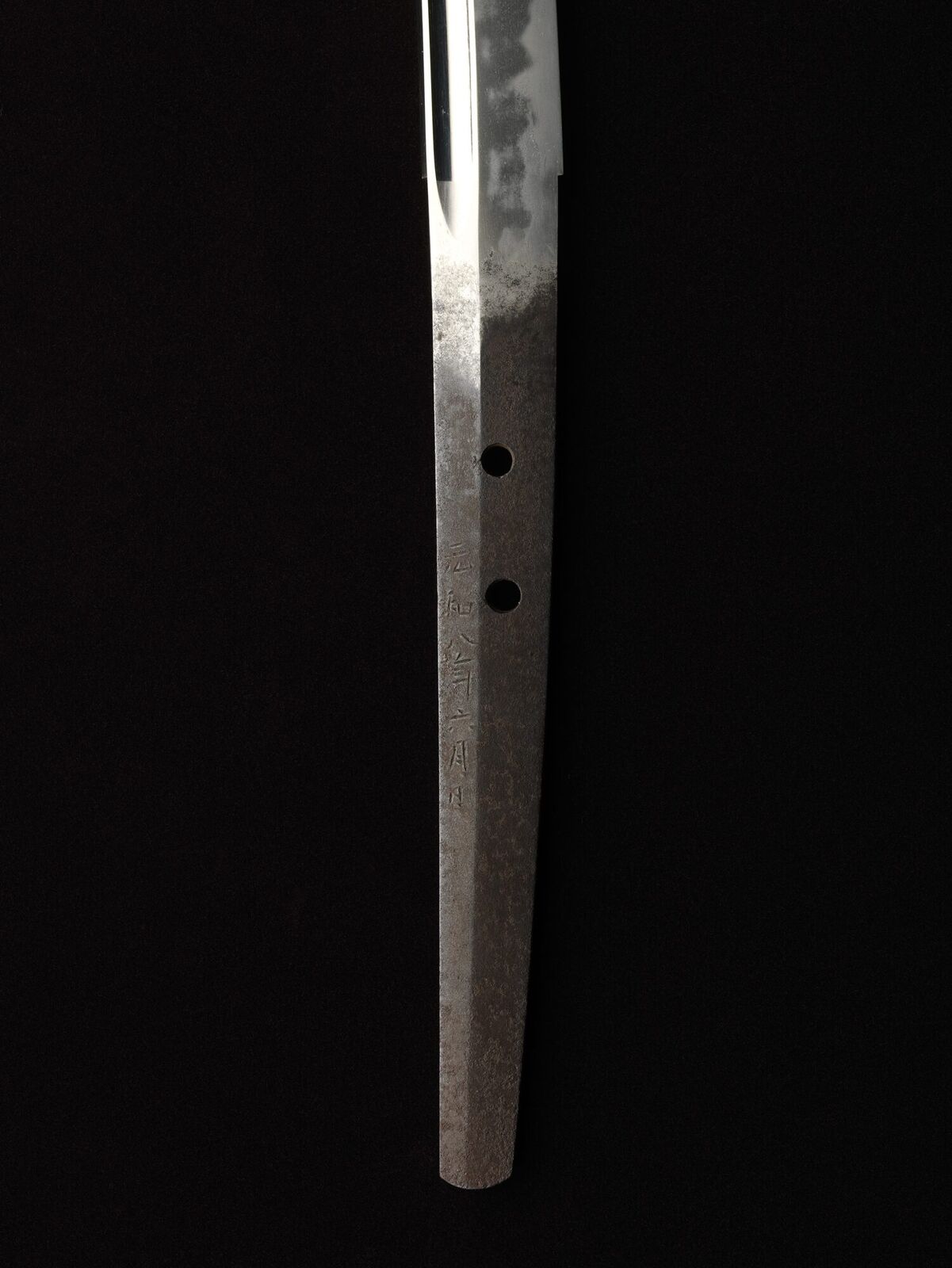
The other side of the tang, with the date 元和八年六月日 (Genna hachinen rokugatsu hi). The Metropolitan Museum of Art, New York · Public domain · source