On this page
His works, one by one
| Work | Designation | Where it is | Note |
|---|---|---|---|
| Tachi 銘光忠 (mei Mitsutada) | National Treasure | Tokugawa Art Museum, Nagoya; 72.4 cm | Received in 1698 by Tokugawa Tsunanari, lord of Owari, after the visit of the shōgun Tsunayoshi |
| Tachi 銘光忠 (mei Mitsutada), unshortened | Important Cultural Property (14 November 1953) | Tokugawa Art Museum; 82.4 cm | A rare signed ubu nakago |
| Ikoma Mitsutada (生駒光忠, Ikoma Mitsutada), katana with a gold-inlaid signature | Important Cultural Property (18 September 1936) and National Treasure (2 February 1955) | Eisei Bunko Foundation (永青文庫, Eisei Bunko), Tokyo; 68.4 cm | Appraised as Mitsutada by Hon'ami Kōtoku |
| Katana with a gold-inlaid signature | National Treasure | Private collection | According to the Japanese Wikipedia |
| Tachi 銘光忠 (mei Mitsutada) | Important Cultural Property (12 June 1975) | Tokyo National Museum; 68.4 cm | A long, slender blade, in a flamboyant style |
| Tachi with the gold-inlaid signature 光忠 本阿 (Mitsutada, Hon'a) and its kaō | Important Cultural Property (18 February 1949) | Tokyo National Museum; 69.4 cm | From the Tokugawa shogunal house; appraisal by Hon'ami Kōchū |
| Unsigned katana, attributed to Mitsutada | Important Cultural Property; formerly a property of the imperial household | Tokyo National Museum; 66.6 cm | Attribution |
| Tachi 銘備前国長船光忠 (mei Bizen-no-kuni Osafune Mitsutada) | Not designated; from the imperial collection | Sannomaru Shōzōkan (三の丸尚蔵館, Sannomaru Shōzōkan) | Shortened, with the signature at the tip of the nakago: proof that he lived in Osafune |
| Shokudaikiri Mitsutada (燭台切光忠, Shokudaikiri Mitsutada), unsigned, attributed | Not designated; a burnt blade | Tokugawa Museum, Mito (Ibaraki) | Burnt in the Kantō earthquake of 1923 |
| Tachi signed 光忠 (Mitsutada) in shrines and museums | Important Cultural Properties, according to the Japanese Wikipedia | Kishū Tōshōgū, Izumo Taisha, Itsukushima Jinja and Hayashibara Museum | Not checked one by one in the official database |
The Ikoma Mitsutada
A katana 68.4 cm long, shinogi-zukuri with iori-mune, ikubi-kissaki, a wide mihaba, a somewhat thick kasane and little sori; very compact ko-itame with ji-nie and a crisp midare-utsuri; an ō-chōji hamon, more flamboyant in the lower half, with gunome in the upper. Hon'ami Kōtoku appraised it as Mitsutada at the end of the Keichō era and inlaid the signature in gold. Its name comes from Ikoma Sanuki-no-kami Chikamasa, lord of Sanuki. The Japanese Wikipedia considers it the most flamboyant of his works.
The Shokudaikiri Mitsutada
According to the Japanese Wikipedia and Sesko, Date Masamune cut down a servant with it, together with a bronze candlestick standing behind him, hence the name, “the one that cut the candlestick”. It passed to the Tokugawa of Mito because Tokugawa Yorifusa asked for it; it burnt in the Kantō earthquake of 1923 and was given up for lost. On 30 April 2015 the Tokugawa Museum in Mito announced that it survived as a burnt blade; it is exhibited unsigned, as attributed to Mitsutada.
In the lists
- National Treasures. The Japanese Wikipedia counts three: the signed tachi of the Tokugawa Museum, the Ikoma Mitsutada and another katana with a gold signature in a private collection. The 日本人名大辞典 (Nihon Jinmei Daijiten) gives the same count: a signed tachi and two katana with Hon'ami Kōtoku’s gold signature.
- Kyōhō meibutsuchō (享保名物帳, Kyōhō meibutsuchō). It has not been checked whether any blade by Mitsutada appears in it.
- Wazamono. Mitsutada does not appear in Yamada Asaemon’s ranking of sharpness (業物, wazamono), according to the list in the Japanese Wikipedia.
Two blades on display
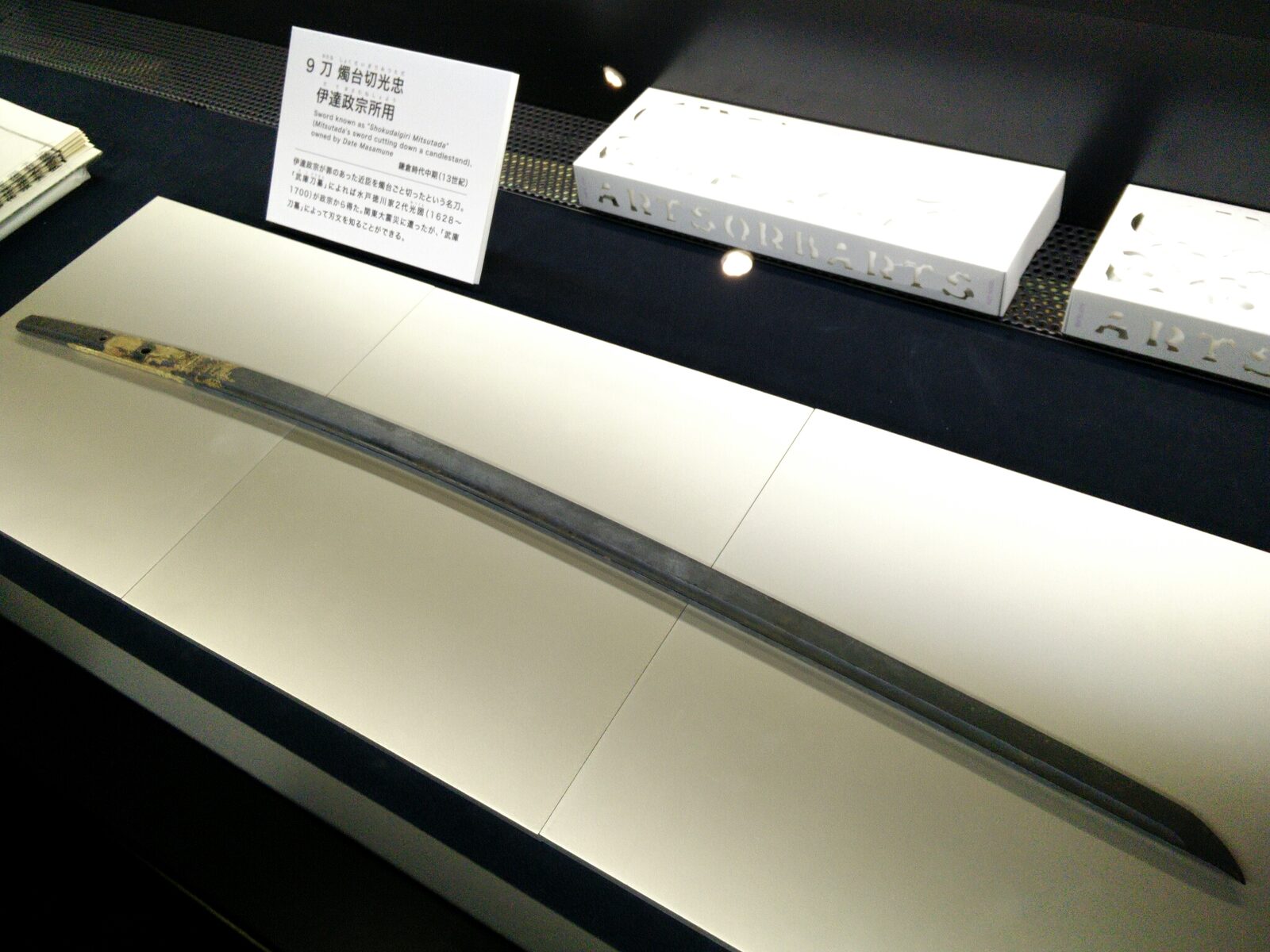
The Shokudaikiri Mitsutada (燭台切光忠, Shokudaikiri Mitsutada), burnt in 1923, at an exhibition at Haneda airport, in autumn 2015. Himeno Masuta, CC BY-SA 4.0, via Wikimedia Commons · CC BY-SA 4.0 · source 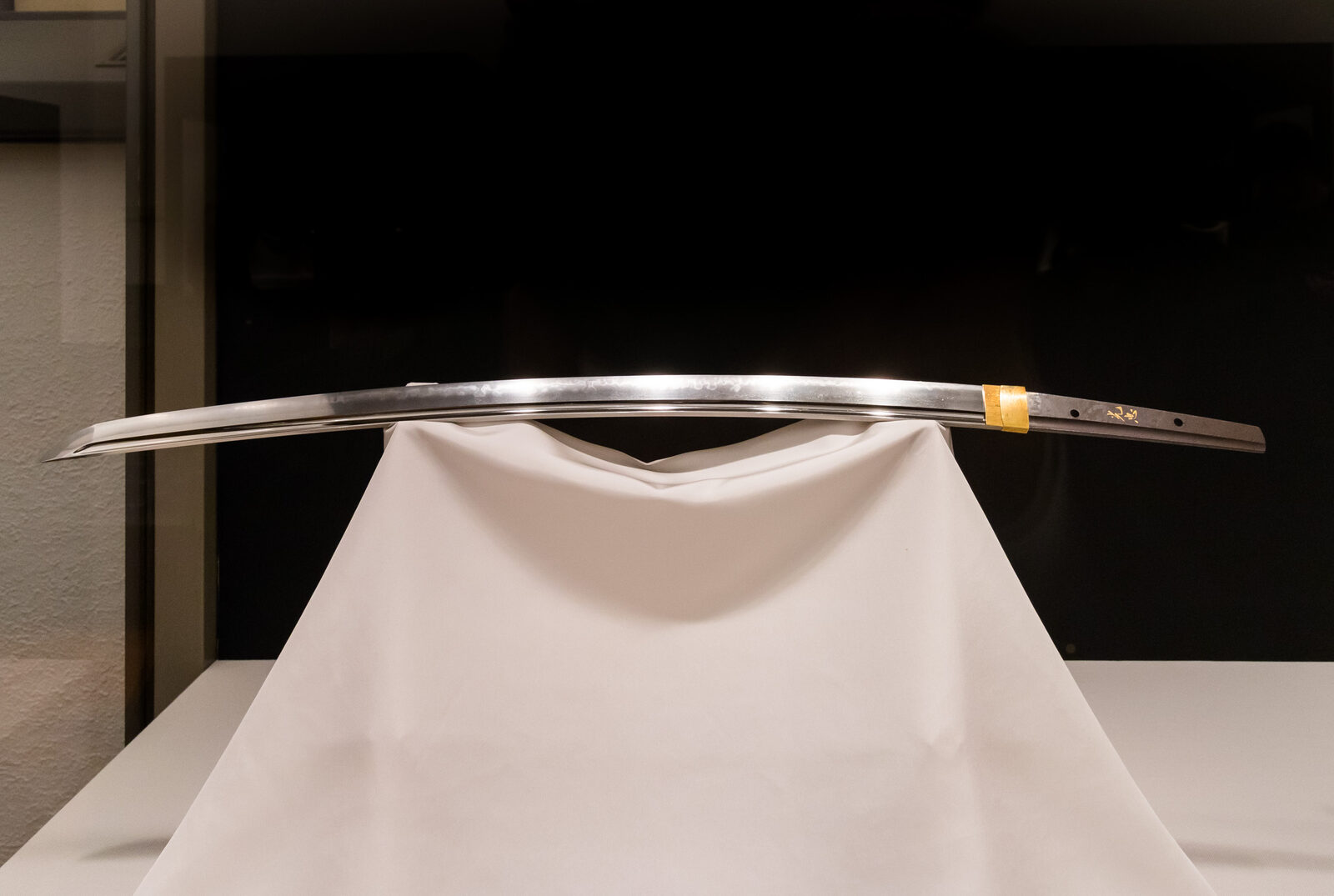
Katana by Mitsutada with the signature 光忠 (Mitsutada) inlaid in gold (金象嵌銘, kinzōgan-mei); Important Cultural Property. Kakidai, CC BY-SA 4.0, via Wikimedia Commons · CC BY-SA 4.0 · source

