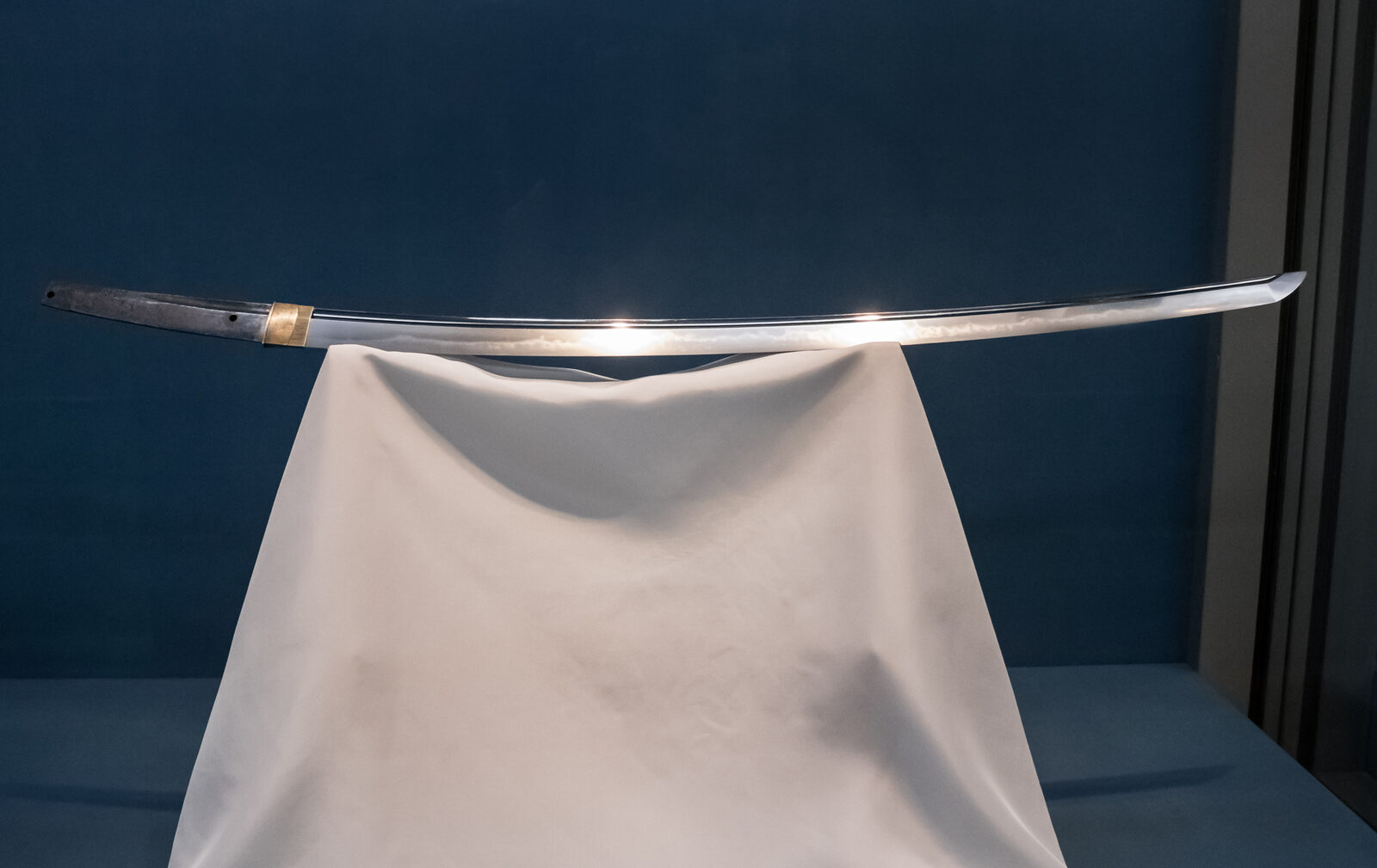
Fukuoka Ichimonji
- The school is so called because it lived in Fukuoka, on the banks of the Yoshii river, in Bizen, and because some of its swordsmiths sign only with the character 一 (ichi).
- In the mid-Kamakura period it produced Yoshifusa, Norifusa and Sukezane, all of showy chōji-midare; Sukezane is the strongest and the most forceful, according to the Japanese Wikipedia.
- Neither the year of his birth nor that of his death is known.
His father
The Japanese Wikipedia gives his father’s name in kanji, without a reading. The Nihon jinmei daijiten+Plus, with the same spelling, reads it 助成 (Sukeshige); the Nihon kokugo daijiten, on the other hand, gives 助房 (Sukefusa) as his father.
To Kamakura
- According to the Japanese Wikipedia, around 文永 (Bun'ei) 3, 1266, he was summoned to Kamakura, to Yamanouchi, when Prince Koreyasu became the seventh shōgun, and settled in Numahama (today Numa, in Zushi). That is why he is called Kamakura Ichimonji and held to be one of the foundations of the Sagami swordsmiths. It is a tradition.
- Markus Sesko tells it differently: in the Kenchō era (1249–1255) the regent Hōjō Tokiyori summoned Awataguchi Kunitsuna from Kyoto and, somewhat later, Bizen Saburō Kunimune and Ichimonji Sukezane from Bizen, to found a sword-forging centre in Kamakura.
- Two sources and two periods: the journey is tradition, not a dated fact.
His place among the Sagami swordsmiths
The old genealogies give Kunitsuna, Kunimune or Sukezane as the father or master of Shintōgo Kunimitsu, the effective founder of the Sagami tradition. In the genealogy of the Sagami swordsmiths of the Kanchi-in-bon Meizukushi, Sukezane comes before Kunimitsu, and the Kiami-bon Meizukushi also treats him as a Sagami swordsmith.
Ogasawara Nobuo, cited by the Japanese Wikipedia, holds the opposite view: his chōji-midare is typical of Bizen, and it is hard to see any relation with the Sagami swordsmiths.