The mounting in detail
«Mounting styles (koshirae)» explains which ensembles exist; this topic opens the pieces one by one. Who makes a mounting and in what order, which animal the hilt skin comes from, which way the menuki face, how to read a tsuba from both sides, why a cast tsuba is no good on a sword, and what lies inside a habaki. At the end, a bestiary for reading the motifs of the fittings.
Who makes a mounting
A koshirae does not come out of a single workshop. Several crafts make it, each with its own name:
| Craft | What it does |
|---|---|
| sayashi (鞘師) | carves the scabbard and the wooden core of the hilt |
| nurishi (塗師) | lacquers the scabbard |
| tsukamakishi (柄巻師) | covers the hilt in ray skin and wraps it |
| shiroganeshi (白銀師) | makes the habaki and the washers (seppa) |
| kinkō (金工) | chisels the metal fittings: tsuba, fuchi, kashira, menuki |
The order of work hardly changes. First the shiroganeshi makes the habaki and the seppa, because the scabbard and the rest of the mounting are fitted to them. Then the fittings are chosen — at least tsuba, fuchi and kashira — and the hole of the tsuba is fitted to the tang. Next the sayashi makes the scabbard and the hilt in wood. The scabbard goes to the lacquerer, and the horn reinforcements of the mouth, the kurigata and the retaining hook are glued on before lacquering. The hilt goes to the tsukamakishi together with the scabbard, so that the outline of the whole matches, and with the menuki already chosen, because they sit under the wrap. Finally everything is assembled and adjusted. A complete mounting takes months: in one case documented in a workshop, a wakizashi mounting took 4–5 months, one for the scabbard, another for the lacquer and then the hilt. And workshops insist that someone has to direct the whole: good craftsmen working on their own do not guarantee a good mounting.
The wood is hō (朴), Japanese magnolia, left to season for more than ten years; according to an NBTHK sayashi, the tree is felled on a rainy day. The traditional glue is sokui (続飯), a paste of cooked, crushed rice: it holds well and still lets the scabbard be opened for repair. Chemical glues prevent that and, according to the NBTHK craftsmen, attract rust. Inside, the scabbard should touch the blade only along the back; where it rubs, years of oil blacken the wood and attack the steel, and the classic repair is to pare that area down and line it with gold leaf and lacquer.
In general, yasume-zaya (休め鞘), «resting scabbard», is another name for the shirasaya (see «Polishing and care»). In the Tokugawa house of Owari the name was also used for a scabbard of their own, likewise called abura-zaya (油鞘) or Takeya-zaya (竹屋鞘): unlacquered wood, with no hilt of its own. The blade rested in it with the wrapped hilt still on, instead of going into an ordinary shirasaya, and the scabbard always bore the inscription of Takeya, the house polisher.

Same: the ray skin of the hilt
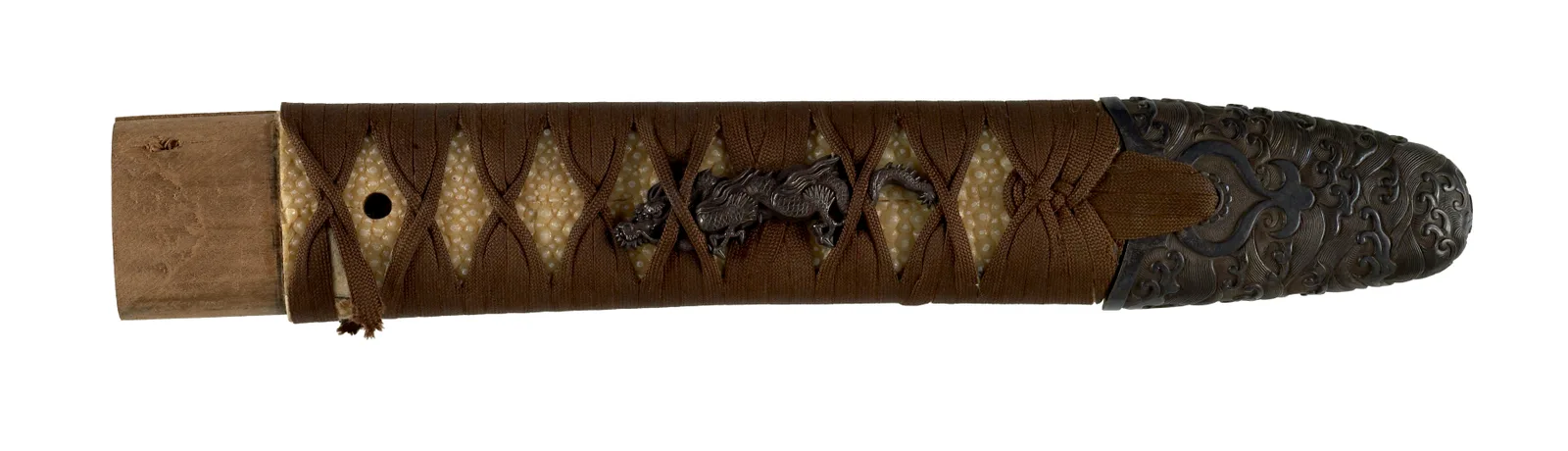
The hilt is covered in same (鮫), a word that means «shark» but almost always refers to ray skin. The reference species is the tsuka-ei, Pastinachus sephen, a ray of the Indian Ocean and the western Pacific whose back is paved with hard nodules. Japan had no raw material of that quality: the skin was imported from Southeast Asia, and around 1620 the Dutch East India Company was buying it in large quantities to bring to Japan. More came from Ayutthaya, the capital of Siam, and the daimyō picked the best skins as gifts for the shōgun.
The largest nodule, in the middle of the ray's back, is called the oyatsubu (親粒). There is only one per skin, and seeing it clean between the diamonds of the wrap is a sign of good work. Workshop tradition adds two rules: the animal's head goes towards the kashira and the tail towards the fuchi, because the nodules, which are scales, lean towards the tail; and the piece used to be cut from the centre of the skin, with the oyatsubu halfway along the hilt, whereas on many Edo mountings it sits next to the kashira, to get more out of an expensive skin.
Covering follows an order. The skin is soaked to soften it, dry-fitted several times while the wood is pared down, and finally glued. Along the edge and back of the hilt, thin strips of wood, kyōgi (経木), or of paper are added to even out the surface; the adhesive is kusune (くすね), pine resin with rapeseed oil, or sokui. Under each crossing of the wrap goes a small pad of Japanese paper. Kotō-period hilts examined in workshops have no strips: the wrap sits directly on the nodules, which can be felt through it; it is harder to do, but the cord does not move.
There are three ways of covering the hilt, the same-kise (鮫着せ):
| Covering | What it is | What it says about the mounting |
|---|---|---|
| tanzaku-gise (短冊着せ) | two rectangular panels inset, one on each face | the economical way, often with offcuts |
| hara-awase (腹合わせ) | the skin goes all the way round and closes edge to edge, usually in the middle of the ura face | one full turn, no overlap |
| maedare-gise (前垂れ着せ) | a turn and a half, overlapping on the edge side | the strongest and the one that uses most skin; carefully made mountings |
Same was sometimes lacquered black, which hardens it and protects it from water. In workshop practice, lacquered same was the norm in the Kotō period, and white spread with the Shintō. White was for formal dress: for the daishō worn with ceremonial clothing, the bakufu prescribed black scabbards and wraps with white same. On a scabbard, lacquered skin polished until the nodules are flush produces patterns called kairagi (梅花皮), with variants such as hana-kairagi (花梅花皮), mame-kairagi (豆梅花皮), kikutoji (菊閉) or chirimen (縮緬); this uses the parts of the skin that are no good for a hilt.

Menuki: position and direction
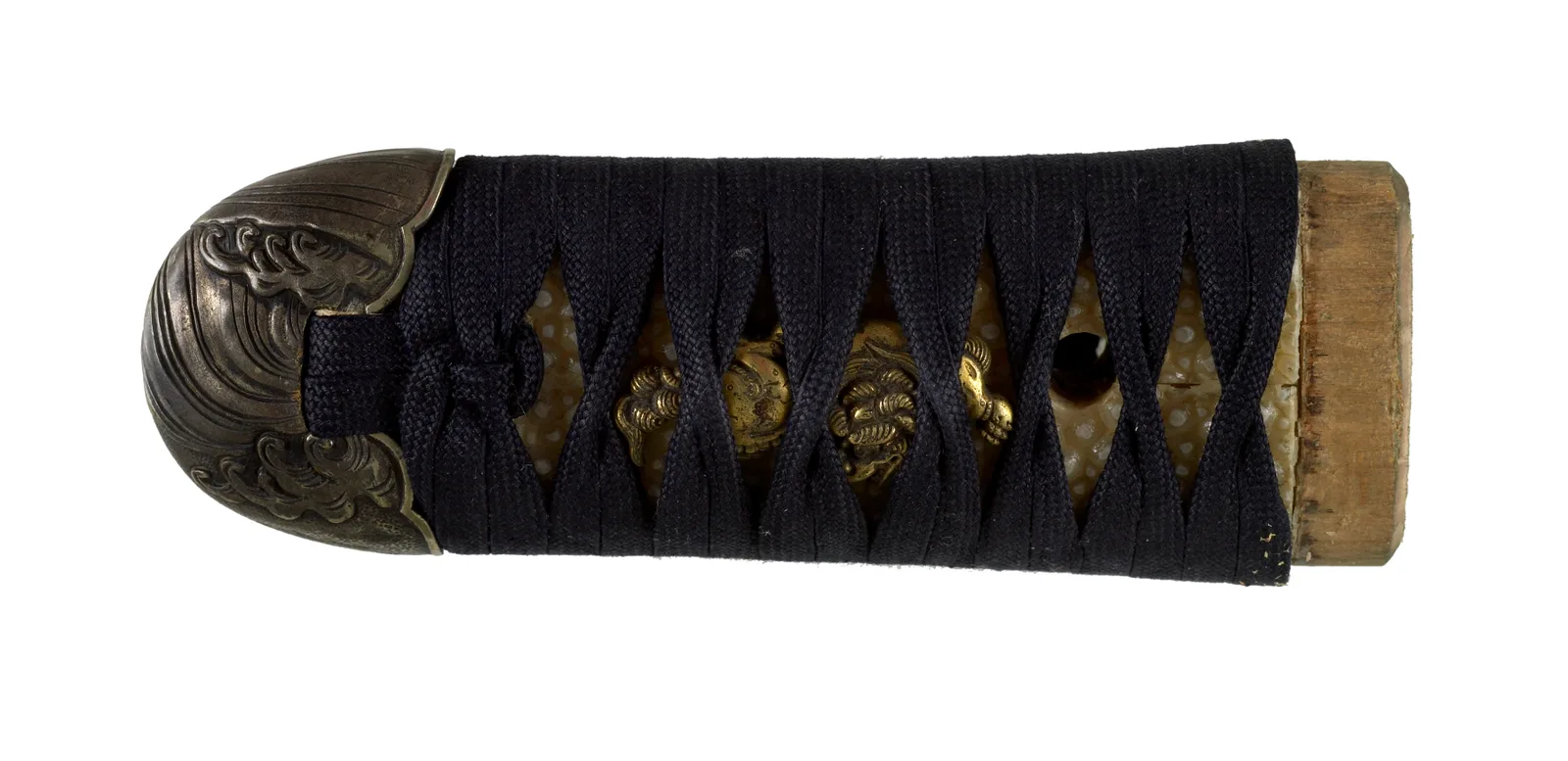
Originally the menuki capped both ends of the peg that holds the blade in the hilt (mekugi). By the Edo period they have parted from it: they remain as ornament and as a grip for the hand, held under the wrap by small stems, the ne (根, «root»).
Their position follows a rule. On a katana, the menuki on the omote side sits towards the fuchi and the one on the ura side towards the kashira, so that one falls under the palm and the other under the fingers. Animal or human figures face the tsuba, that is, towards the blade: with the sword seen from the omote, hilt to the left and edge up, the figure faces right. In plant motifs, the root or stem also points towards the tsuba. If the two figures differ, the larger goes on the omote. It is not a rigid law, and some old mountings do not follow it. Fitted the other way round they are called nige-menuki (逃げ目貫), «fleeing menuki», and were considered a bad omen: the figure runs away from the fight, and samurai took care over the direction.
The Yagyū mounting, devised in the 17th century by Yagyū Ren'yasai Toshikane (柳生連也斎厳包), fencing master to the house of Owari, reverses the position: the omote menuki moves next to the kashira and the ura one next to the fuchi, so that both sit under the palm. This is the gyaku-menuki (逆目貫).

The daishō from the mounting
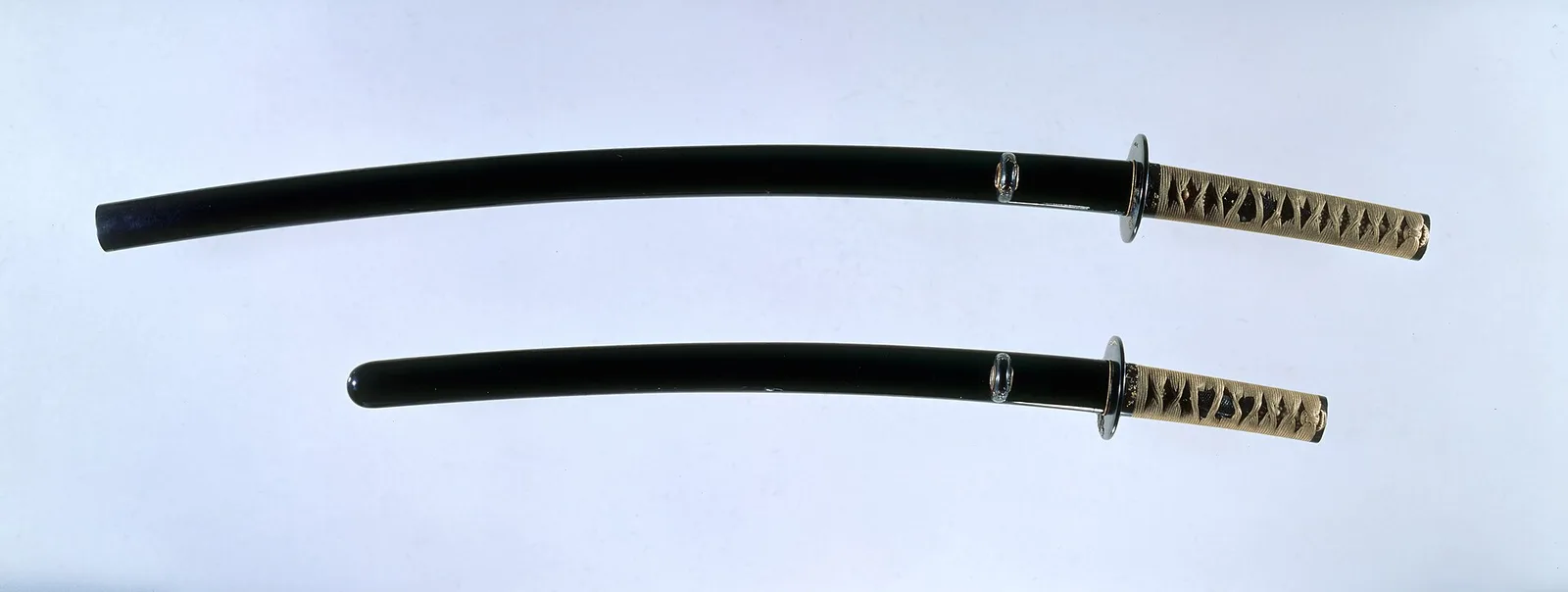
«Mounting styles (koshirae)» tells the origin of the daishō and its role in formal dress. From the mounting's point of view something else matters: what has to match between the two swords. The lacquer of both scabbards and the colour of the hilt wraps have to be the same; for the fittings the same material and a related motif are enough, because complete original sets are rare. The tsuba of the short sword is smaller: in an original set measured in a workshop, that of the dai measures 86 × 81 mm and that of the shō 75 × 70 mm; in general, katana tsuba are around 7.5–8 cm and wakizashi tsuba around 6.2–6.6 cm.
The wakizashi mounting is not a small katana: it belongs to the pair's secondary sword, with its own slot for the kozuka and, in workshop practice, a rounded kojiri (鐺), the end cap of the scabbard. When fuchi, kashira, kozuka, kōgai and menuki are by the same maker with the same motif, the set is called gotokoromono (五所物), and it is among the most prized.
Two practical warnings. «Daishō» refers to the mountings: two blades in shirasaya are a pair of blades, not a daishō. And not every Edo mounting belonged to a samurai: moneylenders, village heads and merchants could carry a wakizashi when travelling or on formal occasions. An edict of 1629 required the daishō of samurai on duty, and in 1876 the Haitōrei (廃刀令) banned carrying swords in public.
Sageo, kurigata and kaerizuno
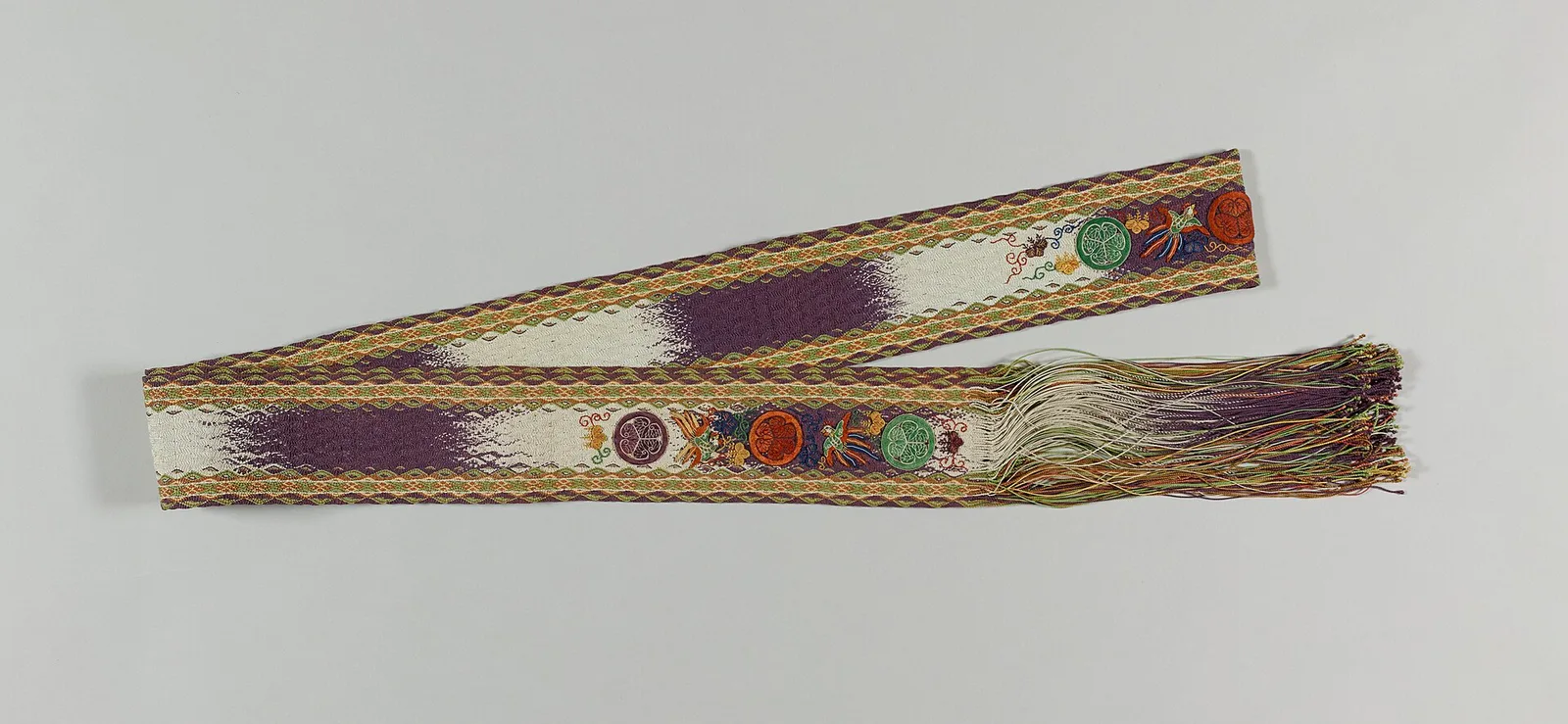
The sageo (下緒) is the cord that runs through the kurigata (栗形) — also kurikata — and ties the scabbard to the obi. It is almost always silk, though there are deerskin, hemp and cotton ones, and the most common weave is flat. In the Edo period its colour followed rules of rank: scarlet, for instance, belonged to the great lords and the shōgun. The eye of the kurigata has a metal reinforcement, the shitodome (鵐目).
Swords in use wore the sageo loose, not tied in decorative bows: ornamental knots are for storing a sword, not for carrying it, and they wear out the cord. Workshop tradition says that in peacetime the sageo hung loose and on campaign it was tied tighter.
Further down, some scabbards carry the kaerizuno (返角), a hook of horn or metal that catches on the obi so the scabbard does not come out with the blade when drawing. On the Higo mounting it is angled towards the kurigata. In workshop practice it was common before the 16th century; later many mountings leave it out, because it gets in the way in daily life. Rare katana have also been seen with the kurigata on the ura side: left-handers, or wearing the sword edge down, have been suggested, but there is no sure explanation.
The tsuba has holes for cords too. On the Satsuma mounting, two small holes, the sayadome (鞘止), allowed the tsuba to be tied to the scabbard so the sword would not be drawn lightly; workshop tradition says it was tied with something easy to break, paper or thin wire, and people were taught to draw the sword scabbard and all if need be. Other tsuba have one or two udenuki-ana (腕貫穴), on the back side, for the wrist cord; on the tachi that cord passed through the ring of the pommel, the sarute (猿手).

Anatomy of the tsuba
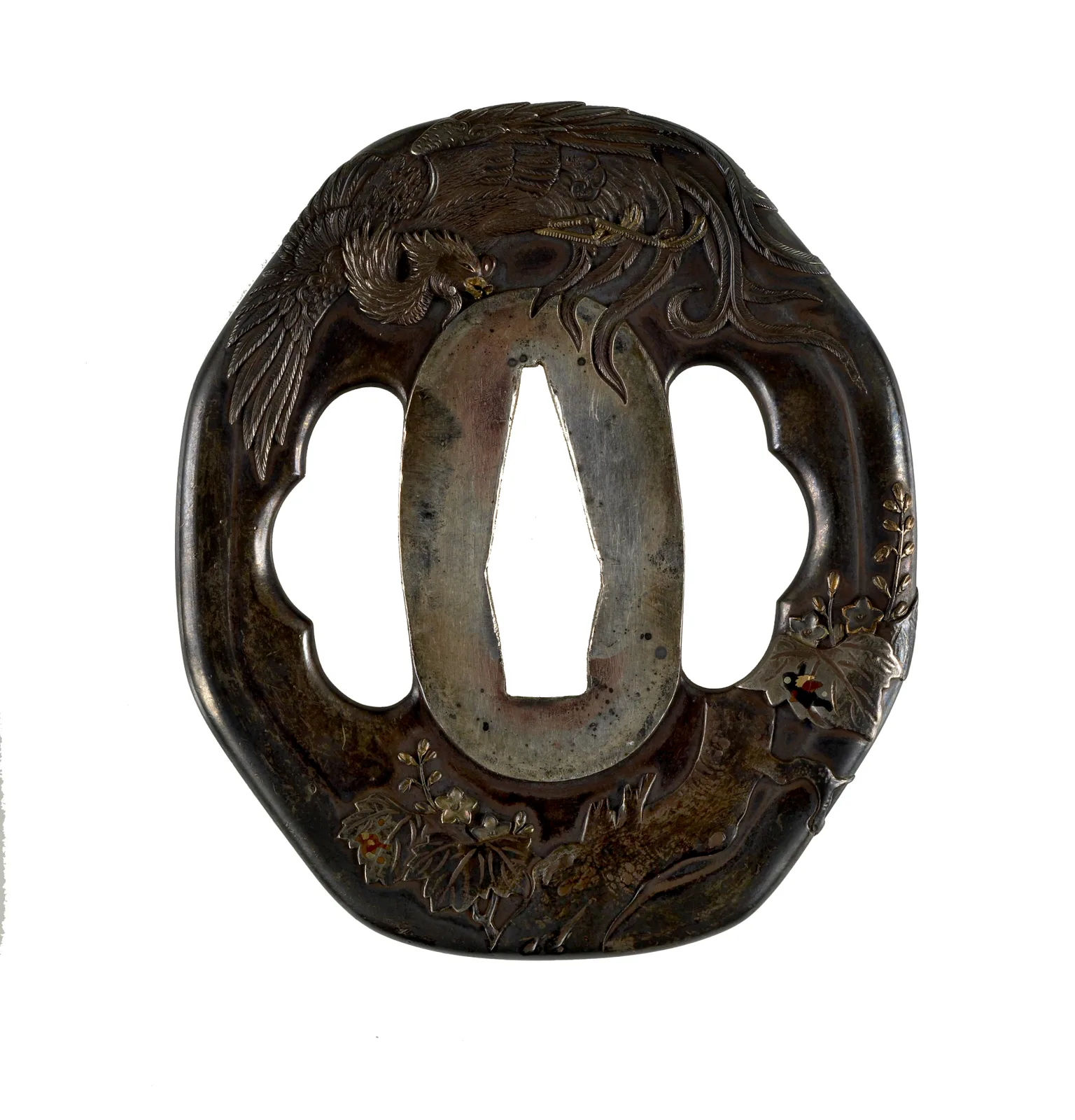
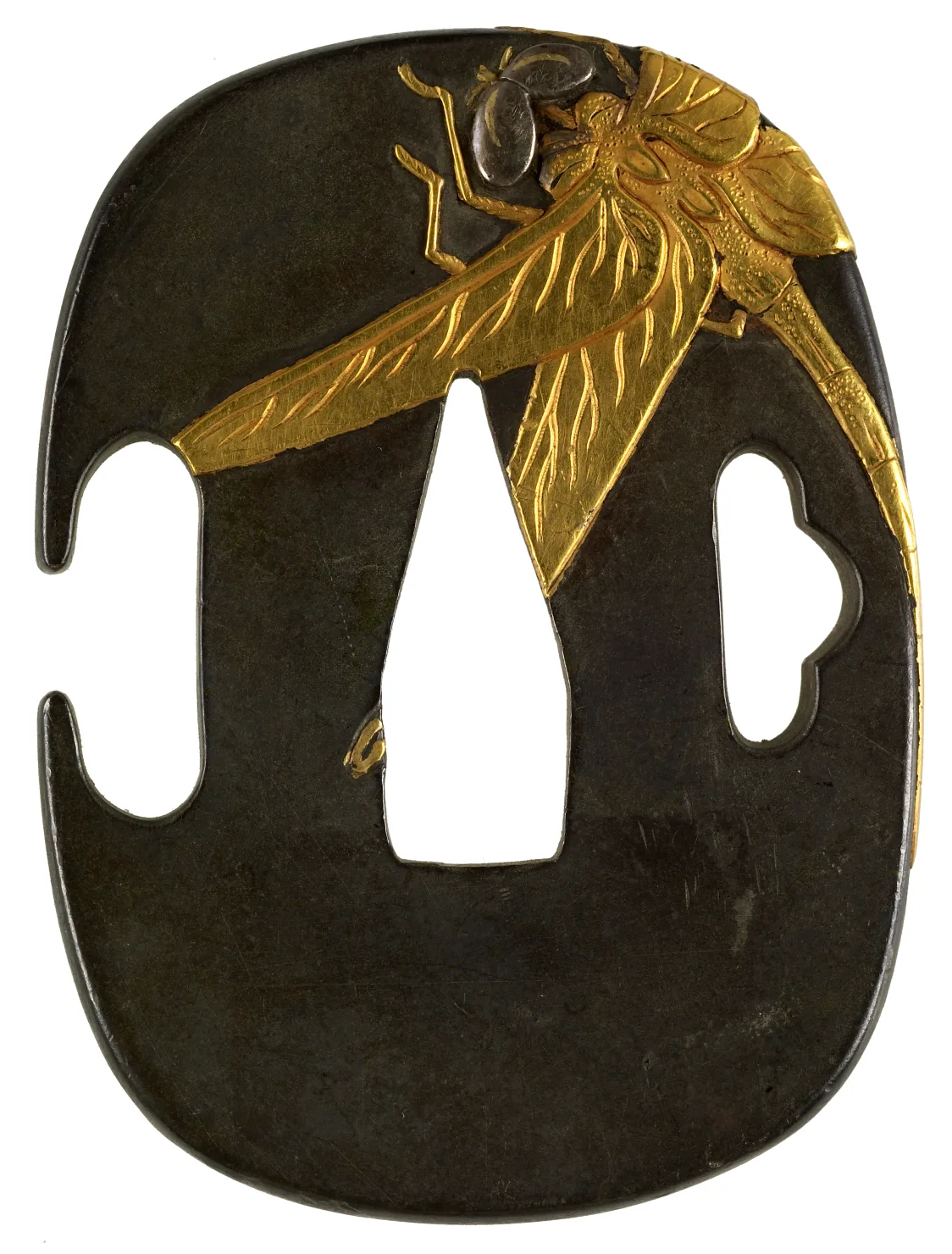
A tsuba is described by zones, and each has a name:
| Part | What it is |
|---|---|
| mimi (耳) | the rim |
| ji (地) | the plate, between the rim and the centre |
| seppa-dai (切羽台) | the central oval where the washers sit |
| nakago-ana (茎穴) | the hole for the tang |
| sekigane (責金) | the copper wedges that fit the nakago-ana to each blade |
| kozuka-hitsu (小柄櫃) | the opening for the handle of the kozuka, half-moon shaped |
| kōgai-hitsu (笄櫃) | the opening for the kōgai, with three lobes, the suhama (州浜) shape |
| mei (銘) | the signature |
The two faces are not the same. The omote (表) faces the hilt: it is the side seen head-on by someone standing in front of the wearer. The ura (裏) faces the blade. Looking at a katana tsuba from the omote, with the nakago-ana in the position of use, the kōgai-hitsu is on the right and the kozuka-hitsu on the left. The rule of shapes is not exact, and many wakizashi and tantō tsuba have only the kozuka opening, which is placed on the left.
The seppa-dai of the omote takes the fuchi; that of the ura, the habaki. That is why the ura has to stay flat. On the omote there are sometimes punch marks around the nakago-ana: some are original and others were made by the fitter to tighten a loose hole, and they are always on the omote. The signature usually goes on the seppa-dai, to the left of the nakago-ana on the omote, and is hidden by the seppa once mounted; from the 16th century many signatures are on the omote, but in the Edo period some masters, such as Shōami Shigetsugu, signed on the ura so the fitting marks would not damage it. On tachi tsuba, which hang edge down, the design and the signature are oriented the other way round from a katana tsuba. Tachi tsuba have been seen remounted on katana, with the nakago-ana reshaped the other way round.
The guard protects the hand and stops the opposing blade: locking guard against guard has its own name, tsubazeriai (鍔迫り合い).

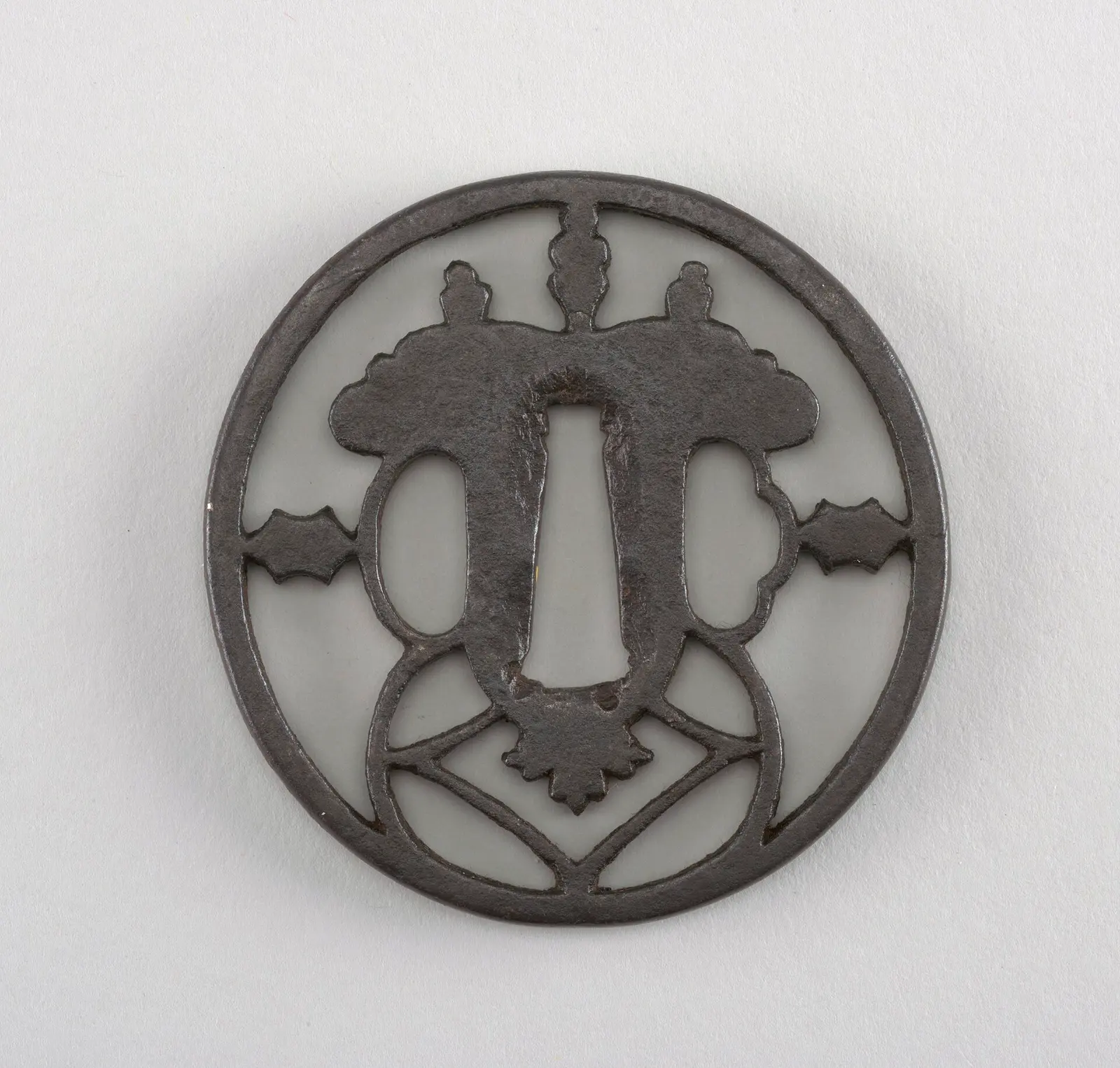
The iron of the tsuba: tekkotsu
On forged iron tsuba, knots or streaks harder and darker than the rest sometimes come to the surface, above all on the rim: this is tekkotsu (鉄骨), «iron bones». It is a feature prized on the pierced tsuba of Owari, on those of Kanayama and on those of Nobuie, and it says a great deal about the metal: it comes from uneven iron, worked with the hammer, with zones of different hardness that time and patina leave standing in relief.
Workshop tradition distinguishes natural tekkotsu, which comes from the iron itself, from tekkotsu made on purpose, exaggerated and spread too regularly, which tends to give away a late piece or an imitation. On that view, the natural kind comes from uneven steel: low-grade tamahagane (玉鋼), few folds, workshop scraps welded together, or three-layer tsuba. Made tekkotsu has been seen, for example, on a tsuba signed Nobuie made in the 19th century, with a probably recent signature. Tekkotsu proves nothing on its own: it is read together with the shape, the openwork, the patina and the signature.
What is valued in the iron of a tsuba is its patina, the colour of the stable rust it has built up: sanding it or cleaning it with metal polish removes exactly what makes the piece old. How red rust is dealt with, and the debate over oil and wax, are covered in «Polishing and care».
Cast tsuba: why they are no good
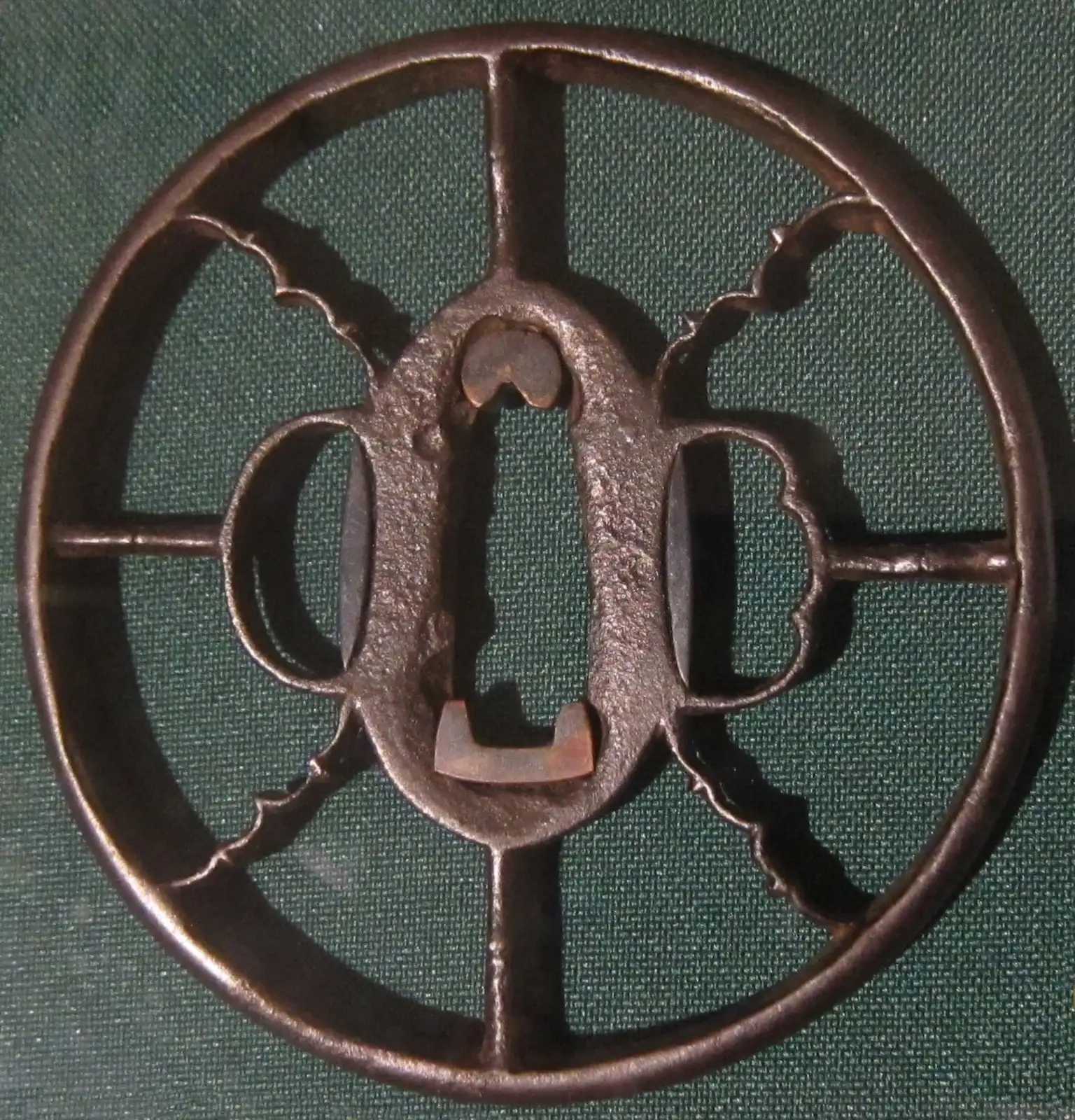
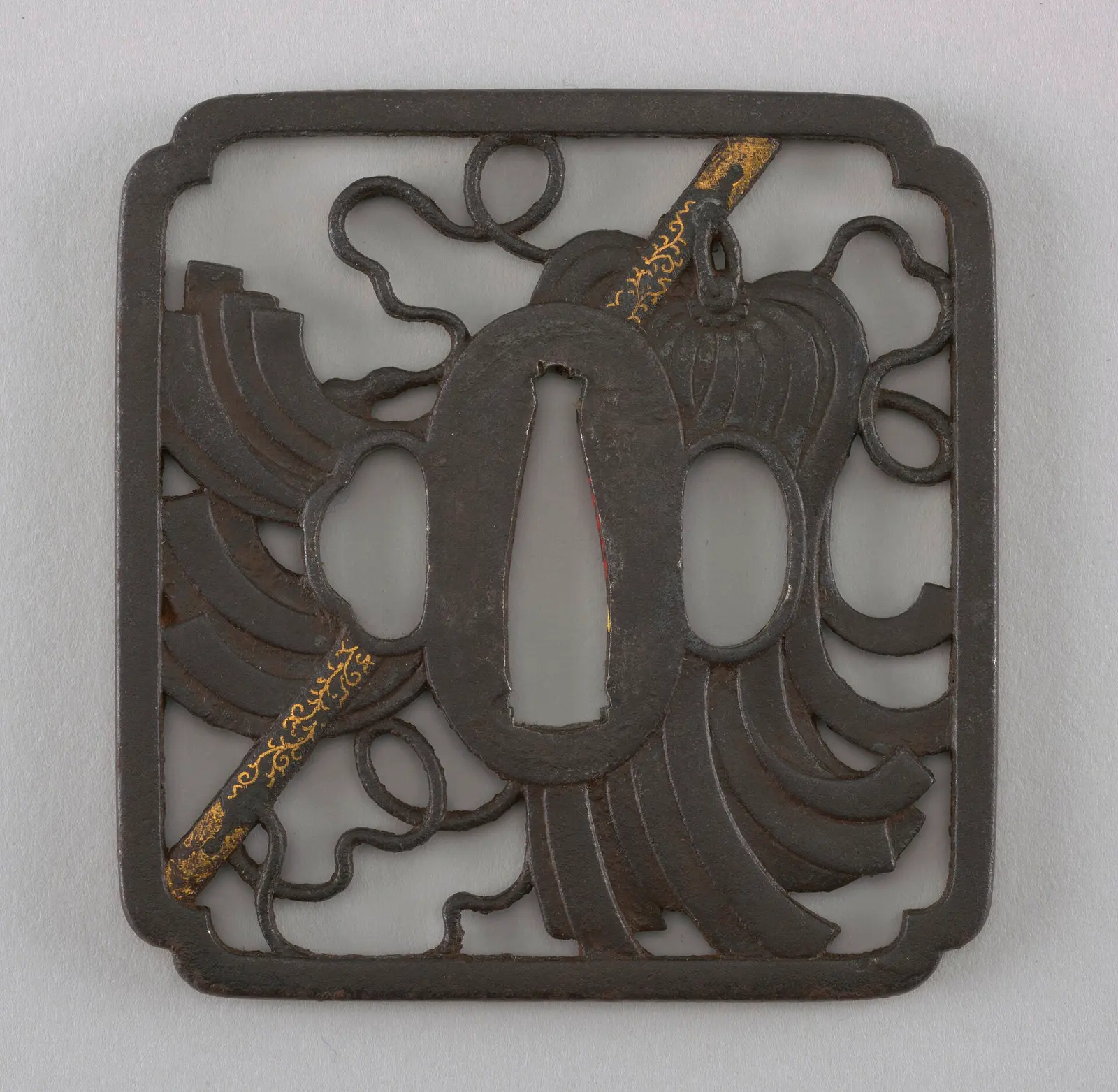
A tsuba is forged. Cast iron carries so much carbon — more than roughly 2 % — that it can be neither forged nor hardened, and it breaks under a sharp blow. In Japanese, a cast piece is imono (鋳物) and pig iron zuku (銑), as against steel, hagane (鋼), and iron, tetsu (鉄). A cast tsuba can split under an impact a forged one survives: it is unfit for a sword that will be used, and is left as a display object. Frank Brinkley was already writing it in 1902: the Japanese denied that cast iron was ever regarded as a suitable material for a guard, its liability to fracture being a fatal objection.
Brinkley also records a tradition that illustrates the point. A celebrated swordsman of Owari, Yagyū, had fifty tsuba made in the 16th century by the best craftsmen of his day, pounded them in a mortar with a heavy pestle and kept only those that survived; from then on his guards became the fashion, preferred to finer work that had not passed the test. It is a single-source anecdote and should be read as such, but it shows well what was expected of a guard.
Where, then, do cast iron tsuba come from? Almost all are late copies. Brinkley himself explained that many of the guards sold to foreign collectors in his day were cast, made for the unwary buyer, and that the false European idea that the old ones were cast was born from them. There are no fine old tsuba made by casting; there are moulded copies of good models, from Owari, Akasaka or Nobuie. Someone who has seen many in workshops dates them to the 18th and 19th centuries and knows none from the Kotō period; other collectors place most from Taishō onwards. On the market they are worth very little next to a forged guard of the same design, and one has been seen to break under a plastic mallet, like a bar of chocolate. They can be recognised by several signs, none conclusive on its own:
- casting flash on the inner edges of the openwork and the hitsu;
- gas pores, su (巣), on the flat faces;
- the mould seam along the edge, sometimes filed away;
- a piece slightly smaller than its model, with a smaller seppa-dai and hitsu, from the metal shrinking as it cooled;
- odd rust and dull edges, without the crispness of the chisel;
- forced ageing, by burying the piece or rusting it on purpose.
That is why the Koshirae section of this catalogue only publishes mountings and fittings with an NBTHK paper at Tokubetsu Hozon level or above. A cast copy does not pass that examination, and the paper guarantees that what you see is forged and chiselled work, not a casting. «NBTHK papers» explains what each level certifies.

Inside the habaki
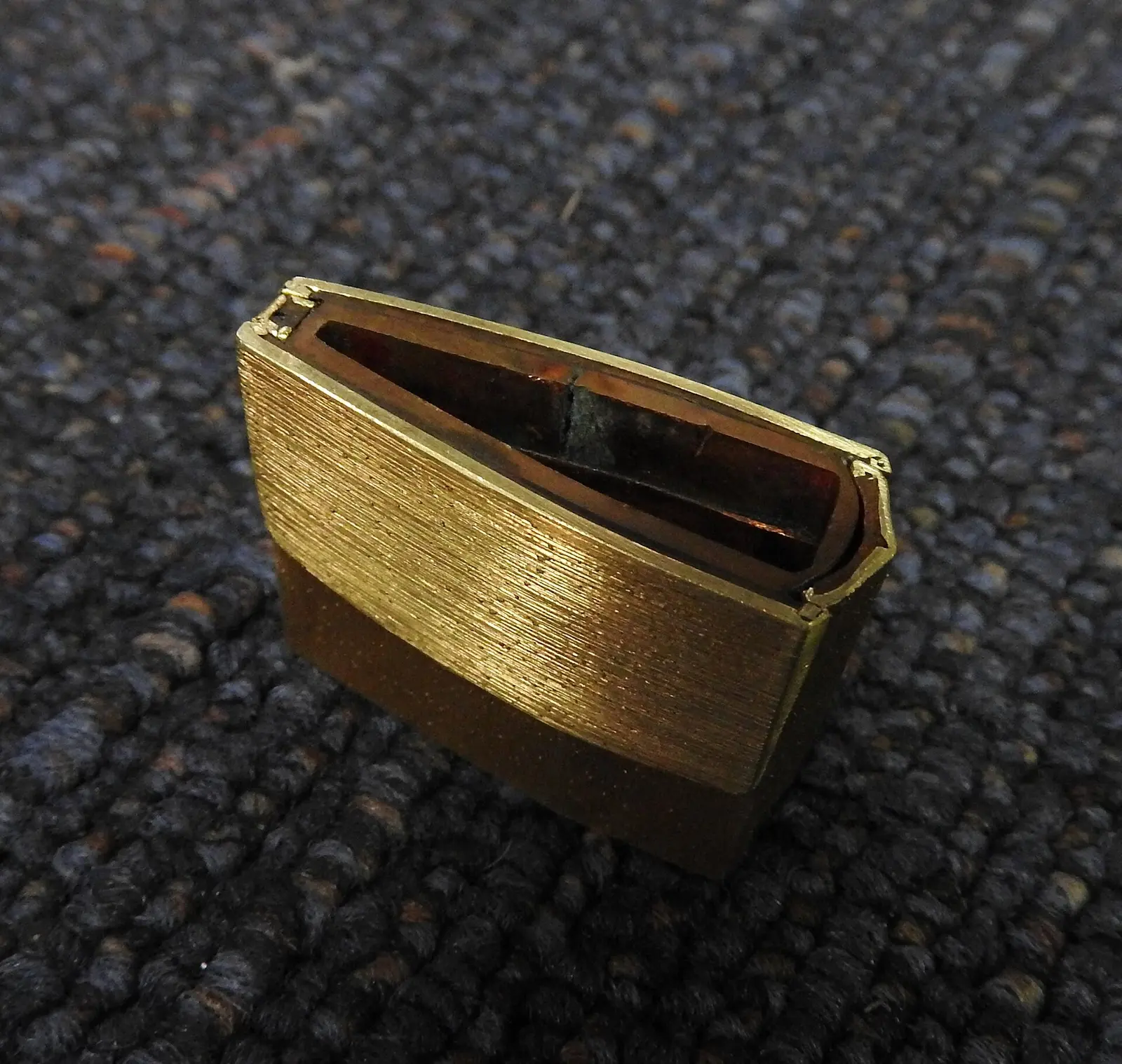
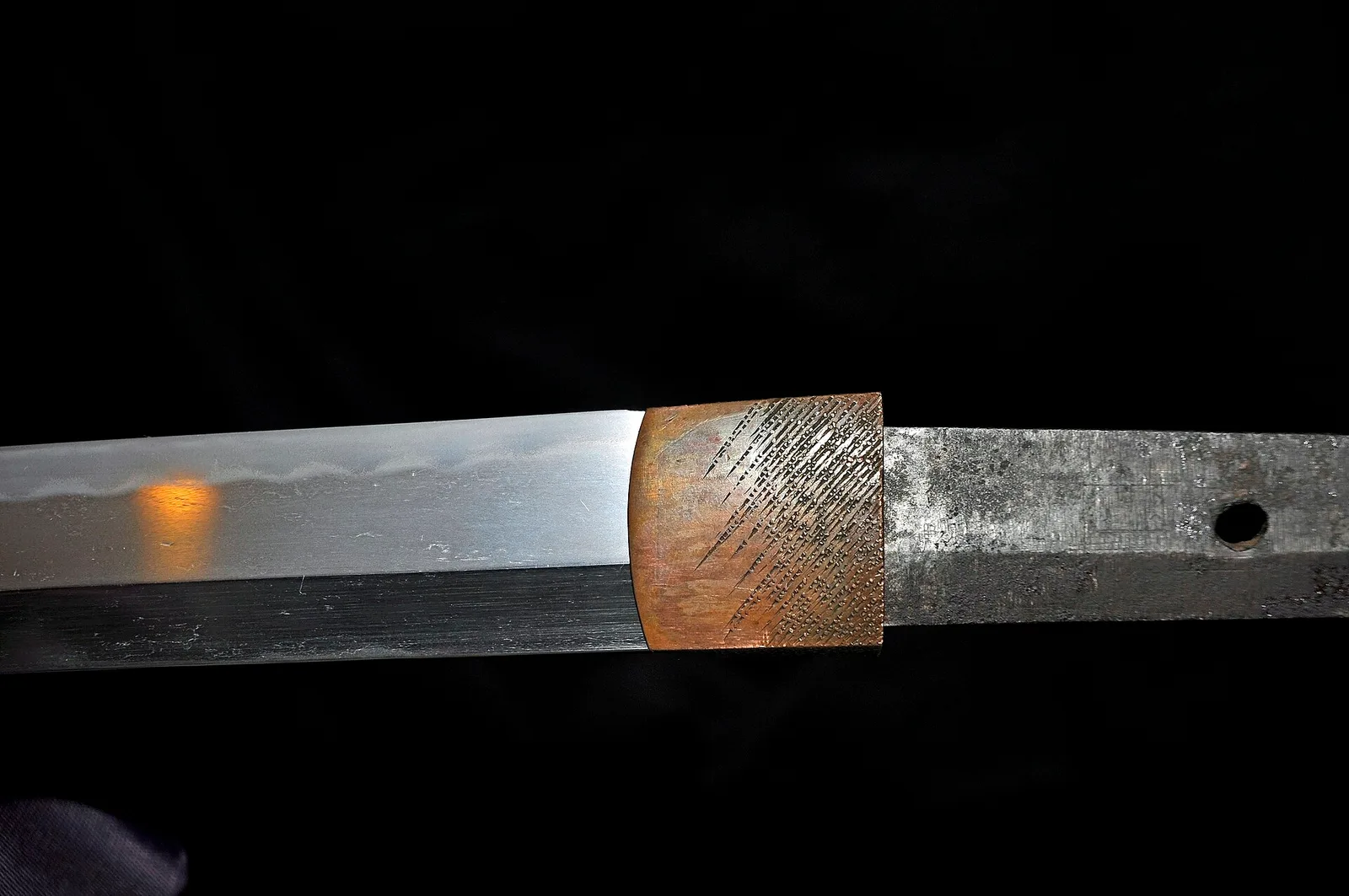
The habaki (鎺) holds the blade in the scabbard by friction against the mouth (koiguchi), keeps it «floating» so that it touches the wood only along the back, and acts as a stop for the tsuba and seppa. For the preservation of the blade it is the most important piece of the mounting: the first thing is that it fits well; decoration comes after.
It is made by the shiroganeshi, and the craft follows an order the NBTHK has documented step by step with a master of the trade. A sheet of pure copper, suaka (素銅), is cut; it is forged to give it body, because copper hardens under the hammer; it is bent to the shape of the back and forged again over a dummy tang (kari-nakago, 仮中心); the nomikomi (呑込み), the section that sits on the back, is cut down; the edge side is silver-soldered; it is filed; the chikaragane (力金), the inner wedge on the edge side, is adjusted, and it is tried on the real blade until it grips at all four corners. Finally it is patinated in a chemical bath.
| Type | What it is |
|---|---|
| ichijū-habaki (一重鎺) | one piece; the most common |
| nijū-habaki (二重鎺) | two pieces fitted together: the inner one (shitagai) and the outer one (uwagai); usually more elaborately worked |
| daitsuki-habaki (台付鎺) | with a flat ledge, like a pedestal, at the end that sits against the seppa |
| tachi-habaki (太刀鎺) | slender; without a nomikomi it is called tsukkake-habaki (突掛鎺) |
The most sensible material for a sword in use is copper. Over it may go an inset sheet of gold or silver, kin-kise (金着せ) or gin-kise (銀着せ); in the workshop documented by the NBTHK, two tenths of a millimetre thick. Solid gold or silver habaki, kin-muku (金無垢) and gin-muku (銀無垢), are luxurious but soft for use; shakudō and iron are uncommon. It is said that in the Edo period kin-kise was reserved for high-ranking samurai. A warning when buying: if the patinating liquid mixes with oil and stays under the gold sheet, it corrodes the habaki from inside and ends up pitting the blade.
The surface is filed in patterns that have names: horizontal, yoko-yasuri (横鑢); lattice, higaki-yasuri (檜垣鑢); the Yūjō, which workshop tradition names after a great goldsmith, Gotō Yūjō, the founder of the Gotō house, and its variant with raised petals, the botan-Yūjō; rock, ganseki (岩石); or neko-gaki (猫掻き), «cat scratch», with irregular strokes, born among Edo chisellers for the back of kozuka and later carried over to the habaki. Some also bear the mon (紋), the family crest, pierced or engraved. Some regions had their own model: the Kaga habaki, Kashū (加州), with oblique grooves, five on one face and four on the other; the Owari one, with horizontal filing on the outer piece and lattice on the inner; the Higo one, horizontal on the outer and diagonal with grooves on the inner; and the Shōnai one, with a straight engraved stroke, the ichimonji (一文字), on the inner piece. Some workshops also describe a Kawagoe (川越) habaki, with horizontal notches.

How the fuchi and kashira are made
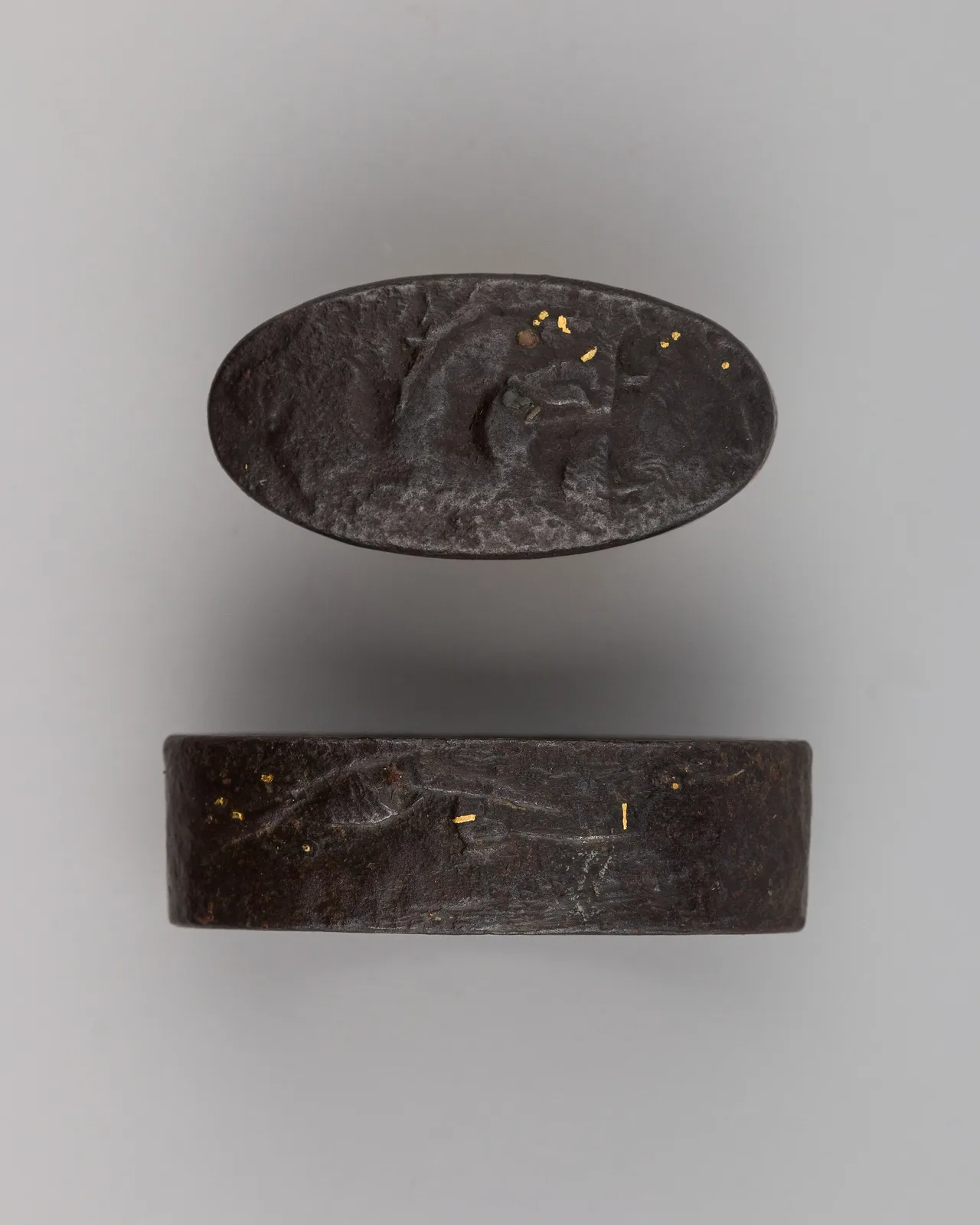
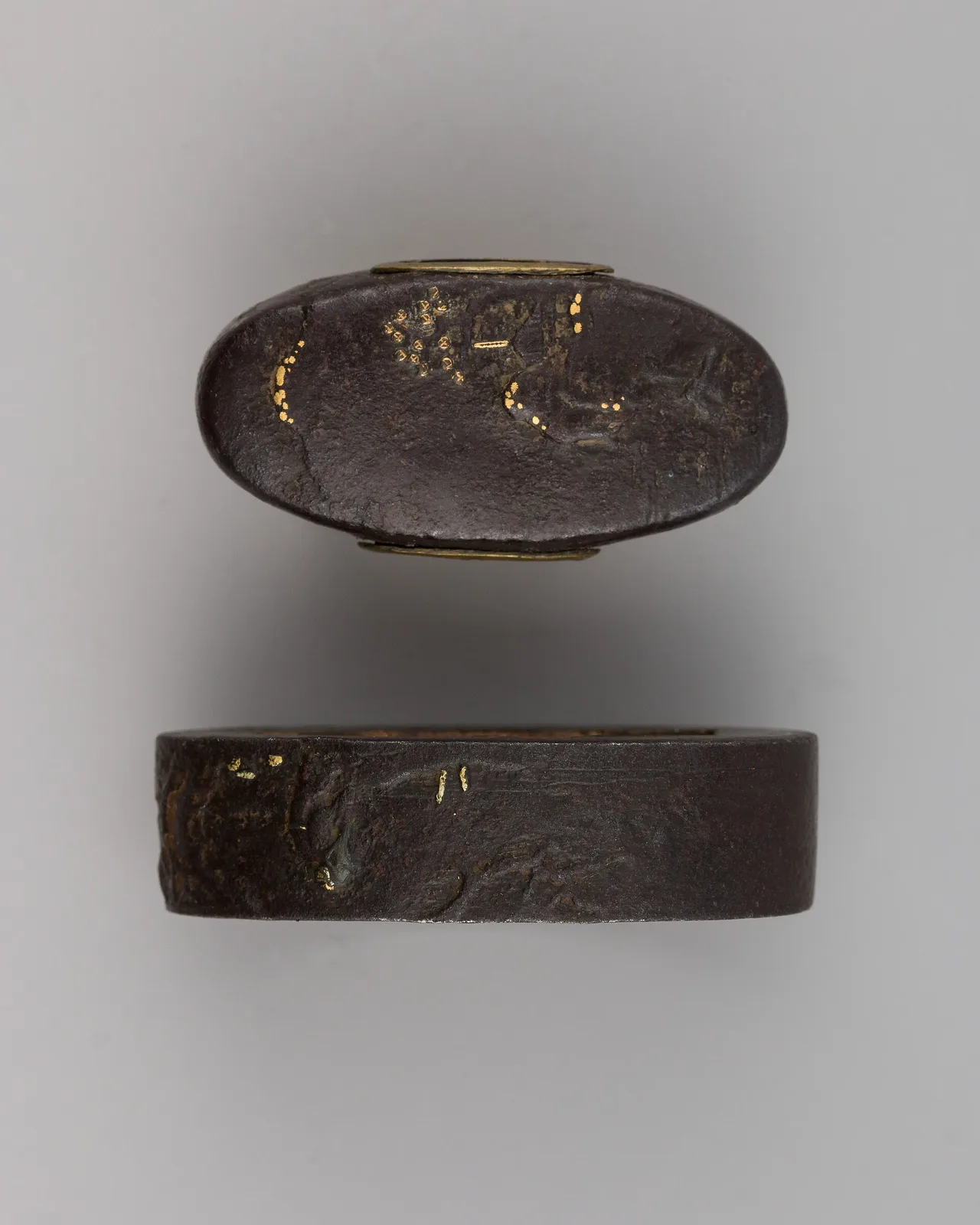
The collar and the cap of the hilt are made in different ways. The fuchi (縁) is almost always built from a side band to which a top plate pierced for the tang is soldered, plus a small third piece as reinforcement. The kashira (頭) is formed from a single sheet, folded and raised, with two eyelets (shitodome) through which the cord of the wrap passes.
Relief is worked by raising the sheet from the back and chiselling it from the front, with inlays or overlays of other metals. On some old iron fuchi the band is forge-welded and the copper plate is fitted in without solder; the technique can be seen on old Higo fittings. On the tachi, the end of the hilt is not a kashira but a kabutogane (冑金), more massive and made in two pieces, with the ring for the cord (sarute) and its eyelet (hatome, 鳩目).
Few fittings goldsmiths remain today, and mass-produced catalogue fittings are almost always cast. It is the same line that separates, in tsuba, forged and chiselled work from a casting.

A bestiary of sword fittings
The motifs of fittings are rarely pure decoration: they usually tell a story or pose a visual riddle, and knowing the animal is half the reading. These are the most frequent.
| Motif | What it is and what it means |
|---|---|
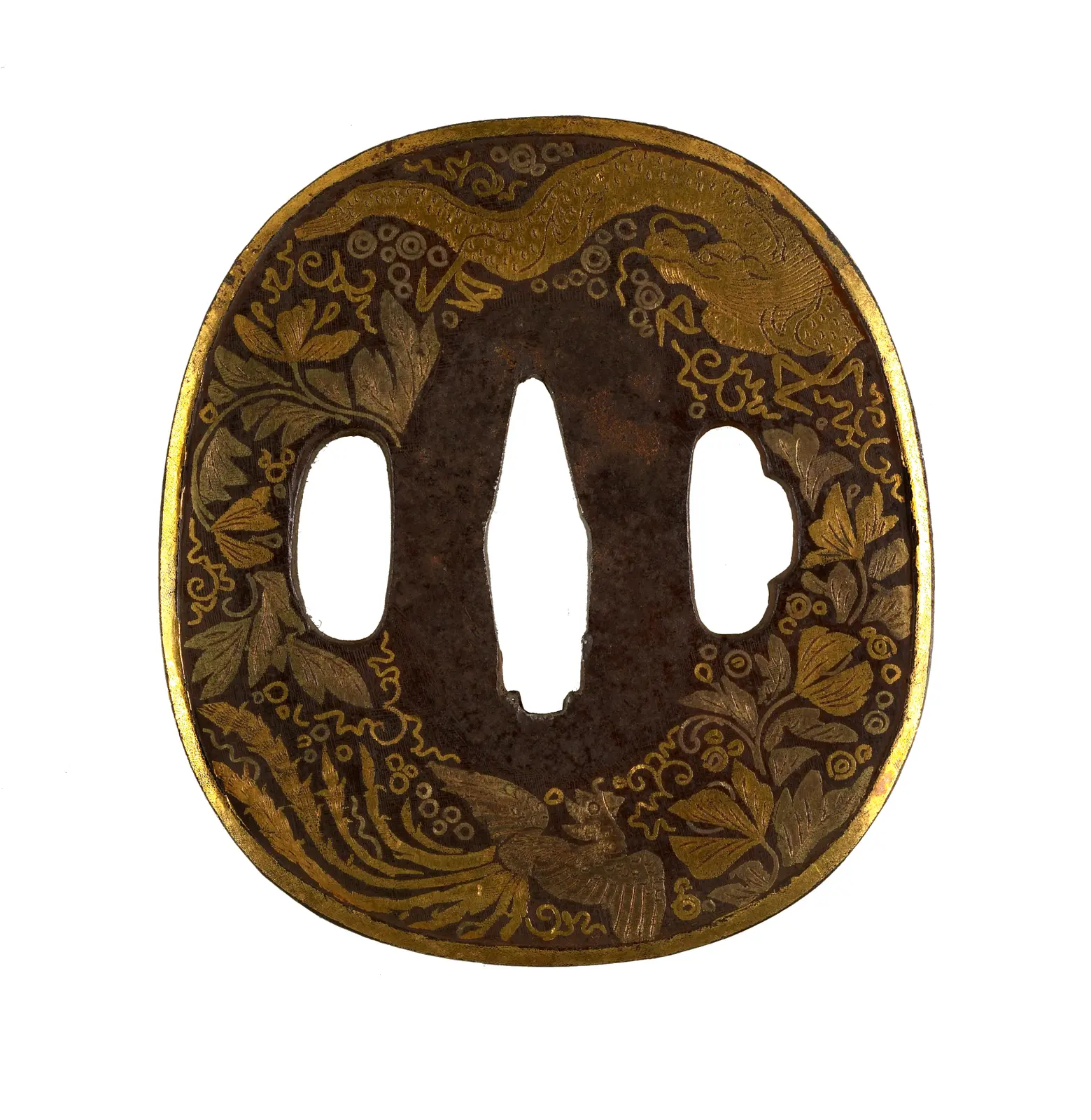
| Dragon, ryū (龍) | Wingless, but it flies: it is born in water and rises to the sky like a whirlwind. It often holds the wish-granting jewel, hōju (宝珠). The blue dragon, seiryū (青龍), guards the east. In workshop tradition, the male is recognised by a tail ending in a sword blade. |
| shishi (獅子) | The «lion» of Chinese iconography, not the real animal. Almost always with peonies, botan (牡丹): the king of beasts with the king of flowers. As the saying goes — the shishi no ko-otoshi (獅子の子落とし) — the mother throws her cubs off a cliff and raises only those that climb back. |
| kirin (麒麟) | Body of a deer, tail of an ox, hooves of a horse and one horn, sometimes two. It heralds the coming of a good ruler. |
| sai (犀) | A mythical «rhinoceros», like the kirin but with its body covered by a shell. It is rare, and sometimes hard to tell from the kirin. |
| baku (獏) | Trunk of an elephant, legs of a tiger, tail of an ox and body of a bear. It eats nightmares and wards off evil. |
| hōō (鳳凰) | The East Asian «phoenix», bird of good government. It perches on the paulownia, kiri (桐); hence, in the hanafuda (花札) deck, the December card shows it with the tree. |
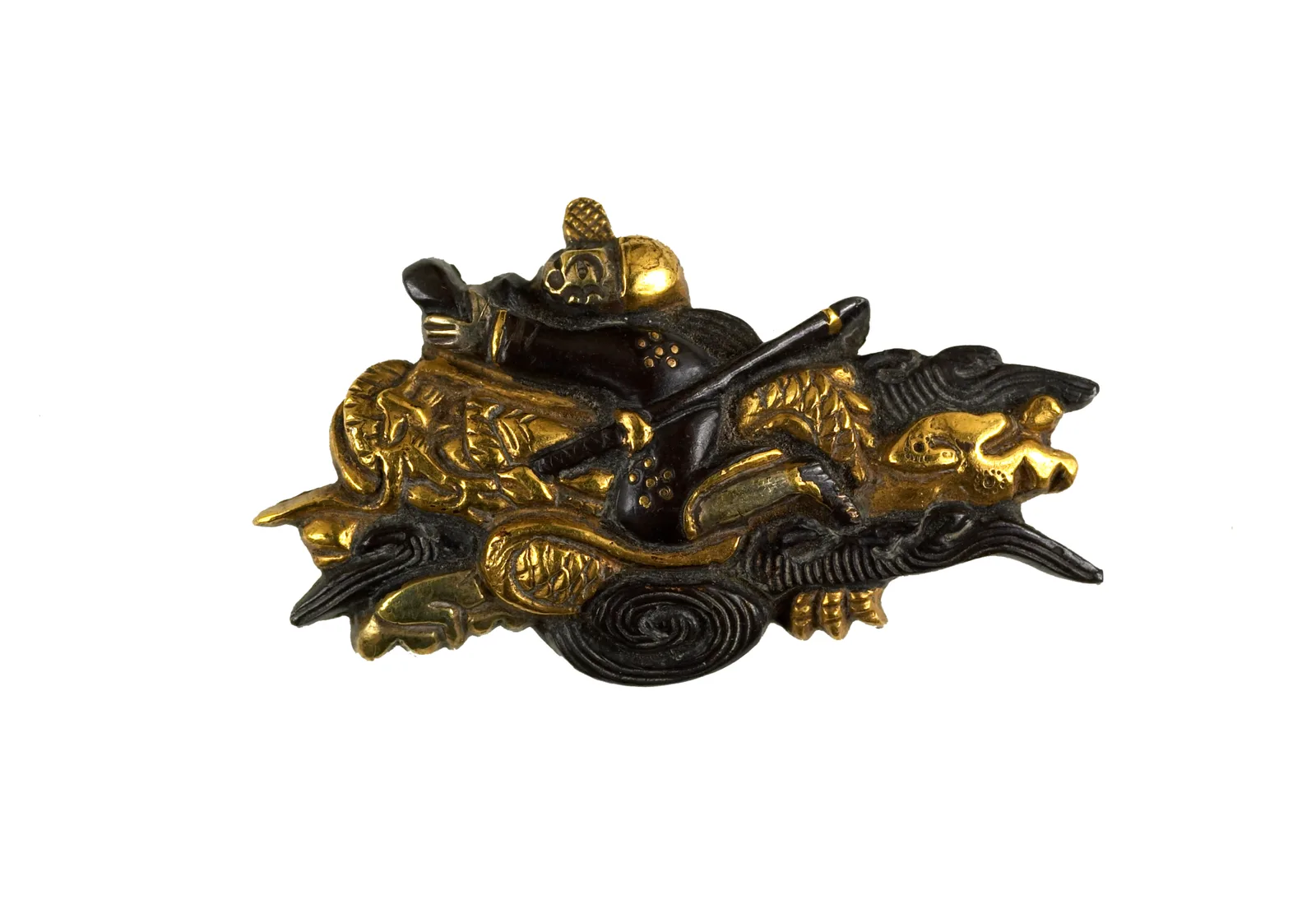
| nue (鵺) | A chimera with a monkey's face, tiger's legs and a snake for a tail. It tormented the emperor until Minamoto no Yorimasa (源頼政) brought it down with an arrow and his retainer I no Hayata (猪早太) finished it off; as a reward he received the sword Shishiō (獅子王). Its night call, taken for the monster's, is that of a thrush, the tora-tsugumi (トラツグミ). On fuchi-kashira, Yorimasa usually goes on the kashira and the nue on the fuchi. |
| shachi (鯱) | A fish with the head of a tiger or dragon that spouts water; on roofs it protects against fire. It is shown head down and tail up; the golden ones of Nagoya castle are the most famous. |
| Dragonfly, tonbo (蜻蛉) | The kachimushi (勝虫), «victory insect»: it is said always to fly forward and never to retreat. A very frequent martial motif. |
| Tiger and bamboo, take ni tora (竹に虎) | A classic pairing, like the shishi with the peony; it even appears on some kurigata. |
| Carp, koi (鯉) | An auspicious motif on fuchi and kashira. |
The blue dragon of the east is one of the four guardians of the cardinal points, the shijin (四神), together with the white tiger, the black tortoise and the vermilion bird of the south, suzaku (朱雀), with which the hōō is sometimes identified.
Further reading
- Wikipedia · Japanese sword mountings The vocabulary of the mounting piece by piece, from the kashira to the kojiri.
- Wikipedia · Tsuba Parts, materials, sizes and schools of the guard.
- Wikipedia · the habaki The forms of the habaki (tachi, one-piece and two-piece) and the shirogane-shi who makes it. In Japanese.
- Tōken Collection Kuwana · menuki Origin of the menuki, their place on omote and ura, and the nige-menuki. In Japanese.
- Japanese Sword Index · the mountings The hilt piece by piece: the ray skin, the wrapping and its fittings, within the whole koshirae. In English.
- Brinkley, «Japan: Its History, Arts and Literature», vol. VII (1902) The chapter on sword fittings, with cast tsuba and the Yagyū anecdote. Public domain.