On this page
From Seki to Kyoto
The NBTHK thinks that the first Iga no Kami Kinmichi was the son of Kanemichi (兼道, Kanemichi), a swordsmith of Seki, in Mino, who later changed his name to Daidō. According to the tradition it records, in 1559 (Eiroku 2) the kanpaku Nijō Haruyoshi appointed him palace swordsmith, and he went to Kyoto with his father and his brothers Rai Kinmichi, Tanba no Kami Yoshimichi and Etchū no Kami Masatoshi; there they founded the Mishina school (三品派, Mishina-ha). Another version given by the NBTHK is that Kanemichi presented a sword in 1569 or 1570 and received a title for it.
The Nihon Jinmei Daijiten places the move to Nishinotōin, in Kyoto, around the Eiroku era (1558-1570), and Markus Sesko in 1593 (Bunroku 2): the sources do not agree.
The first
According to the NBTHK, his oldest dated work is of 1581 (Tenshō 9), signed 金道作 (Kinmichi saku), and he received the title of Iga no Kami in 1594 (Bunroku 3). Sesko adds that he forged a sword for Emperor Ōgimachi.
The NBTHK relates that in the third month of 1614 (Keichō 19) Tokugawa Ieyasu commissioned from him a thousand 陣太刀 (jin-dachi), ceremonial tachi for his army; when he delivered them, in the sixth month, all the swordsmiths of Japan came to work under his direction, with a licence to make tools for castles and moats and free passage through the barriers. On Ieyasu’s recommendation, the emperor is said to have given him the title of 日本鍛冶惣匠 (Nihon kaji sōshō), “master of all the swordsmiths of Japan”. Markus Sesko places the commission “some time before” the battle of Sekigahara, of 1600, and gives him as a reward the title and permission to engrave the imperial chrysanthemum on the tang. Neither of the two sources cites a document of the time: it is tradition.
He died on the 11th day of the twelfth month of Kan'ei 6, according to the NBTHK and the Nihon Jinmei Daijiten: January 1630 in the Gregorian calendar, and 1629 for the NBTHK and for Sesko. The NBTHK records another theory, which has him living until between 1634 and 1637, the years of the second generation’s first work signed by another hand and of the first signed by himself.
The swordsmiths’ titles
According to Markus Sesko, the Kinmichi house was the official link with the court for the honorary titles of all the swordsmiths: the applications, with their fee, reached its Kyoto office, which put them in order and presented them to the court official in charge, the 弁官 (benkan). The Heibonsha encyclopaedia, on Kotobank, says the same of Kinmichi’s successors and adds that their power came from this.
Sesko sees in the title a homage to that of 日本鍛冶惣庁 (Nihon kaji sōchō) which the retired emperor Go-Toba is said to have given to Nobufusa, of Bizen.
The generations
| Swordsmith | What is on record | Dates |
|---|---|---|
| The first | Iga no Kami in 1594; Nihon kaji sōshō for Ieyasu’s commission, according to tradition | ?-1629 or 1630 |
| The second, Kanbei (勘兵衛, Kanbei) | Son of the first according to the Nihon Jinmei Daijiten; the first to engrave the title on the tang, according to Sesko, and with the chrysanthemum | ?-1680 |
| The third, also Kanbei | Son of the second according to the same dictionary; changed 惣匠 (sōshō) to 宗匠 (sōshō), according to Sesko; around the Kyōhō era he forged a sword for the shōgun in Edo | 1655-1726 |
| Generations of the 19th century | Blades signed 日本鍛冶宗匠伊賀守藤原金道 (Nihon kaji sōshō Iga no Kami Fujiwara Kinmichi) in the Tokyo National Museum | 1829 and 1835 |
How many generations bore the name is not recorded in the sources consulted.
In the history of Kyoto
Markus Sesko believes that Dewa Daijō Kunimichi, born in 1576, trained first with the Mishina Iga no Kami Kinmichi and, around 1609, with Horikawa Kunihiro.
The Japanese Wikipedia relates, in the article on the duel of Kagiya no Tsuji, that the sword that broke in Araki Mataemon’s hand was, it is said, by Iga no Kami Kinmichi or by Izumi no Kami Kinmichi. It is an anecdote without a document.
Images
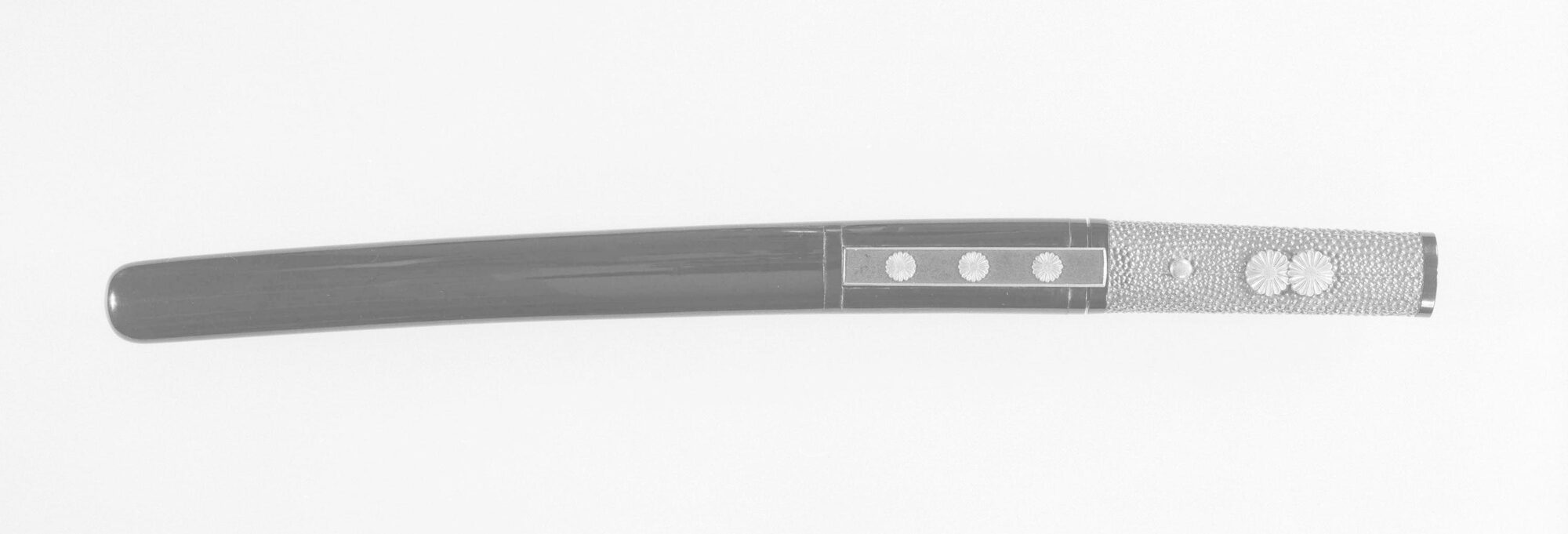
The same mounting, from the other side, with the chrysanthemums. Tokyo National Museum, via ColBase · ColBase terms of use · source