On this page
Who taught whom
Kawashima Masahide, the father
A blacksmith of Aki (Kōchi), who presents himself as “鍛工十四代” (tankō jūyondai), the 14th generation of blacksmiths. The long video calls him a “刃物鍛冶” (hamono-kaji): he made cutlery, not swords. As a boy, Kawashima helped him with the sledgehammer in the smithy; his father would ask what time he got out of school so as to plan the work.
We have found no independent source on Masahide or on the fourteen generations.
Nakata Masanao (中田正直), in Seki
Kawashima was apprenticed to him in Seki (Gifu) on leaving secondary school, in 1989, and stayed six years, until 1995: one more than the minimum of five, “in gratitude for his training”.
On Nakata Masanao we have found no non-commercial public sources: neither his dates, nor his work, nor his career can be documented here.
Yoshihara Kuniie III (吉原國家): the mukansa
Everything that follows he publishes himself.
- Born on 17 February 1945 in Setagaya (Tokyo), second son of the 2nd Kuniie (吉原将博). He started out helping the 1st Kuniie, his grandfather.
- He received his swordsmith’s licence in 1965 and between 1971 and 1981 won numerous special prizes (特賞, tokushō) at the NBTHK new-work exhibition.
- In 1982 the NBTHK recognised him as mukansa (新作名刀展無鑑査, Shinsaku Meitōten mukansa) and he took the name of 3rd Kuniie.
- He forged swords for the treasures of the Ise shrine at the renewals of 1970, 1985 and 2006, and halberds (hoko) in 1989 and 2009.
- Intangible cultural property of Katsushika (1998) and of Tokyo (2008); president of the Zen Nihon Tōshōkai from 2008 to 2013; president of the 日本刀文化振興協会 (Nihontō Bunka Shinkō Kyōkai) foundation since 2018. He forges in Nishi-Mizumoto (Katsushika, Tokyo).
- His brother Yoshihara Yoshindo (吉原義人) is also a mukansa: in 2026 he is listed as “無鑑査出品” (mukansa shuppin). The kinship is given by secondary sources.
Kawashima studied the Bizen-den with him in Tokyo from November 1995. Kuniie publishes no list of pupils: the training is told only by Kawashima.
What a mukansa (無鑑査) is
It is an NBTHK title for swordsmiths who have accumulated first-rank prizes in its annual new-work competition (formerly 新作名刀展, Shinsaku Meitōten, or 新作刀展覧会, Shinsakutō Tenrankai; today 現代刀職展, Gendai Tōshokuten). A mukansa exhibits without going before the jury: in the official lists he appears separately, as “無鑑査出品” (mukansa shuppin).
In 2026 nine swordsmiths exhibited in this way: Yoshihara Yoshindo, Gassan Sadatoshi, Kanbayashi, Kawachi, Yoshikawa, Miyairi Norihiro, Matsuda, Kubo and Takami.

The school he pursues: the Fukuoka Ichimonji II
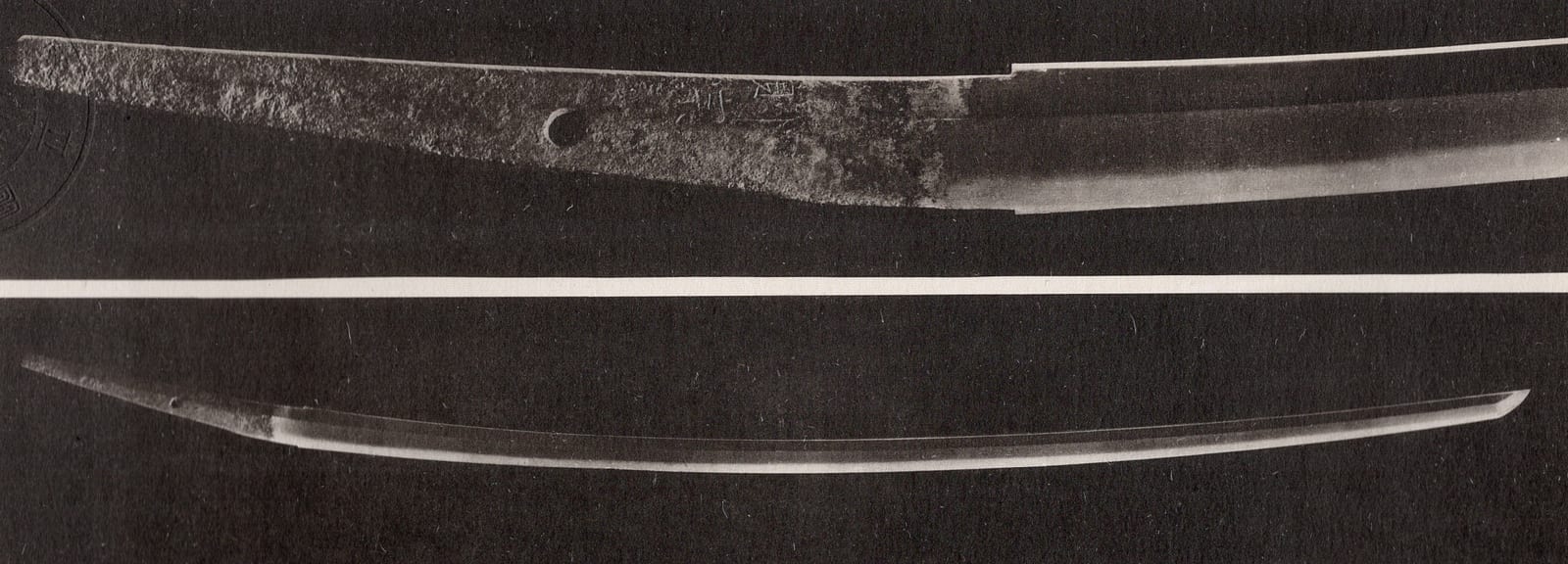
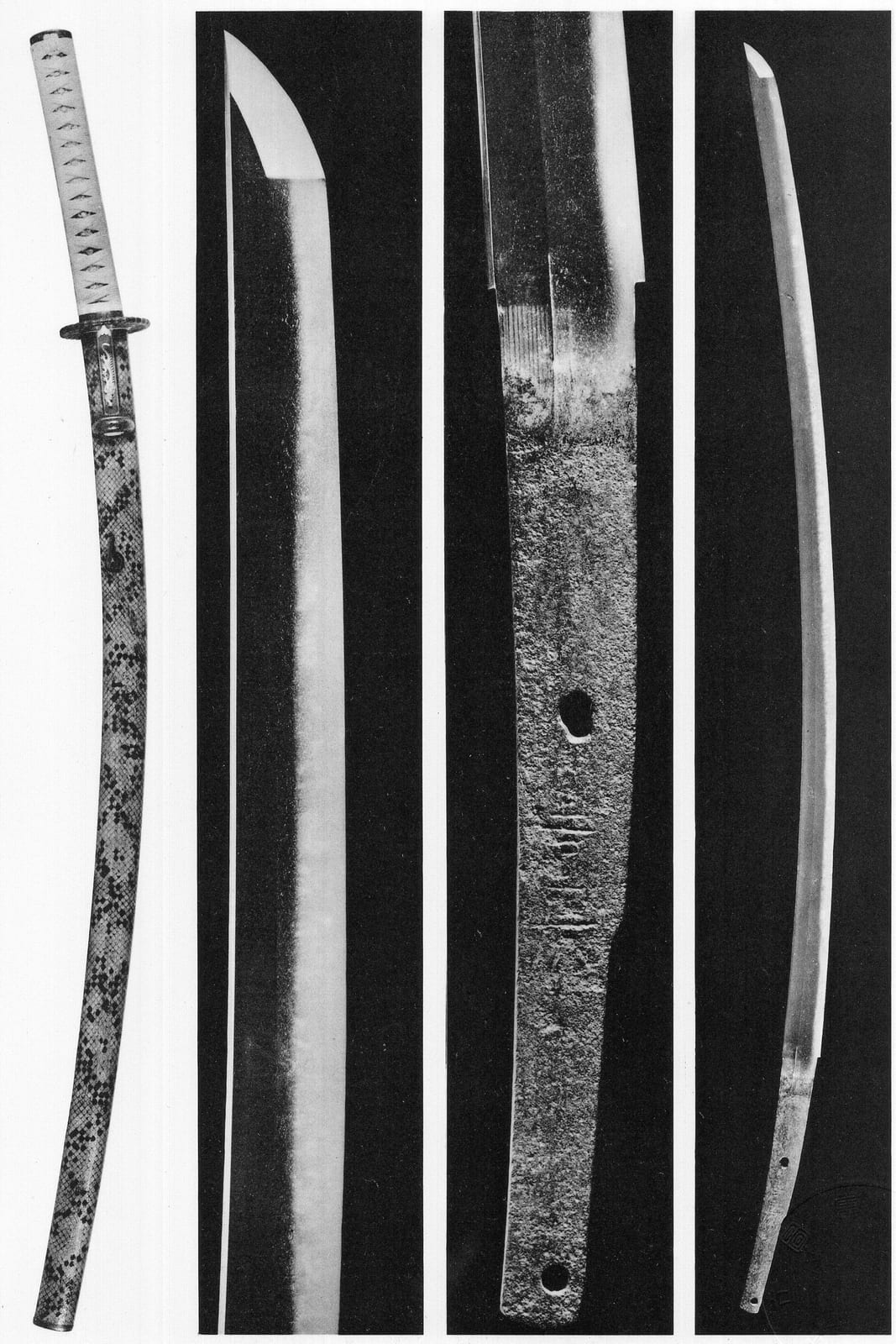
Besides his masters of flesh and blood, Kawashima measures himself against a 13th-century school: the Fukuoka Ichimonji, which worked in Osafune-chō Fukuoka, within present-day Setouchi. Its founder was Norimune (則宗); Yoshifusa (吉房) and Sukezane (助真) are two of its most celebrated names. The Sanchōmō, which is unsigned, is attributed to this same school on grounds of style.