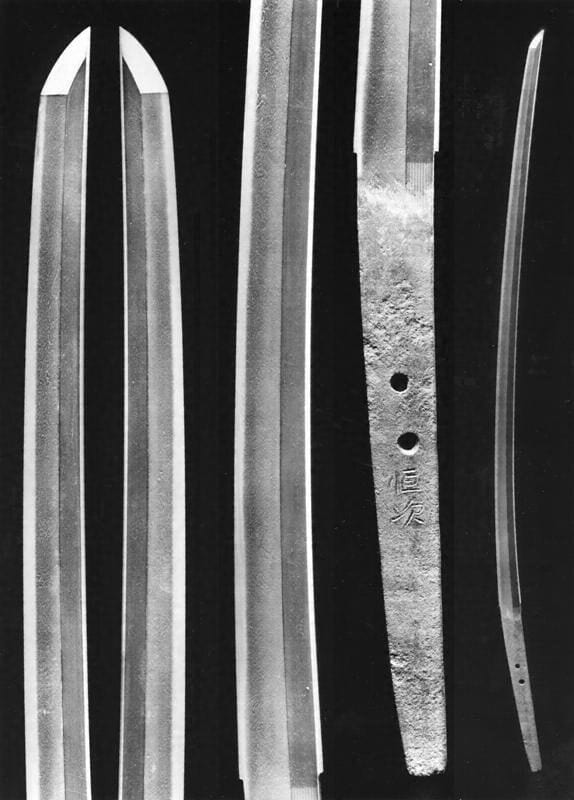
One name in two schools
- The Japanese Wikipedia relates that the Ko-Aoe, in Bitchū, had swordsmiths with the names of those of the Ko-Bizen: first Masatsune and then those who bear the character “tsune” (恒, tsune), and that it is sometimes hard to decide whether a blade belongs to one school or the other.
- The record of a tachi signed “Tsunetsugu” at the Kyūshū National Museum gives him as a swordsmith of Bitchū, of the Aoe, and says that from the Chū-Aoe to the Sue-Aoe there were, it is said, several with that name.
- A tachi of 1330 (Gentoku 2) signed “Bitchū-no-kuni Manju-shō jū Sahyōe-no-jō Tsunetsugu”, with its katana mounting and a certificate by Hon'ami Kōjō of 1680 (Enpō 8), shows how a Tsunetsugu of Aoe signs.
The Juzumaru: from Aoe to the Ko-Bizen
- Tradition attributed the Juzumaru to Aoe Tsunetsugu, of the Ko-Aoe, one of the monthly-rota swordsmiths (goban-kaji), of the end of the Heian or the beginning of the Kamakura.
- Satō Kanzan proposed that it was by the Tsunetsugu of Bizen, son of Masatsune of the Ko-Bizen.
- According to the Japanese Wikipedia, the NBTHK’s recent research concludes that it is by the Tsunetsugu of the Ko-Bizen, Sakon-no-shōgen, active in Bizen at the end of the Kamakura. Wikipedia does not give that conclusion with an inline reference, and the NBTHK’s article has not been found.
- Satō Kanzan added that the value of the blade is the same whether it is Ko-Aoe or Ko-Bizen.
Nichiren’s sword
- According to the Japanese Wikipedia, the Juzumaru was the sword of the monk Nichiren: a believer gave it to him when he entered Mount Minobu, and his rosary (数珠, juzu) hung from the hilt, which is where its name comes from.
- It disappeared from the Kuon-ji temple in the Kyōhō era.
- Around 1919 the enthusiast Sugihara Shōzō, of Amagasaki, found it among the possessions of some nobles that came up for auction. The Kuon-ji doubted that it was the genuine one and did not accept it, and the blade was donated to the Honkō-ji temple.