On this page
Quick profile
- Name
- Tsunetsugu; he is called Ko-Bizen Tsunetsugu to tell him apart from the Tsunetsugu of the Aoe of Bitchū AT
- Kanji and reading
- 恒次 (Tsunetsugu) · 古備前恒次 (Ko-Bizen Tsunetsugu) AT
- Period
- The Ko-Bizen runs from the end of the Heian to the middle of the Kamakura. The Japanese Wikipedia, in giving the NBTHK’s conclusion on the Juzumaru, places him as active in Bizen at the end of the Kamakura. AT
- Province
- Bizen AT
- School
- Ko-Bizen, the oldest Bizen school AT
- Master and generations
- Satō Kanzan proposed that the Tsunetsugu of the Juzumaru was the one of Bizen, son of Masatsune of the Ko-Bizen. The record of an Aoe tachi at the Kyūshū National Museum says that there were several Tsunetsugu in Aoe. AT
- Documented fact and tradition
- Documented: tachi signed “Tsunetsugu” with their official record, such as the one at the Tsuchiura city museum, Important Cultural Property. Tradition: that the Juzumaru was from Aoe and that it was Nichiren’s sword. AT
In short
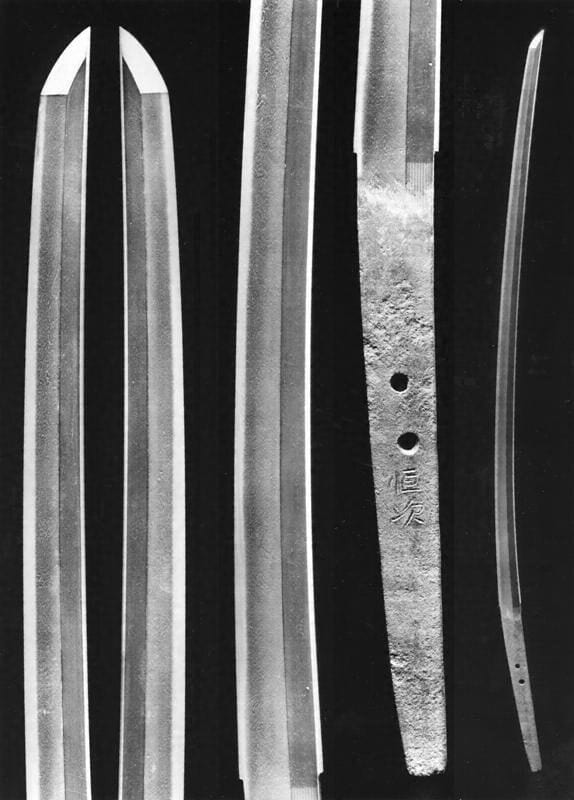
What we know. The Juzumaru is a tachi signed “Tsunetsugu”, Important Cultural Property (重要文化財, jūyō bunkazai), kept by the Honkō-ji temple in Amagasaki. There is also a tachi signed “Tsunetsugu” of the Kamakura period, Important Cultural Property since 1950, at the Tsuchiura city museum, whose record does not say which school it belongs to.
How we know it. Almost everything comes from the Japanese Wikipedia, which summarises the tradition, Satō Kanzan’s proposal and the NBTHK’s conclusion. The records of the Agency for Cultural Affairs document the tachi of Tsuchiura and of Aoe.
What we do not know. His dates, the text of the NBTHK’s study and the official record of the Juzumaru.
Sections
- Ko-Bizen and Ko-Aoe · from Aoe to Bizen · Nichiren Life and times Why there are several Tsunetsugu, how the Juzumaru passed from Aoe to the Ko-Bizen and the story that links it to Nichiren.
- Ko-itame · midare-utsuri · nakago ubu Work and style What the sources say of the blade of the Juzumaru, the traits of the Ko-Bizen and how a Tsunetsugu of Aoe signs.
- Tenka goken · meibutsu · jūyō bunkazai Famous works The Juzumaru, the tachi of Tsuchiura and the Aoe blades that bear the same name.
- Bibliography Sources The sources consulted on 4 October 2026, with their link, and the credit for the image.