Sugata
Hinohara Dai, in the NBTHK Sword Journal (no. 726, 2017), gives the typical Hizen shape: little difference in width between the base and the point, and a deep sori. The katana of the Kyūshū National Museum is shinogi-zukuri, with iori-mune and chū-kissaki, wide, sturdy and with a deep sori; its record notes, however, that it narrows from the base to the point.
Jihada
For the NBTHK, a tight ko-itame with dense ji-nie and fine chikei: the konuka-hada (小糠肌, konuka-hada) of Hizen, a grain so fine that it recalls rice bran. The record of the Kyūshū katana speaks of a very tight ko-itame with thick ko-nie that gives it that look, and that of the Tokyo National Museum of a carefully worked ko-itame. In a tantō copying Rai Kunimitsu, the Sword Journal (no. 755, 2019) finds his steel somewhat drier than that of the original.
Hamon
His most characteristic register is a suguha with a wide, even nioiguchi, “like a ribbon”, which often has kuichigai-ba and nijūba (Sword Journal, nos. 726 and 745). He also hardened gunome-midare, the Shizu manner, hitatsura and the Hizen chōji with long ashi, sometimes with a different temper on each side (no. 751).
The Kyūshū katana has a chū-suguha with some ko-gunome and a bright nioiguchi; that of the Tokyo National Museum, a mature work, a ko-chōji with long ashi. The Tokyo National Museum sums up his style as varied, from suguha to chōji.
Bōshi
The bōshi runs parallel to the fukura and ends in ko-maru with a turn-back (no. 726); in the tantō, ko-maru with hakikake (no. 755). On the Kyūshū katana, ko-maru turning back somewhat deeply.
Nakago and mei
The NBTHK gives the tip of the tang as iriyama-gata and straight file marks, kiri, sometimes katte-sagari (no. 726). The Kyūshū katana has an unshortened tang, the tip in sakiiri-yamagata, very gentle katte-agari file marks, a single hole and the signature on the sashi-ura side.
On the hira-zukuri tantō, which are very rare in his work, he signed on the omote side, near the mune, with a long signature (no. 745).
Horimono
The katana of the Tokyo National Museum has carvings at the base of the blade: on one side, a bonji and two parallel grooves; on the other, a dragon coiled around a sword. The Kyūshū wakizashi also has a dragon carved in a recessed panel.
Who he is confused with
With his son, Mutsu no Kami Tadayoshi: midare of chōji was the speciality of the third, and the Sword Journal (no. 751) warns that a katana signed by the second with that temper may have been made by the third in his name. With the first Tadayoshi, in the tantō: when he signed Tadayoshi, he finished the tang in kurijiri, with katte-sagari file marks (no. 745).
Details
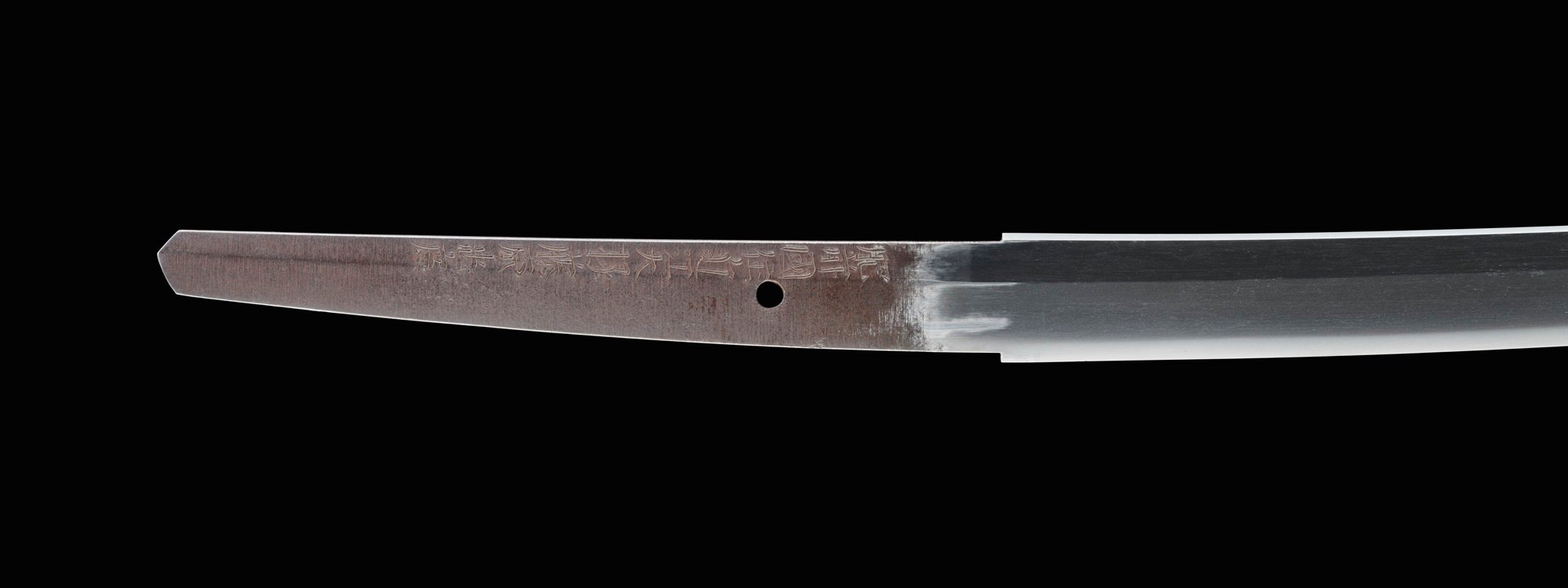
The tang of the katana of the Kyūshū National Museum, with the signature 肥前国住近江大掾藤原忠広 (Hizen no kuni jū Ōmi Daijō Fujiwara Tadahiro). Kyūshū National Museum, via ColBase · ColBase terms of use · source 
The point of the katana of the Tokyo National Museum, with its ko-chōji. Tokyo National Museum, via ColBase · ColBase terms of use · source 
The same point, from the other side. Tokyo National Museum, via ColBase · ColBase terms of use · source 
Bonji and two grooves at the base of the katana of the Tokyo National Museum. Tokyo National Museum, via ColBase · ColBase terms of use · source 
The other side: a dragon coiled around a sword, and the signature on the tang. Tokyo National Museum, via ColBase · ColBase terms of use · source