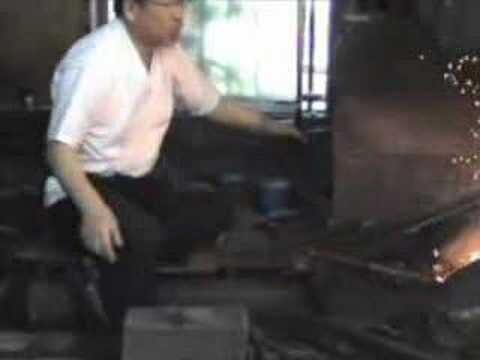
A man in a white shirt, seated before the hearth, pulls the bellows lever; sparks fly.

Still from the video, © The Japan Times · © The Japan Times

Three generations of swordsmiths

Life and forging

From the family forge in Setagaya to his own in Katsushika, with a long spell in the United States, three swords for the Ise shrine and a list of pupils that includes two mukansa.

On this page
  1. A family of swordsmiths
  2. The Ise shrine
  3. Outside Japan
  4. Pupils
  5. On television

The sword

History

  1. History

    His grandfather, “yokozuna of the East” AT

    In the 1941 ranking of swordsmiths (現代刀匠人気大番附, Gendai tōshō ninki ōbanzuke), his grandfather, the first Yoshihara Kuniie (1893–1970), appears as “yokozuna of the East”.

  2. The sword

    Born in Setagaya AT

    Eldest son of Yoshihara Masahiro, the second Kuniie. As a child he already helps at the family forge in Setagaya (Tokyo).

  3. The sword

    Swordsmith’s licence AT

    He receives his swordsmith’s licence from the Agency for Cultural Affairs at the same time as his brother Shōji, the future third Kuniie. The following year, his brother’s effort prize at the competition encourages him to devote himself seriously to forging.

  4. The sword

    From the Sōshū-den to the Bizen-den AT

    Until 1970 he forges mainly in the Sōshū tradition (that of Masamune); in the seventies he moves to the Bizen-den.

  5. The sword

    The first Takamatsu-no-miya-shō AT

    He is the first to receive the newly created Takamatsu-no-miya-shō (高松宮賞). The year before he had won the special prize and that of the Commissioner for Cultural Affairs.

  6. The sword

    A forge in Dallas AT

    After attending a meeting of enthusiasts in the United States in 1975, in 1980 he sets up a demonstration forge in Dallas, and later others in San Francisco and Seattle.

  7. The sword

    Mukansa AT

    The NBTHK names him mukansa at 39, together with his brother.

  8. History

    The split helmet AT

    TBS broadcasts the documentary “Chikyū Rōman”, in which a sword of his cuts a helmet (兜割り, kabuto-wari).

  9. History

    A wakizashi in Florence AT

    A wakizashi of his is donated to the Bargello National Museum, in Florence.

  10. The sword

    More than five hundred swords AT

    By then he makes five or six swords a year and has made more than five hundred.

  11. The sword

    Still exhibiting HD

    He exhibits a wakizashi of 40.3 cm among the mukansa of the 現代刀職展 (Gendai Tōshokuten).

A family of swordsmiths

He learned as a child with his grandfather and his father, helping at the Setagaya forge. His younger brother, Shōji (1945–2023), was the third Yoshihara Kuniie (吉原國家); both received their licence in 1965 and were named mukansa in 1982. His son Yoshikazu (1967–2018), whom he trained himself, was the youngest mukansa in history and died at 51.

The Ise shrine

He has been chosen three times to forge the sacred tachi (御神宝太刀, goshinpō tachi) that the Ise shrine renews every twenty years.

Outside Japan

Since the seventies he has taught forging outside Japan: demonstration forges in Dallas, San Francisco and Seattle, and swords that the Metropolitan Museum of Art in New York and the Museum of Fine Arts in Boston offered to buy from him. With Leon and Hiroko Kapp he wrote four books in English: The Craft of the Japanese Sword (1987), Modern Japanese Swords and Swordsmiths (2002), The Art of the Japanese Sword (2012) and, with the polisher Takaiwa Setsuo, The Art of Japanese Sword Polishing (2013).

Pupils

The English Wikipedia counts nine apprentices, his son among them. Among them is Ōno Yoshimitsu, with him and with Kuniie from 1969 and licensed in 1975. Kubo Yoshihiro tells in the NBTHK magazine that Yoshindo was the first swordsmith he met and that he entered his forge in 1989; he recalls that the master imposed nothing and kept saying: “if you want to improve, give it your all; and if not, it makes no difference if you slack off”.

On television

Besides the 1987 documentary, he has appeared on 「情熱大陸」 (Jōnetsu Tairiku, MBS, 2017), 「美の壺」 (Bi no Tsubo, NHK, 2020) and 「プロフェッショナル 仕事の流儀」 (Purofesshonaru: Shigoto no Ryūgi, NHK, 2021), among other programmes.