Sugata
The NBTHK highlights his dramatic shapes: broad blades, sometimes long, with an extended, sharp point, also in tantō and wakizashi. His naginata, about five, have a sharp point without curvature. For the Japanese Wikipedia, his very thick tantō (鎧通し, yoroidōshi), copies of Samonji, are the most representative of that shape in shinshintō. Sesko counts him, with his school, among those who made imposing shapes inspired by the Nanbokuchō, with a point of little fukura.
Jihada
The Japanese Wikipedia points to a silvery streak in the ji, the “white hair” one (白髪筋, shiraga-suji), as his characteristic feature, and describes his steel as beautiful and strong. The NBTHK describes on his wakizashi of 1852 an itame tighter than usual owing to careful forging.
Hamon
He began with the chōji-midare of his master’s Bizen tradition and developed a Sōshū-den of his own: gunome-midare touched with chōji, much sunagashi and kinsuji and areas of strong nie. In the upper half of some blades the temper splits into two lines; the nioiguchi is bright and lively. His models were the old masters: the Japanese Wikipedia cites above all copies of Samonji and of Shizu Kaneuji, with an “old-looking” temper full of kinsuji.
Bōshi
On the tantō of 1834, with a ko-notare temper, the bōshi is pointed. On the 1849 katana from Ueda, according to the city’s record, the bōshi is midare-komi, with a pointed tip, strong hakikake and a rather deep turn-back.
Nakago and mei
His signatures change over the years: 一貫斎正行 (Ikkansai Masayuki) from 1830; 秀寿 (Hidetoshi) in 1834; again 正行 (Masayuki) or 山浦環正行 (Yamaura Tamaki Masayuki), and 清麿 (Kiyomaro) or 源清麿 (Minamoto Kiyomaro) from 1846. The character 製 (sei, “made”) after the name appears only on a few blades, such as Kubota Sugane’s. He was left-handed: the file marks on the tang slant the opposite way to the usual.
Horimono
Many of his best blades carry two parallel grooves (二筋樋, futasuji-hi), already on the joint work of 1830 with his brother. The 1847 tantō of the Yasukuni shrine carries a dragon coiled around a sword (倶利伽羅, kurikara).
Kantei keys
- Extended, sharp point, also in tantō and wakizashi.
- Gunome-midare touched with chōji, abundant sunagashi and kinsuji and strong nie in some areas.
- A temper that splits in the upper half and a bright nioiguchi.
- The silvery streak in the ji and the reversed file marks.
Details
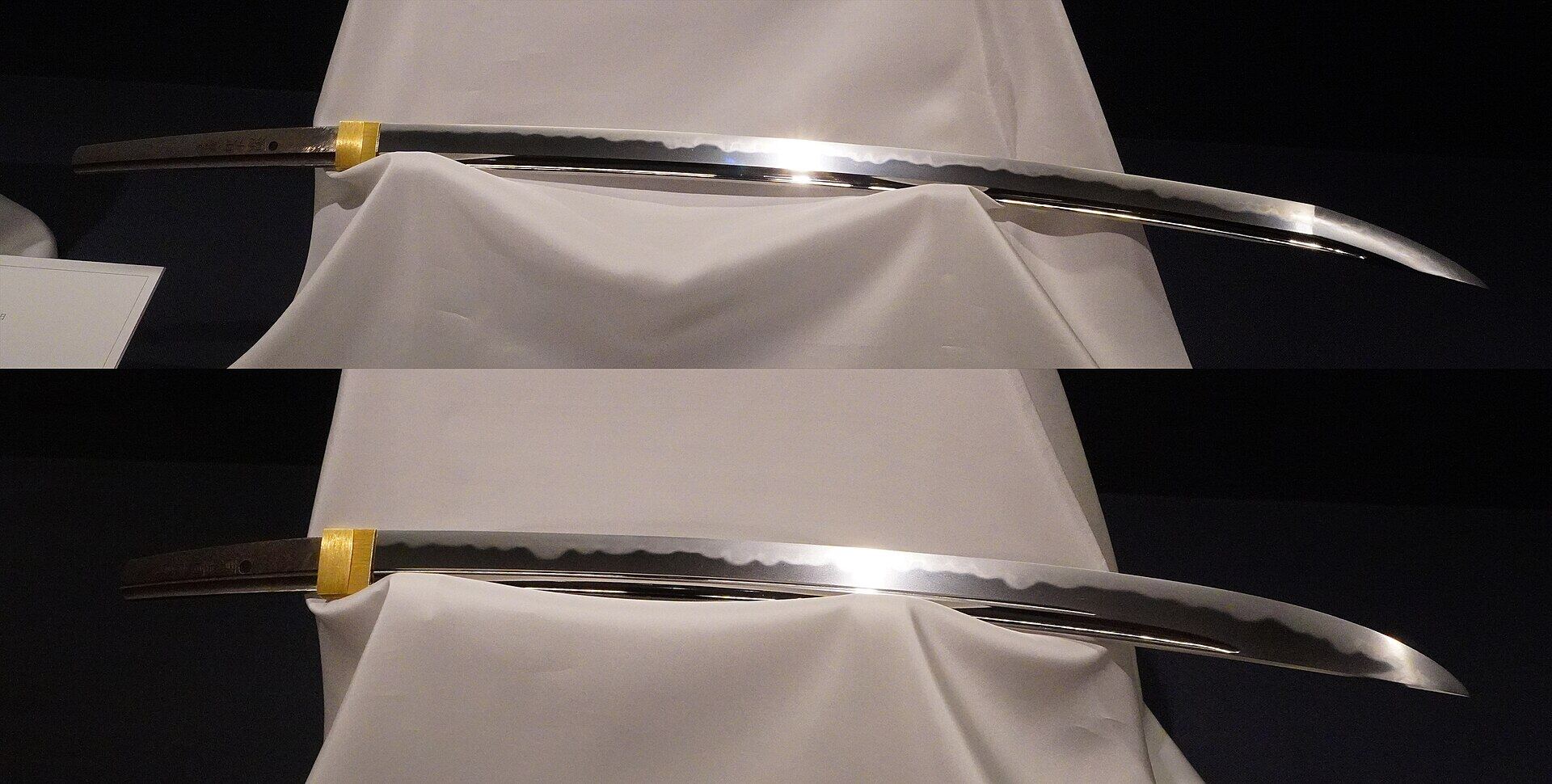
Both sides of a blade of the 1848 daishō (Kaei 1): gunome-midare and midare-komi bōshi. SLIMHANNYA, via Wikimedia Commons · CC BY-SA 4.0 · source 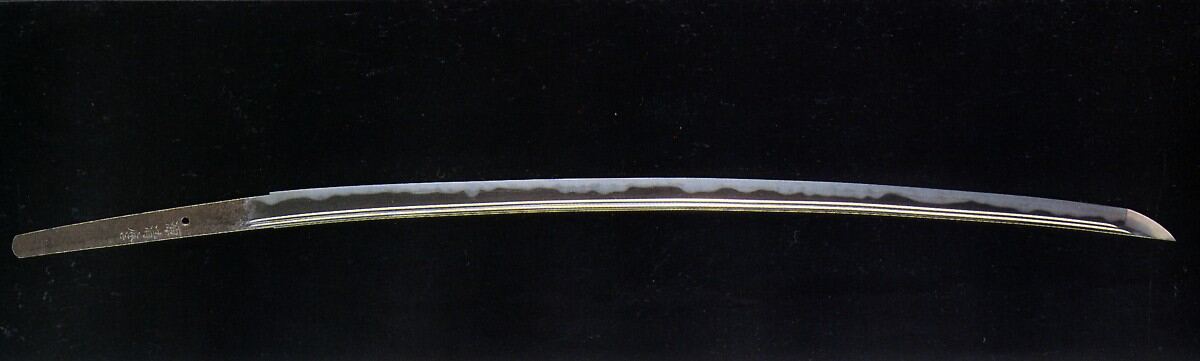
Katana signed 源清麿 (Minamoto Kiyomaro), of the eighth month of 1849 (Kaei 2), of the Kimura family of Ueda: a treasure of Nagano Prefecture. City of Ueda (Ueda Multimedia Information Center) · © City of Ueda
