On this page
Training
According to Sesko, he was born in 1778 in Yamagata, in Dewa, into a family of smiths who made farm tools; the NBTHK and the Japanese Wikipedia give 1779, counting that he died at the age of 79 in 1857. Towards the end of the Kansei era (1789-1801) he went to Edo to study under Suishinshi Masahide, who was also from Dewa.
His earliest signed blade is from 1801 (Kansei 13), made at the age of 23 and signed Shōji Naotane; from it the NBTHK deduces that he joined Masahide around 1798 and became independent around 1804. Sesko has him already independent in 1801. The Japanese Wikipedia records another tradition: that his father was a Dewa smith who signed Yasumitsu (安光), and that he began as Jirō Yasumitsu; the article itself says this is not on record and that the truth is uncertain.
Swordsmith to the Akimoto
He entered the Akimoto house, lords of Yamagata and from 1845 of Tatebayashi, in Kōzuke, as a salaried swordsmith (お抱え, okakae): in 1811 according to the NBTHK, in 1812 and through Masahide’s mediation according to Sesko. He went on working in Edo. He lived first in Nihonbashi Horie-chō and around 1812 moved to Shitaya Okachimachi; once he lost his house in a fire that swept through the Kanda district.
According to Sesko, he received the title of Chikuzen Daijō (筑前大掾) around 1821-1822 and, in 1848, at the age of 70, that of Mino no Suke (美濃介), when he brought a tachi to the Takatsukasa house (鷹司, Takatsukasa) in Kyoto.
The journeys
The NBTHK relates that he forged far from Edo, from Nikkō in the east to Bizen in the west, and that he marked on the tang the place where he forged. Sesko describes three great journeys: from Sagami to Ise between 1831 and 1832, with a pilgrimage to Ise; from Shinano by way of Osaka; and, once he was Mino no Suke, Osaka, Kyoto, Bitchū and Tango. On these journeys he taught the local smiths, and he also took an interest in iron and its production.
The Matsushiro test
In 1853, in Matsushiro, twelve blades from the castle armoury were put through a toughness test (荒試し, ara-tameshi), five of them by Naotane. According to Sesko, a katana of 1835 broke when striking an iron plate and another bent and broke against an anvil; from then on, he says, the samurai looked on his blades with suspicion. The Japanese Wikipedia qualifies this: the test was brutal, and it would be hasty to call his blades fragile.
The workshop and the generations
No second swordsmith signing Naotane is recorded. His best pupil, Jirōtarō Naokatsu (次郎太郎直勝, 1805-1858), sent by the Tatebayashi domain, married his daughter, became his successor and inherited the workshop. The Tokyo National Museum presents him as a pupil and later adopted son of Naotane, and holds a katana of his from 1835 in Sōshū style. According to the Japanese Wikipedia, the second Naokatsu first signed Naoyoshi (直好) and later Shōji Yamon Naokatsu (荘司弥門直勝).
According to the same Wikipedia, he raised Kitaji Masatsugu (北司正次), Masahide’s grandson, and made him his son-in-law; he worked with the engraver Yoshitane (吉胤), and the intendant Egawa Hidetatsu (江川英龍) was his pupil and his friend. Sesko also names among his pupils Ogoma Tanenaga (小駒胤長), Shinkei Tanemitsu (心慶胤光) and Sōryūshi Tamateru (雙龍子玉英). The NBTHK speaks of a “Naotane workshop” with pupils and collaborators: a naginata of 1834 bears the inscription “one of fifty”.
His death
He died on 18 June 1857 (Ansei 4), at the age of 79, and is buried at the Honnen-ji temple (本然寺, Honnen-ji) in Asakusa. Around 1850 he had commissioned his portrait from the painter Takada Enshū (高田円洲); the Shōji family kept it until it was destroyed in the Great Kantō earthquake of 1923, and no image of him is known.
Gallery
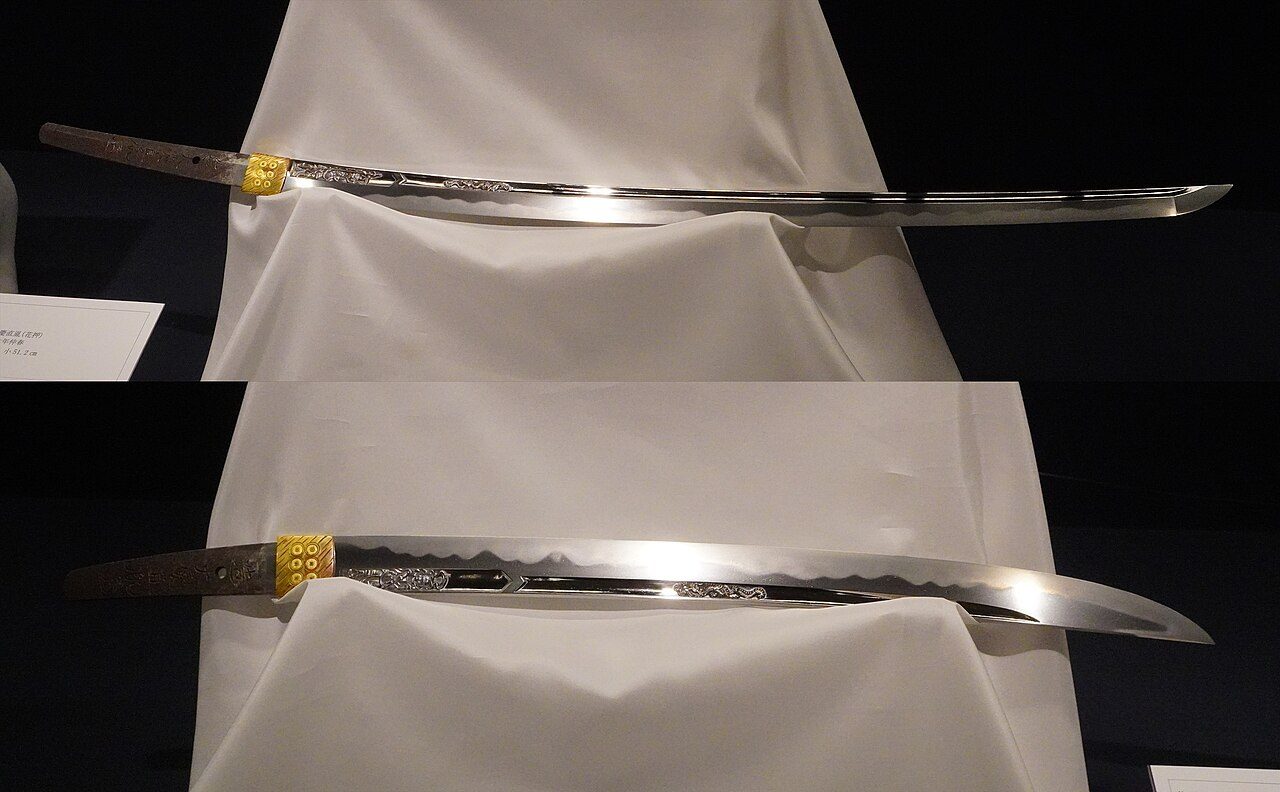
The daishō of Tenpō 7 (1836), signed 造大慶直胤 (Taikei Naotane kore o tsukuru), in an exhibition. SLIMHANNYA, CC BY-SA 4.0, via Wikimedia Commons · CC BY-SA 4.0 · source 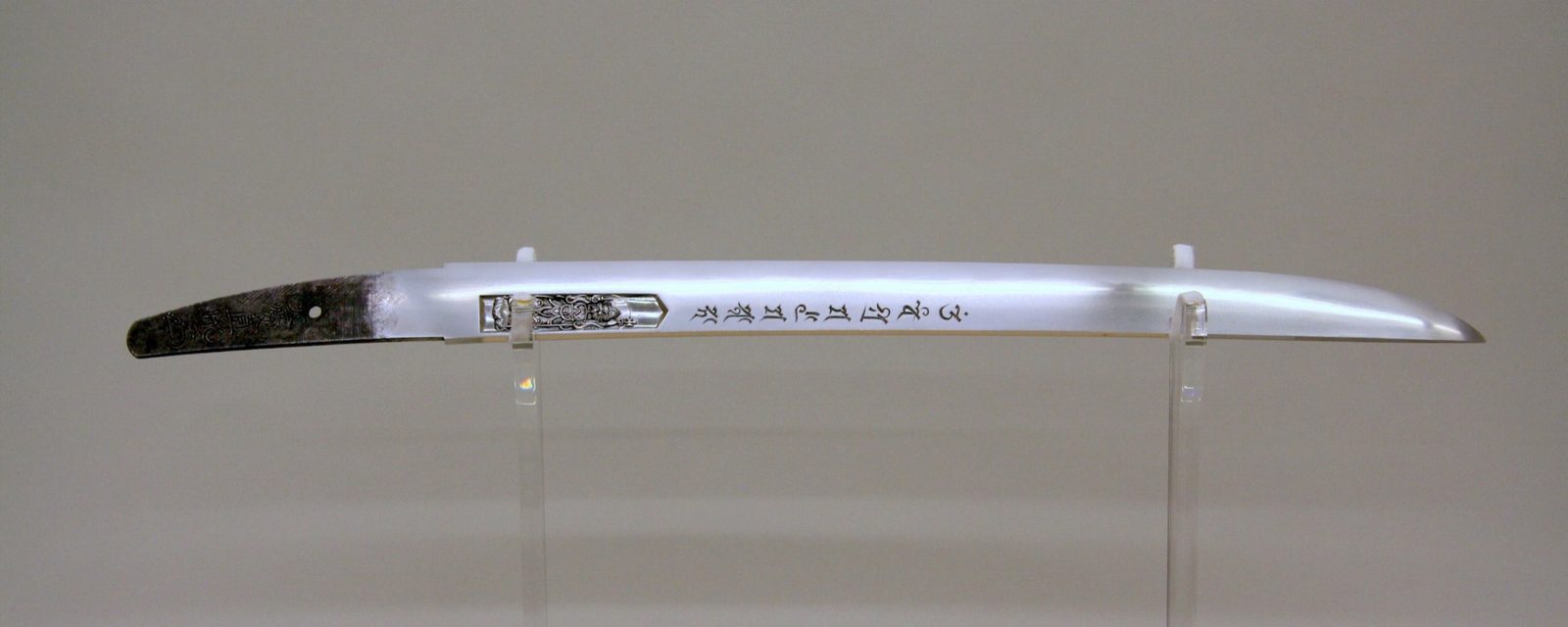
Wakizashi by Naotane, with carvings of a figure and of Sanskrit characters. The Metropolitan Museum of Art. The Metropolitan Museum of Art, New York · Public domain · source
