Kinkō: the metalwork of sword fittings
A tsuba, a kozuka or a pair of menuki can be the work of an artist with a name, a school and a style of his own, just like the blade they go with. This topic is about those artists, the kinkō: which metals they worked, with which techniques, which schools order them, and how one of their pieces is looked at today. The parts of the mounting and how they are put together are in the two mounting topics.
Who a kinkō is
Kinkō (金工) simply means “metalworker”; in the sword world, it is the artist who makes the metal fittings of the mounting, the tōsōgu (刀装具): the tsuba, the fuchi and kashira, the menuki, the kozuka and the kōgai. He is not the smith who forges the blade, nor the shiroganeshi who makes the habaki: it is another craft, with its own families, its own schools and its own signature.
It was not always a separate craft. The oldest tsuba are said to have been made by the blade smiths themselves or by armourers, but the dictionaries warn that this classification is a hypothesis, not a proven fact. Workshops devoted only to the tsuba appear in Muromachi, and it is at the end of Muromachi that tsuba begin to carry their maker's signature. The great names come later, in the second half of Edo, after the Genroku era: just as blade forging goes into decline, fittings become one of the country's great artistic crafts.
The metals: shakudō, shibuichi and the rest
What first sets a Japanese fitting apart is its colour, and that colour is chemistry. The kinkō worked with a repertoire of metals and alloys, the irogane (色金, “coloured metals”):
| Metal | What it is | How it looks |
|---|---|---|
| shakudō (赤銅) | copper with a few parts of gold per hundred: the dictionaries give between 3 and 7 %, sometimes with a little silver | black with a blue or violet sheen, like a crow's wing |
| shibuichi (四分一) | “one quarter”: originally three parts copper to one of silver; today it usually carries less silver | silvery grey; also called oborogin (朧銀), “veiled silver” |
| suaka (素銅) | almost pure copper | reddish |
| tetsu (鉄) | iron, forged and patinated | dark brown or black; the metal of most tsuba |
| gold and silver | inlaid, as foil or solid | their own colour, against the dark ground |
Shakudō does not come out of the casting black: freshly polished, it looks like bronze. Its colour comes from a final bath, the niiro (煮色), in which the piece is boiled in a solution of verdigris, rokushō (緑青), copper sulphate and alum. A very thin layer of copper oxide forms on the surface, with particles of gold dispersed in it that absorb the light. That is why repolished shakudō loses its black and does not regain it on its own, and why a fitting is never rubbed with an abrasive.
The techniques: from high relief to fish roe
Those metals are worked with the chisel, tagane (鏨). Each technique has its own name, and recognising them is half of attributing a piece:
- takanikubori (高肉彫): high relief, carved by leaving the motif and cutting back the ground, or raised from the back and finished from the front. Low relief is usunikubori. In the glossary, high relief appears as takabori (高彫り).
- sukashi (透かし): openwork, cutting the motif right through.
- kebori (毛彫): the fine, “hair” line of even width.
- katakiribori (片切彫): with a single-bevelled chisel driven in at an angle, the line swells and thins like a brushstroke; the dictionaries relate it to the brushwork of the Maruyama school of painting, and tradition credits it to Yokoya Sōmin, around the Genroku era (1688–1704).
- shishiaibori (肉合彫): the outline of the motif is cut down and its inside modelled in low relief, so that nothing rises above the surface; it is credited to Sugiura Jōi.
- nanako (魚々子): a ground of tiny grains, struck one by one with a ring-tipped chisel and lined up like fish roe, hence the name. It is very old: according to the Japanese Wikipedia (article 魚々子, nanako), the Shōsōin documents already mention its craftsmen, and the oldest dated piece is from 762. From Kamakura the rows become regular, and in Edo variants appear, such as nanako in bands.
- zōgan (象嵌): inlay of another metal. In hira-zōgan (平象嵌) it lies flush; in nunome-zōgan (布目象嵌) the ground is hatched in a grid, like cloth, and a foil or wire of gold or silver is hammered onto it.
- iroe (色絵): thin sheets of gold or silver fixed over the carved parts to colour them.
The techniques are combined: a gold motif in high relief on shakudō with a nanako ground is, almost on its own, the mark of a whole school, the Gotō.
Iebori: the Gotō house
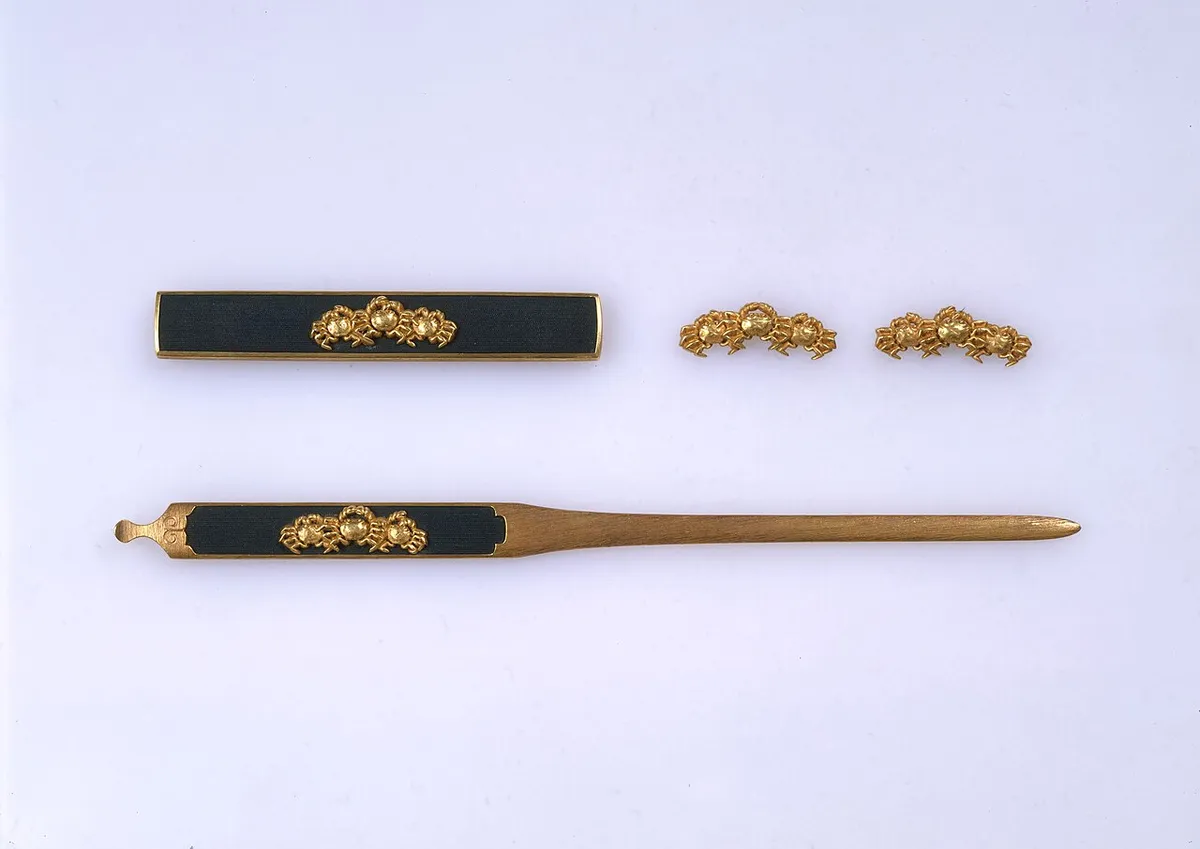
For three and a half centuries, the ceremonial fittings of the warrior elite came from a single family. The Gotō house (後藤家, Gotō-ke) counts as its founder Gotō Yūjō (後藤祐乗, 1440–1512), from Mino, who according to family tradition served in the guard of the shōgun Ashikaga Yoshimasa (足利義政) and turned to fittings at his order. The house later worked for the Oda, the Toyotomi and the Tokugawa; the main line moved from Kyoto to Edo in 1662, and it lasted seventeen generations, until Meiji. It also minted the large gold coins, the ōban.
Its work is called iebori (家彫), “carving of the house”, as opposed to that of the independent workshops. Three features identify it: the noble metals, shakudō, gold and silver, and as a rule never iron; a fixed repertoire of subjects, dragons, lions, waves, crests, warriors, flowers and birds, repeated according to a canon kept the way the Kanō painters kept theirs; and a preference for the small pieces, kozuka, kōgai and menuki, with very few tsuba. It is also the Gotō who give prestige to the mitokoromono (三所物): menuki, kōgai and kozuka by the same maker and with the same motif. They were the required fittings for the formal mountings of the daimyō and the shōgun.
Two warnings. No piece signed by Yūjō himself survives: his work is unsigned or carries an attribution added by later generations of the house, and that is how his name on a fitting must be read. And the regularity that gave the school its prestige is the same that, for the dictionaries, takes away its freedom compared with the city workshops.
Machibori: Yokoya Sōmin and the three of Nara
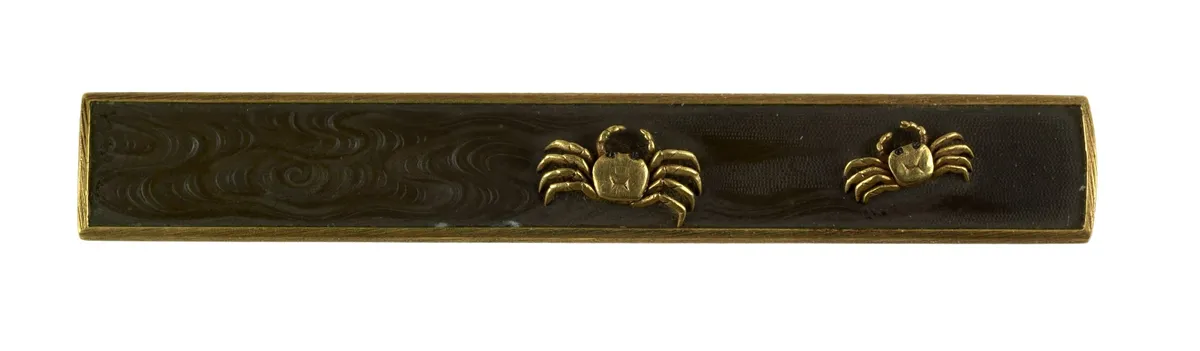
Facing the shōgun's house stands machibori (町彫), “town carving”: the work of kinkō who worked on their own account, for whoever commissioned them. It is said to begin with Yokoya Sōmin (横谷宗珉, 1670–1733), born in Kyoto into a family of carvers in the Gotō orbit. He learned iebori in Edo and, around 1690, tired of its conventions, set up on his own with free subjects, materials and compositions, often taken from drawings by painters such as Kanō Tan'yū or Hanabusa Itchō. Katakiribori is credited to him, and so is the kozuka composed vertically, where until then it had been composed horizontally. After him came, among others, the Yanagawa, Ōmori, Ishiguro and Hamano schools.
The other great names of town carving are the three of the Nara school, the Nara sansaku (奈良三作), who were not Sōmin's pupils but came from their own school:
- Nara Toshinaga (奈良利寿, 1667–1737): mostly fuchi-kashira with figures and with flowers and birds, in a strongly marked high relief and bold compositions.
- Tsuchiya Yasuchika (土屋安親, 1670–1744): born in Tsuruoka, in Dewa; he served a daimyō and then opened a workshop in Kanda, in Edo. He is celebrated for how he matches the shape of the tsuba to its motif, and three of his tsuba are Important Cultural Properties.
- Sugiura Jōi (杉浦乗意, 1701–1761): the creator of shishiaibori. He made mostly kozuka; only two tsuba by him are known.
In Kyoto, Ichinomiya Nagatsune (一宮長常, 1722–1786) worked in the same years. With machibori, landscapes, animals, legends and scenes of everyday life enter the fittings, far from the fixed repertoire of the Gotō.
The tsuba schools
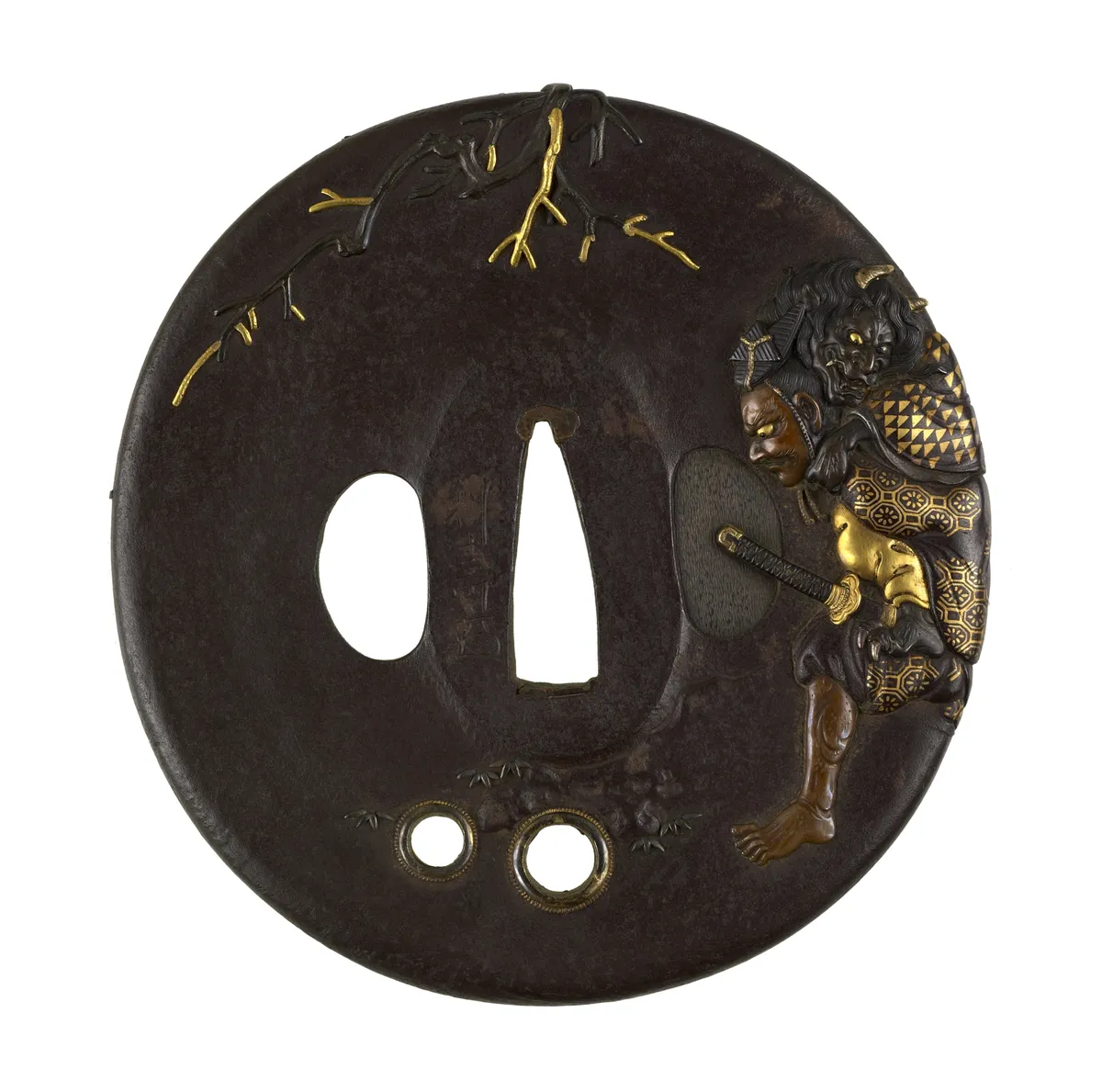
The tsuba has a history of its own, largely in iron. The first tsuba of the uchigatana, at the end of Muromachi, are simple iron plates with a little openwork. Soon workshops devoted only to them appear, and from then on the history is ordered by schools:
- Shōami (正阿弥): born in Kyoto in Muromachi, they became the most widespread school, with branches in Iyo, Awa, Aizu, Shōnai, Edo and other provinces; much iron with gold inlay.
- Nobuie (信家), in Owari, and Kaneie (金家), in Fushimi, between Muromachi and Momoyama: the first, thick, well-forged iron with inscriptions and flowers in kebori; the second, the first to bring pictorial scenes to the tsuba.
- Umetada Myōju (埋忠明寿), in Kyoto: he inlays metals of several colours flush, in hira-zōgan, and brings colour to the tsuba.
- The pierced iron tsuba of early Momoyama, such as Kyō-sukashi and Owari-sukashi, and later, among the pierced ones, those of Akasaka, Chōshū and Echizen Kinai.
- Higo: at the start of Edo, in the service of the Hosokawa house, the Hayashi, Nishigaki, Shimizu and Hirata schools, of martial taste, with openwork and nunome-zōgan; their story is in “Mounting styles (koshirae)”.
The Gotō, by contrast, made hardly any tsuba: nearly all their work is in the small pieces.
The end of the craft: Ichijō, Natsuo and 1876
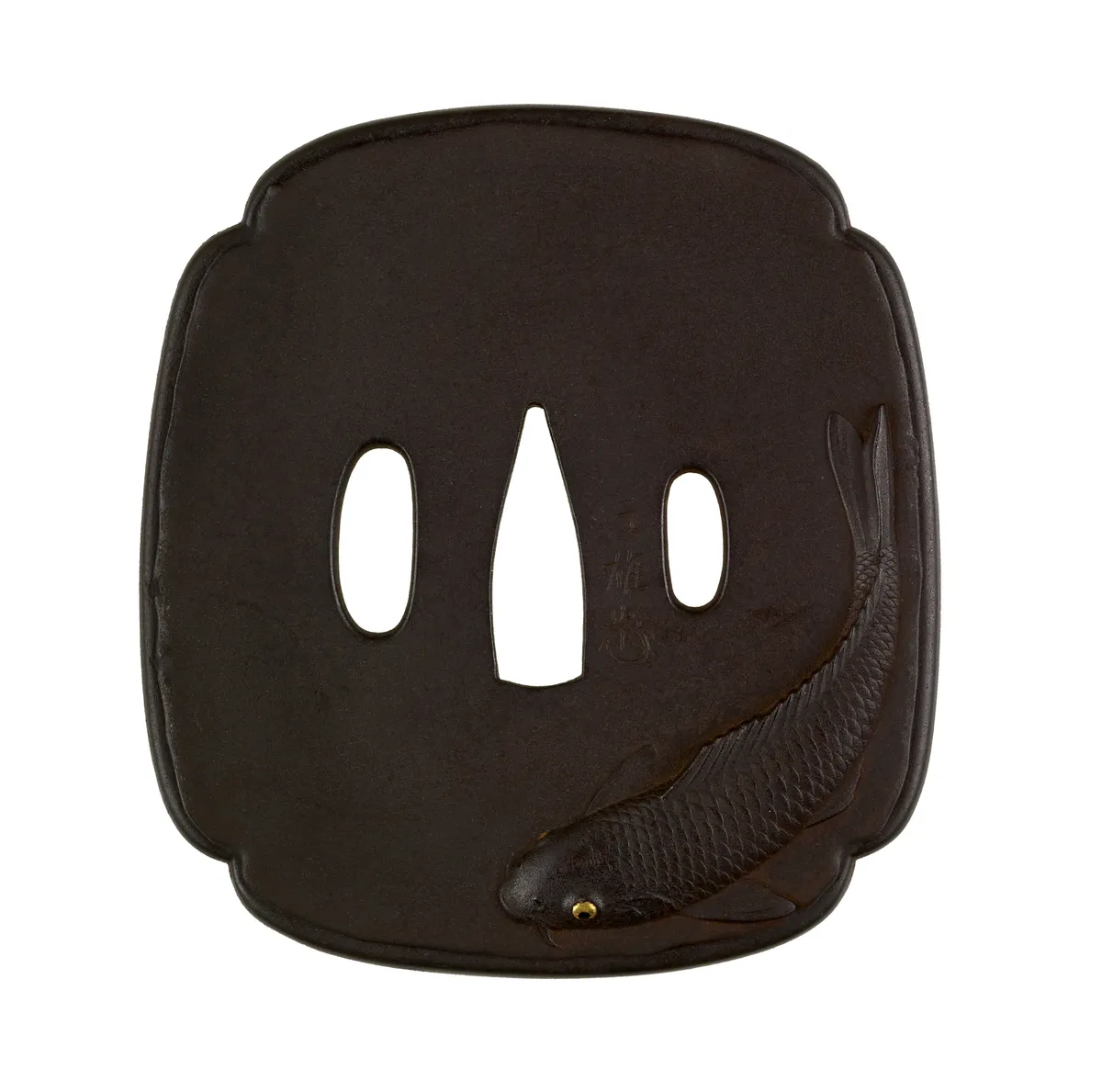
The last great Gotō, Gotō Ichijō (後藤一乗, 1791–1876), broke with the custom of the house and took to making tsuba. But the name that closes the story is Kanō Natsuo (加納夏雄, 1828–1898). Born in Kyoto and adopted as a child by a sword dealer, he learned the chisel from the age of twelve and drawing from life with a painter of the Maruyama-Shijō school; in 1854 he opened a workshop in Edo, in Kanda. He was a master of katakiribori, and on iron tsuba he brought the motif to drawing from nature.
In 1876 the ban on wearing swords, the haitōrei (廃刀令), left most kinkō without work. Natsuo carried on: as early as 1869 the new government had commissioned from him the models for the first Meiji coins, and in 1873 he made for the emperor the mounting of an eighth-century straight sword from the Shōsōin, the Suiryūken (水龍剣). In 1890 he was among the first artists appointed to the Imperial Household, the teishitsu gigeiin (帝室技芸員), and he taught at the Tokyo School of Fine Arts. Others, such as Shōami Katsuyoshi (正阿弥勝義, 1832–1908), moved from fittings to vases, incense burners and ornaments, many of them for export.
How to look at a fitting
Three things, before letting the motif carry you away:
- Metal and technique. The colour of the shakudō or shibuichi, the regularity of the nanako, the stroke of the katakiribori: these are the data by which a piece is attributed, like the hada and the hamon on a blade.
- The signature, with caution. Signed tsuba begin at the end of Muromachi, and the early Gotō pieces are unsigned: what they carry are attributions by later generations. A piece cast in a mould, imono, imitates a chiselled one, but usually gives itself away by its pores, the su (巣).
- The set. A mitokoromono is one only if the three pieces are by the same maker and share the same motif; three pieces brought together later do not make one.
The NBTHK examines fittings apart from the blade, with the same levels, from Hozon to Tokubetsu Jūyō, and criteria of their own, published in its examination standards (審査基準, shinsa kijun): a correct signature, or an identifiable period and school; good workmanship and good condition; and, against, castings from Meiji onwards, visible restorations and polishing that wipes away the patina. How that paper is read is in “NBTHK papers”; how the pieces fit into the mounting, in “The mounting in detail”.
Further reading
- Kotobank · the Gotō house What the Japanese encyclopaedias say about the Gotō family, iebori and its canon. In Japanese.
- Kotobank · machibori What town carving is, who started it and which schools followed. In Japanese.
- Kotobank · the tsuba The history of the guard, from the burial mounds to Meiji, school by school. In Japanese.
- Yokoya Sōmin, on Wikipedia His life, his break from the Gotō orbit, katakiribori and his pupils. In Japanese.
- Kanō Natsuo, on Wikipedia From Kyoto to Edo, the Meiji coins, the Suiryūken and his 1890 appointment. In Japanese.
- Shakudō, on Wikipedia What it is made of and why it turns black in the niiro bath. In Japanese.