The saya
The saya (鞘) is the scabbard of the sword: a piece of wood carved inside to the measure of one single blade, which holds it, protects it and, in the mounting, carries it at the belt. This topic goes through it from end to end: its parts, how the sayashi makes it, its lacquers, the shirasaya and its inscription, how it is kept in good order, and what is worth knowing to use it and to commission one. The rest of the mounting is in «Mounting styles (koshirae)» and in «The mounting in detail».
What the saya is
The saya (鞘) is the case the blade goes into. It protects the blade from damp and dust, and protects whoever carries it from the edge. It is not a stock part: the sayashi hollows it out following the shape of one single blade, with its curve, its thickness and its habaki, and that scabbard fits no other. The craft sheet of the Agency for Cultural Affairs, Bunkachō (文化庁), puts it this way: in this work not the slightest deviation is allowed.
There are two kinds of saya. That of the koshirae (拵), the mounting, carries lacquer or a covering, horn reinforcements and fittings, and is the one that was worn at the belt. The shirasaya (白鞘) is bare wood and serves to store the blade; the NBTHK compares the koshirae to going-out clothes and the shirasaya to everyday wear or, in its illustrated sheet, to pyjamas. By cross-section one also tells apart the hira-zaya (平鞘), flat, that of the old tachi made for use, and the maru-zaya (丸鞘), with an egg-shaped section, fuller on the back side than on the edge side, which was at first a ceremonial form and from Muromachi on also became the rule for swords made for use.
It is made by the sayashi (鞘師). He carves the shirasaya and, for the mounting, the wooden scabbard that will later receive the lacquer, the koshirae-shitaji (拵下地); he also prepares the seats of the other fittings and, according to that same sheet, is the one who coordinates the making and repair of the whole mounting. In 2018 that agency included the making and repair of the scabbard among the conservation techniques of the heritage it protects, the sentei hozon gijutsu (選定保存技術). Who makes each of the other parts is in «The mounting in detail».
The parts of the saya
From the mouth to the tip, the scabbard of a mounting has these parts; the diagram numbers them in the same order:
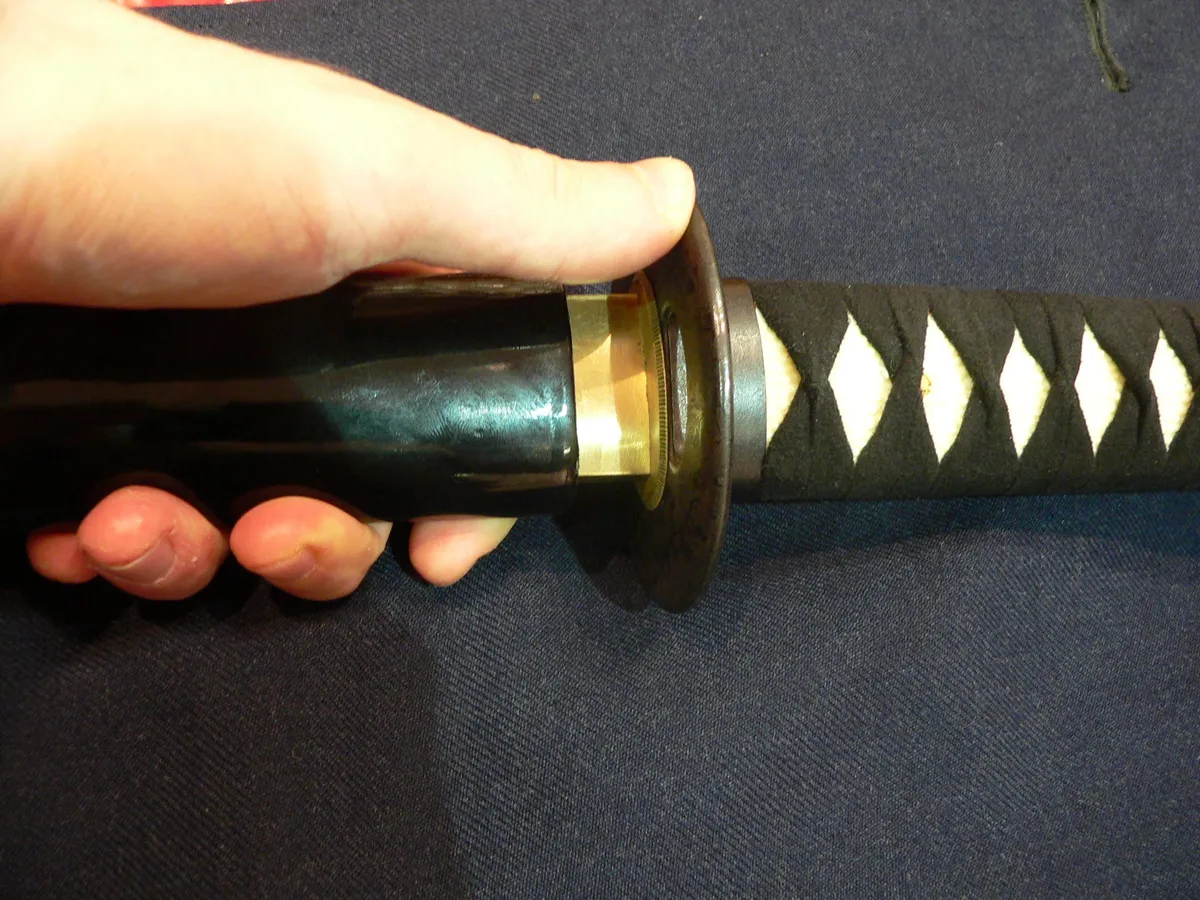
- koiguchi (鯉口): the mouth, so called because it recalls the open mouth of a carp. In a shirasaya it is usually the wood itself, although quality ones have a horn mouth; in the mounting it is a piece of water-buffalo horn. The habaki, which holds the blade, fits into it: pushing the tsuba with the thumb to release it is called koiguchi wo kiru (鯉口を切る), «cutting the mouth».
- hitsu (櫃): the grooves carved in the faces of the scabbard for the kōgai, on the sashi-omote side, the one that faces outward when the sword is worn, and for the kozuka, on the other. Their ends show at the mouth and come out through the holes of the tsuba, the hitsu-ana, so they can be drawn without unsheathing the sword. Carving them is difficult, and not all scabbards have them.
- kurigata (栗形): the chestnut-shaped projection with an eyelet on the sashi-omote side. It rests against the obi so the scabbard does not slip downward, and the sageo passes through it.
- shitodome (鵐目): the metal lining of the kurigata's eyelet.
- sageo (下緒): the cord that passes through the kurigata and ties the scabbard to the obi.
- kaerizuno (返角): a hook, lower down and on the same side, that catches on the obi so the scabbard does not come away with the blade when drawing. Not all mountings have one.
- kojiri (鐺): the cap at the tip, which wears easily and is therefore reinforced with horn or metal.
The history and uses of the sageo, the kurigata and the kaerizuno, and how the habaki is fitted to the blade, are in «The mounting in detail».

How it is made
The wood is hō (朴), Japanese magnolia. The NBTHK sheet on the shirasaya gives its reasons: it has little oil, hardly warps, is soft just enough, and takes up and gives off moisture in balance. The Bizen Osafune Sword Museum adds that it is not too hard and has no substances that rust the blade, and a Japanese sword-study page, that unlike pine or cedar it has hardly any resin. Other woods were used before, such as hinoki (檜). The hō is left to dry in the open air, naturally, for ten years or more: wood stretches and shrinks over time, and work this exact cannot allow it to move afterwards.
The work, as the Bizen Osafune museum describes it:
- kidori (木取り): a thick block is chosen, looking at the rings and the grain, and cut with the saw to the measure of the blade.
- The block is split lengthwise into two halves, one for each face of the blade.
- kakiire (掻入れ): on each half the outline of the blade is drawn and hollowed out with chisels, nomi (鑿), of various sizes; the chisel marks are then evened out with a knife, the kiridashi kogatana (切り出し小刀).
- The two halves are glued with sokui (続飯), a paste of kneaded rice grains, and tied with cord and wooden wedges until it dries. The sokui does not harm the blade and lets the scabbard be opened again to clean or repair it; a chemical glue would do the opposite.
- The outside is worked. A shirasaya is planed, its mouth is fitted, the peg hole, the mekugi-ana (目釘穴), is opened in the hilt at the height of the one in the tang, the edges are eased, and it is polished with leaves of muku (椋) and with tokusa (木賊), horsetail.
- The scabbard of a mounting is left thinner than a shirasaya, because the lacquer will add thickness, and the pieces of water-buffalo horn, suigyū no tsuno (水牛の角), are fitted: the koiguchi, the kurigata, the kaerizuno and the kojiri. Afterwards it goes to the lacquerer, the nurishi (塗師), and to whoever covers and wraps the hilt.
What matters about the fit can be seen in the cross-section. Inside, the blade does not rest on the wood: the habaki, tight in the mouth, holds it, and the rest of the blade hangs in the air. Each habaki is made to the measure of its blade, and the mouth of the scabbard to the measure of that habaki. If anything does rub inside, let it be the back and never the edge.

Lacquers and finishes
The scabbard of a mounting is lacquered with urushi (漆), Japanese lacquer, which protects it from water and damp. The lacquer is applied in layers: first raw urushi, ki-urushi (生漆), which seals the wood; then a base, the shitaji (下地); then coats of lacquer, black or another colour, and a final coat, the uwanuri (上塗り). Between coats it is left to dry and smoothed by polishing, and the cycle is repeated many times; the number of coats and the recipe of the base vary from one nurishi to another. Scabbards in the Shōsōin (正倉院), from the 8th century, already carry black lacquer. In Edo, lacquerers dedicated only to the scabbard appear, and from the middle of the period fancy finishes multiply.
The most common finishes:
| Finish | What it is |
|---|---|
| roiro (呂色) | black lacquer polished to a mirror finish; that of the ceremonial daishō of the samurai in Edo |
| ishime-nuri (石目塗) | lacquer with a stone-like grain, which does not slip in the hand |
| samezaya (鮫鞘) | scabbard covered in ray skin, the same, coated in lacquer until the grain is hidden and then polished until the grain shows through flush; with the skin called kairagi (梅花皮), the grains draw plum blossoms |
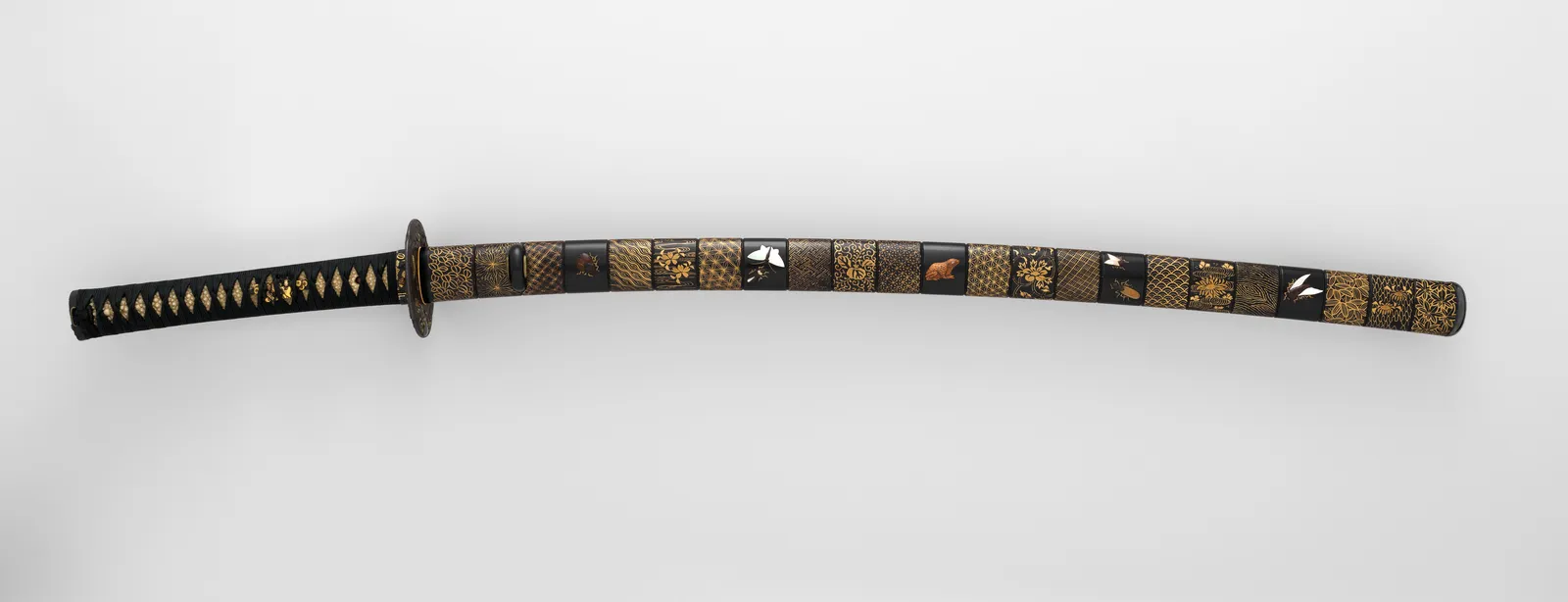
| kizami-zaya (刻鞘) | scabbard carved in relief before lacquering: in rings that imitate a stack of little boxes, the inrō-kizami (印籠刻), or in oblique cuts; it grips and decorates |
| kawari-nuri (変塗) | the name for all the fancy finishes, such as the rankaku-nuri (卵殻塗), with eggshell inlaid in the lacquer |
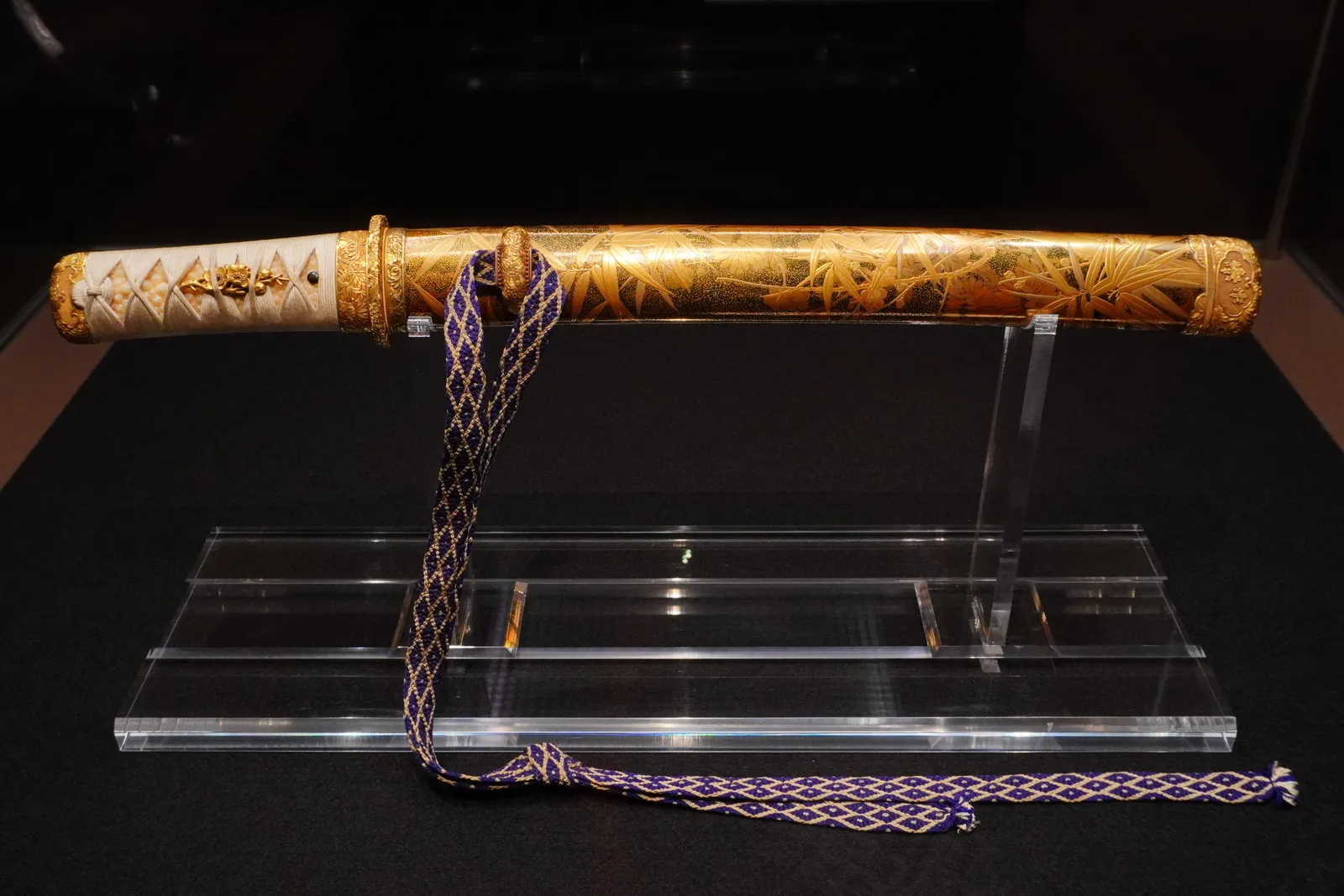
| maki-e (蒔絵) | a design drawn in lacquer and sprinkled with gold or silver; frequent on scabbards of the late Edo period |
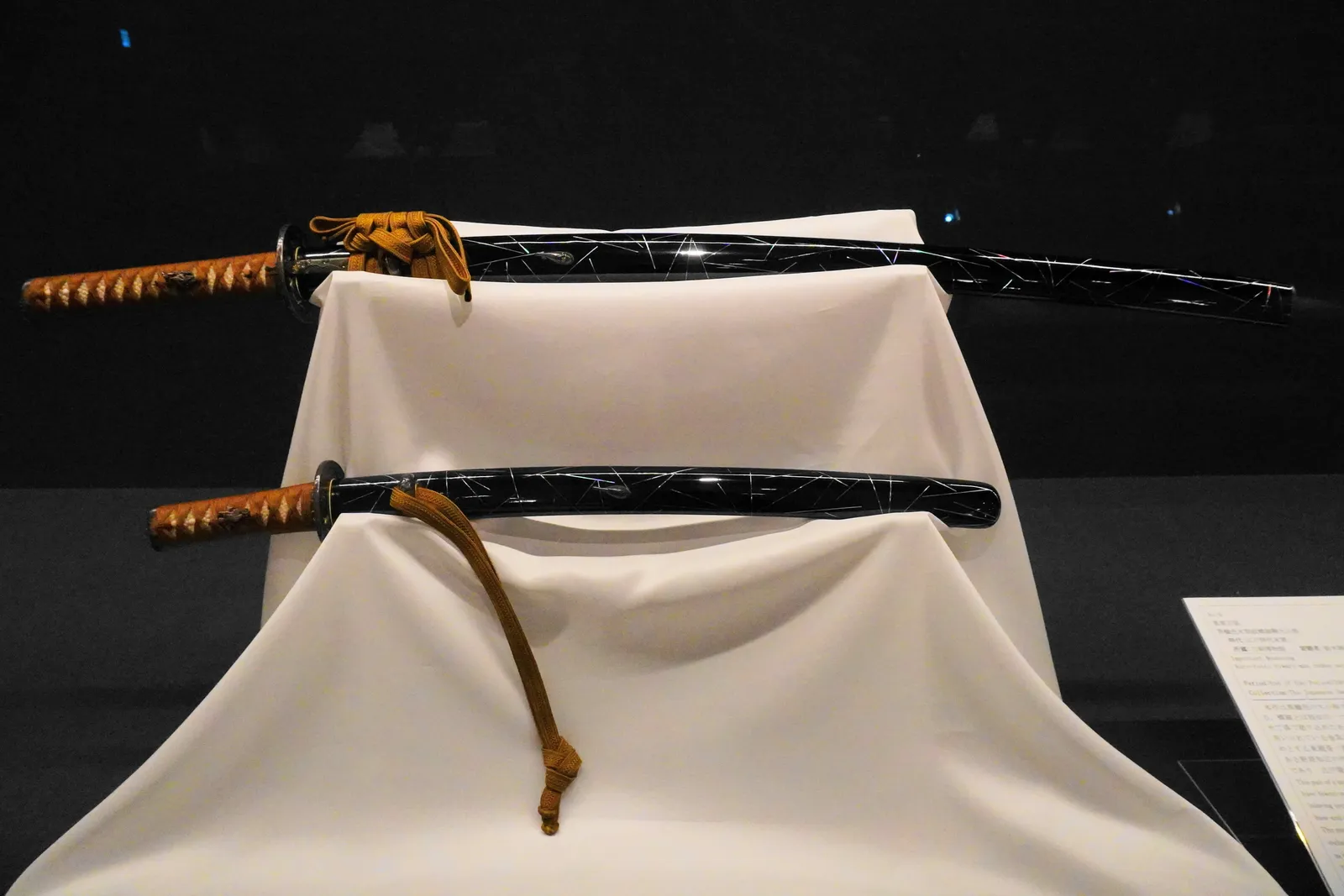
| raden (螺鈿) | mother-of-pearl inlaid in the lacquer; aogai (青貝) is the blue-gleaming mother-of-pearl, in sheets or powder |
Besides the lacquered ones, there are scabbards covered in ray skin with its grain showing, or in leather.
Neither the NBTHK nor Tōken Collection Kuwana ranks the finishes by their resistance. The NBTHK and the Japanese Wikipedia do say that those with relief or texture, such as the kizami-zaya and the ishime-nuri, were also made so the scabbard does not slip in the hand. And a Japanese sword-study page says that lacquer seals the wood and does not let it breathe: a blade kept for years in a lacquered scabbard can rust inside. That is why the blade is kept in the shirasaya.
Shirasaya and sayagaki
What the shirasaya is, why the blade rests in it and what happens then to the mounting is told in «Mounting styles (koshirae)». Here, what sets it apart as a piece. It is made like the scabbard of a mounting, but it is not meant to be carried: according to Tōken Collection Kuwana, it is not made sturdy. Its mouth is usually the same wood; in quality ones, horn. It is thicker than the lacquered scabbard, and not on a whim: this way its surface can be shaved down if it gets dirty. According to the NBTHK sheet, inside it may have a hollow, the chiri-otoshi (塵落とし), where the dust and oil that fall are collected, so they do not touch the blade. And since it is closed with sokui, it is opened at the joint to clean it inside. It is customary for a freshly polished blade to get a new shirasaya: the old one may hold dirt that scratches the new polish.
On the shirasaya the sayagaki (鞘書) is sometimes written: an inscription in which an expert leaves his judgement on the blade. According to the dictionary Nihon Kokugo Daijiten (日本国語大辞典), the appraiser writes it in place of a certificate, and the custom begins in the mid-Edo period. Its origin is practical: in the households of the daimyō, with many blades stored in identical shirasaya, a note was written on the scabbard saying what each one held, so as not to have to draw them. In time, the note came to be treated as a guarantee, in the manner of the origami of the Hon'ami (本阿弥).
A sayagaki usually gives the name of the smith or the attribution, the length of the blade (hachō, 刃長), sometimes its features or provenance, the date and the signature of whoever writes it. There is no fixed format: there are one-liners and whole paragraphs. It is worth what its signer is worth, and it is not an examination paper (see «NBTHK papers»).
Care and repair
How and where the sword is kept is in «Polishing and care». Here, what happens to the scabbard over the years.
Rubbing. If the blade touches the wood inside, the saya-atari (鞘当り), it rusts at that point, however careful one is with it. The NBTHK says it bluntly: the scabbard is to blame, and it should be taken up with the sayashi. An old scabbard with rust or dirt inside can stain the clean blade again, and then what is called for is to make a new one.
Loose or tight. Wood moves with damp and with dryness, and the koiguchi can loosen or tighten even if the scabbard was made to fit exactly. Loose, the blade falls out by itself if the hilt points downward. Tight, the blade must not be forced all the way in, because then it may not come out, nor pulled out in a jerk, because the mouth breaks. The fit is corrected by the sayashi.
The worn mouth. Drawing and sheathing the blade wears away the koiguchi area over the years, explain the iaidō rules of the All Japan Kendo Federation, the Zen Nihon Kendō Renmei (全日本剣道連盟). A crack near the mouth is dangerous, the Federation warns: a worn koiguchi, whether of buffalo horn or of the wood itself, can no longer hold it in.
Repair or make a new one. The shirasaya, glued with sokui, is opened at the joint to clean or repair it. A lacquered scabbard or one with its fittings is another matter: the NBTHK warns that opening it to remove the rust inside is difficult and can damage the blade, and that this is why the shirasaya was devised. The lacquer is the craft of the nurishi, and the repair of the whole mounting is coordinated by the sayashi. On an antique mounting, repair aims to preserve what is there, with knowledge of the materials and techniques of its period, and not to leave it looking new.
Use and commissioning
For anyone practising iaidō with a real blade, the rules the NBTHK gives for drawing and sheathing any sword apply. It is drawn with the edge upward, holding the scabbard from below with the left hand: first the mouth is cut gently and then the blade is drawn out slowly, without letting it wobble. It is sheathed the same way, with the edge upward, resting the tip on the mouth and letting the blade follow its cavity without wobbling, until the habaki seats in the mouth. The study blog Studying Japanese Swords adds that the back should rest on the wood and the edge should not touch the scabbard inside, so as not to scratch it.
The blade is not pulled out in one go: that breaks the mouth and, the NBTHK warns, with the momentum one can get hurt. A shirasaya is not for practice: it was not made sturdy even for that.
The Zen Nihon Kendō Renmei sets this out in detail in its 2003 rules for handling the sword and the mogitō (模擬刀), the practice imitation, in iaidō: Iaidō ni okeru nihontō oyobi mogitō no toriatsukai yōryō (居合道における日本刀及び模擬刀の取扱要領). For the mogitō they ask for the scabbard to be checked before and after each use, in the same look as the mekugi: on the outside, that it has no splits, wear or cracks; on the inside, that the koiguchi is not worn and that the wood is neither scraped nor split. If the mouth does not hold the crack in, those rules warn, the tip may come out through it when drawing or pierce the scabbard when sheathing.
When commissioning a saya it is worth asking for:
- that a sayashi make it for that blade, with the blade and its habaki in front of him;
- hō air-dried for ten years or more;
- the two halves glued with sokui, not with glue: it does not harm the blade and lets the shirasaya be opened at the joint;
- the blade in the air: the habaki seated in the mouth and no rubbing of the edge inside;
- in a mounting scabbard, the koiguchi, the kurigata, the kojiri and, if it has one, the kaerizuno, in horn;
- on collecting it, what the NBTHK looks at in a shirasaya: a natural curve following that of the blade, well-closed joints, and the colour, texture and grain of the wood;
- the finish, with use in mind: those with relief or texture grip better in the hand;
- if the blade has a mounting, a shirasaya to keep it in and a tsunagi for the mounting.
A new mounting for a blade, with its saya, is commissioned at «Custom koshirae».
Further reading
- NBTHK · the habaki and the shirasaya (PDF) The illustrated sheet of the Japanese Sword Museum: why hō wood, the sokui and what to look at in a shirasaya. In Japanese.
- Bizen Osafune Sword Museum · the sayashi The craft step by step: the wood, the hollowing, the sokui, the shirasaya and the horn parts of the mounting. In Japanese.
- Bunka Isan Online · making and repairing the scabbard The sheet of the technique protected by the Agency for Cultural Affairs: the crafts of the mounting and the role of the sayashi. In Japanese.
- The koshirae and the shirasaya, in a diagram A Japanese study page: the parts of the mounting and of the scabbard, the sokui and the play of the koiguchi. In Japanese.
- Tōken Collection Kuwana · the saya Shapes, lacquers, ray-skin and carved scabbards, and the origin of the sayagaki. In Japanese.
- Zen Nihon Kendō Renmei · the sword and the mogitō in iaidō (PDF) The 2003 rules of the All Japan Kendo Federation for checking the sword and its practice imitation: the scabbard, the koiguchi and the mekugi. In Japanese.