On this page
When he lived
The Japanese Wikipedia gives him as a swordsmith of the Heian period who lived in the Sanjō quarter of Kyoto, in Yamashiro Province, from which his name comes. Tradition places him in the reign of Emperor Ichijō, around the Eien era; since no blade of that time bears a date, he is treated “almost as a legend”, and the dates given for him range from the 10th and 11th centuries to the 12th. The Tokyo National Museum describes him as a swordsmith who, it is believed, lived in Sanjō in the second half of the Heian period, of whom very few works remain, and dates the Mikazuki to the 12th century; the Japanese Wikipedia records for it the general opinion of 986–1011 or the 12th century.
What the old texts say
The 観智院本銘尽 (Kanchi-in-bon Meizukushi), cited by the Japanese Wikipedia, says under the reign of Ichijō: “宗近 三条のこかちといふ、後鳥羽院の御剣うきまるといふ太刀を作、少納言しんせいのこきつね同じ作なり” (Munechika, Sanjō no kokaji to iu, Go-Toba-in no gyoken Ukimaru to iu tachi o tsukuru, shōnagon Shinzei no Kogitsune onaji saku nari), that is: “Munechika, called the Kokaji of Sanjō, made the tachi called Ukimaru, sword of the retired emperor Go-Toba; the Kogitsune of the shōnagon Shinzei is the work of the same hand”.
For Markus Sesko, Munechika, nicknamed Kokaji, is the founder of the Sanjō school, which tradition dates to around the Eien era, and his work is “one of the earliest examples of a fully developed nihontō”.
The legend of the fox
The nō 小鍛冶 (Kokaji) tells that Emperor Ichijō commissioned a sword from him; Munechika, without an assistant, went to pray at the Inari shrine of Fushimi, and a young man, who turned out to be the deity of Inari in the form of a fox, served as his hammerer. Thus they forged the tachi Kogitsune-maru (小狐丸, Kogitsune-maru), signed 小鍛冶宗近 (Kokaji Munechika) on the front and 小狐 (Kogitsune) on the back.
It is a legend: according to Sesko, the oldest written record of the play is from 1578 (Tenshō 6), and the tale does not appear in sources of the time. The Japanese Wikipedia adds that the nō dates from Muromachi and that its character 橘道成 (Tachibana no Michinari) does not appear in the genealogy of the Tachibana. The Kogitsune-maru is said to have belonged to the Fujiwara, of the Kujō and Takatsukasa branches, and to have been lost; the one at Ishikiri Tsurugiya Jinja is a wakizashi of 53.8 cm, a different piece, and the one at Isonokami Jingū bears the signature 義憲作 (Yoshinori saku). For Sesko, its whereabouts remain unclear.
The Sanjō school
The Sanjō school (三条派, Sanjō-ha) includes Yoshiie: the official record of the tachi 吉家作 (Yoshiie saku) of the Kyoto National Museum describes it as a work of 三条吉家 (Sanjō Yoshiie). Sesko devotes three chapters of his “Kantei” series to the school.
The legend in pictures
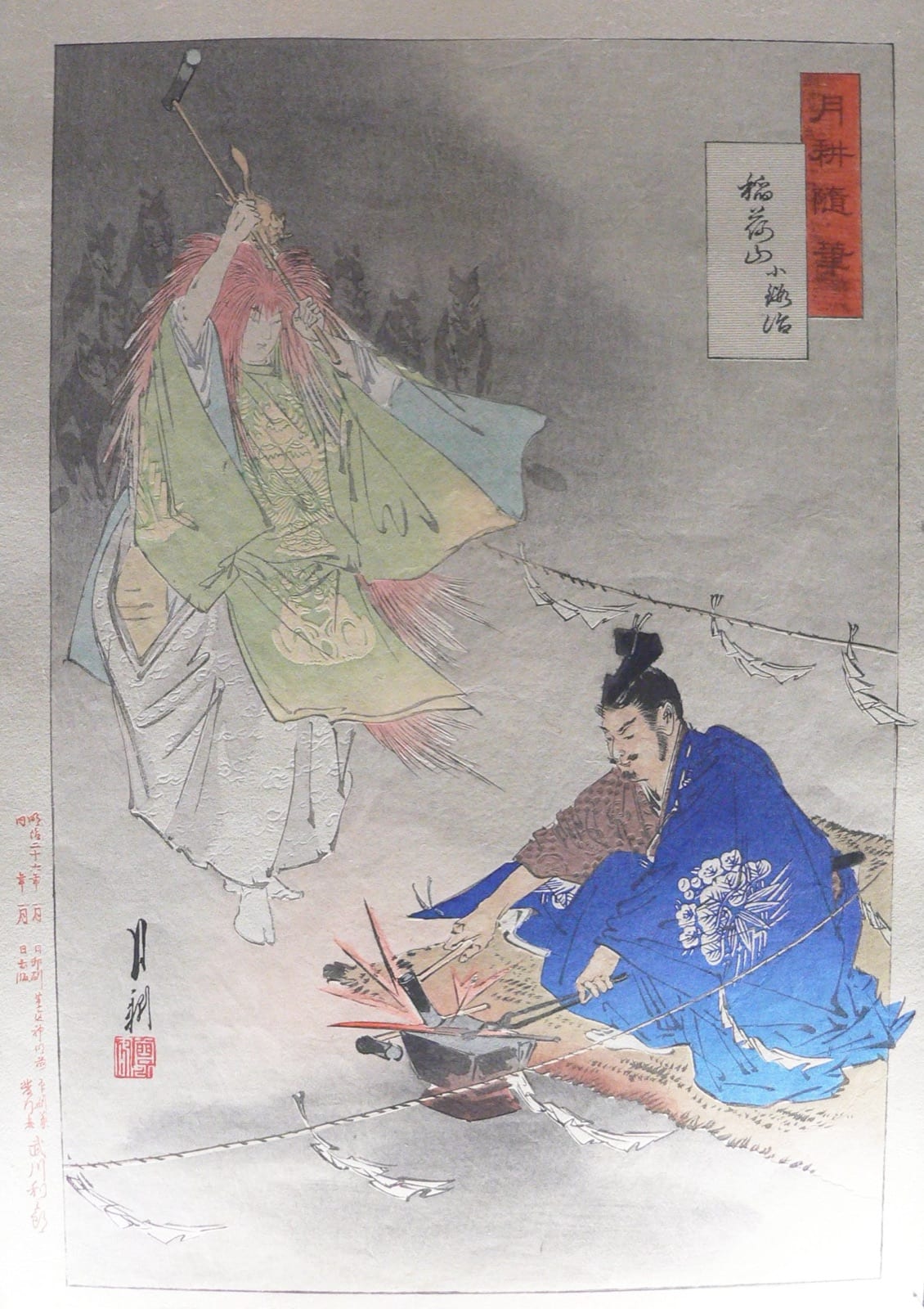
Ogata Gekkō, 稲荷山小鍛冶 (Inariyama Kokaji), from the series 月耕随筆 (Gekkō zuihitsu): Munechika forges with the fox spirit. Ogata Gekkō, public domain, via Wikimedia Commons · Public domain · source 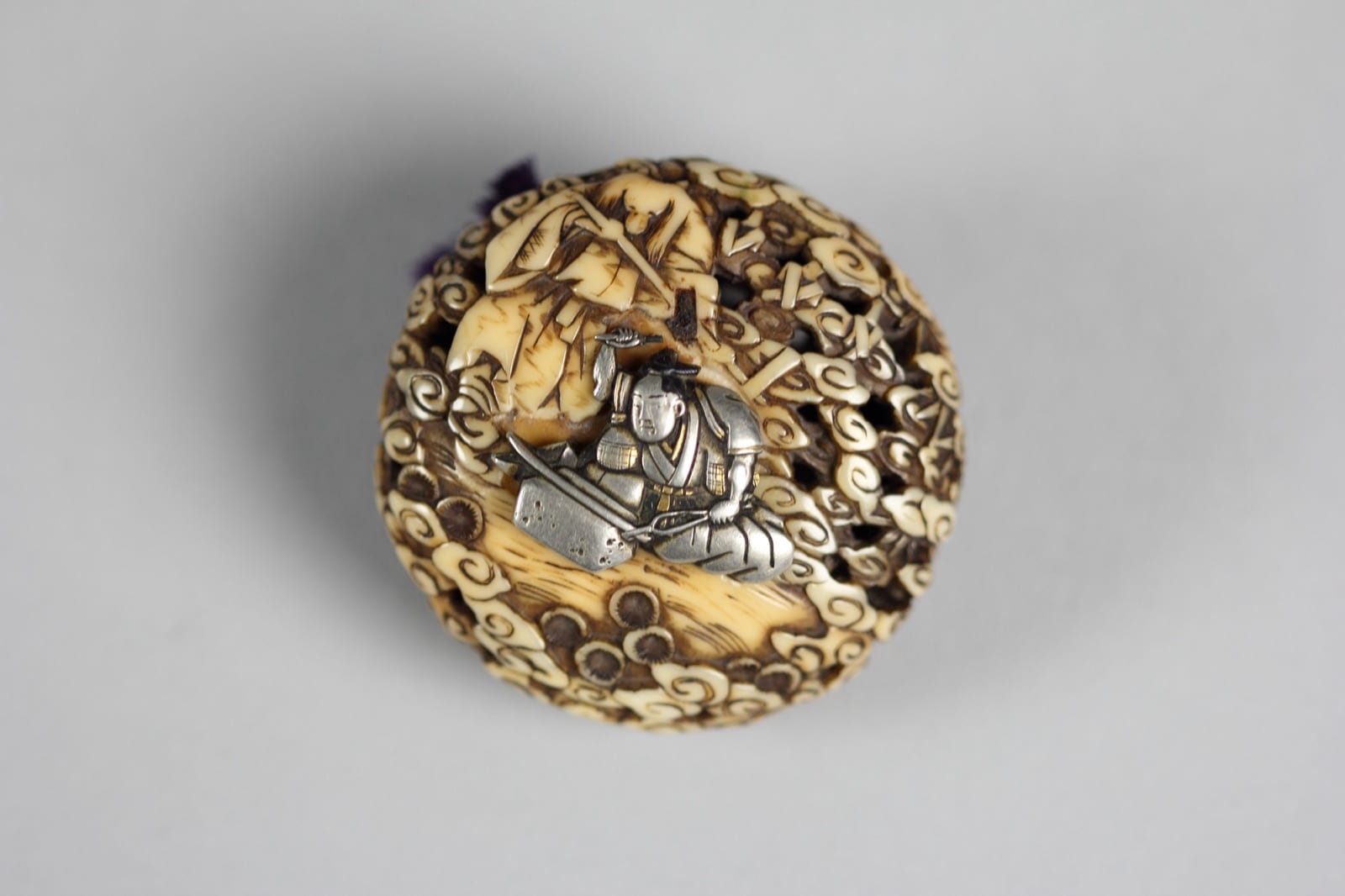
Netsuke of the 19th century: Munechika forges the blade Kogitsune, “the little fox”. The Metropolitan Museum of Art, CC0 · CC0 1.0 · source
