On this page
The founder
According to the Japanese Wikipedia, the first Tadayoshi was born in 1572 (Genki 3) in Nagase, in Takagise, today in Saga, into a samurai family of the Shōni branch in the service of the Ryūzōji. His grandfather Morihiro and his father Michihiro died at the battle of Okitanawate, in 1584 (Tenshō 12); at thirteen he could not enter service, the family lost its stipend and he became a swordsmith.
In 1596 (Keichō 1), by order of the Nabeshima, he went to Kyoto to learn with Umetada Myōju (埋忠明寿). The Japanese Wikipedia does not fix his return: 1598 in the article on the founder, 1599 in the one on the lineage. Back in Saga, in the district that is now Nagase-machi, Nabeshima Katsushige gave the Hashimoto, for their warrior past, the rank of 手明鑓 (teakiyari) and a hereditary stipend of 25 koku.
From Tadayoshi to Tadahiro
The Japanese Wikipedia distinguishes four periods in the founder’s signature: the five-character one, 五字忠銘 (goji chū-mei), 肥前国忠吉 (Hizen no kuni Tadayoshi); the 秀岸銘 (Shūgan-mei), which imitates a monk’s handwriting; the 住人銘 (jūnin-mei), 肥前国住人忠吉作 (Hizen no kuni jūnin Tadayoshi saku), and from 1624 the Tadahiro one.
In 1624 he received the title of Musashi Daijō (武蔵大掾, Musashi Daijō) and began to sign Tadahiro (忠広, Tadahiro), according to Bunka Isan Online: he is Musashi Daijō Tadahiro. The Japanese Wikipedia dates it to Genna 10, the same year, and adds that he changed his lineage from Minamoto to Fujiwara. On the blades for the Nabeshima he could omit the title: this is the 献上銘 (kenjō-mei). In 1629 he engraved on the tang of a katana, now in the Tokyo National Museum, an inscription that names Umetada Myōju and gives his age, 72.
He died in 1632 (Kan'ei 9) and is buried at the Shinkakuji temple in Saga; the second to ninth generations, at the Chōanji.
The generations
The Japanese Wikipedia gives these dates and titles, and cites the website of Saga prefecture.
| Swordsmith | Title | Dates |
|---|---|---|
| 1st: Tadayoshi and, from 1624, Tadahiro | Musashi Daijō, 1624 | 1572-1632 |
| 2nd: Tadahiro, youngest son of the founder according to the same source; never signed Tadayoshi | Ōmi Daijō, 1641 | 1614-1693 |
| 3rd: Tadayoshi, with scarce work | Mutsu Daijō, 1660; Mutsu no Kami, 1661 | 1637-1686 |
| 4th | Ōmi Daijō, 1700 | 1668-1747 or 1775 |
| 5th | Ōmi no Kami, 1750 | 1696-1775 |
| 6th | Ōmi no Kami, 1790 | 1736-1815 |
| 7th: Tadahiro; did not use Tadayoshi | 1771-1816 | |
| 8th: in charge of the Saga cannons from 1850 | 1801-1859 | |
| 9th: with scarce work | 1832-1880 |
The death of the fourth generation is unclear: the source writes “1747 (安永4年, An'ei yonen)”, and An'ei 4 is 1775.
The Nabeshima swordsmiths
According to the Japanese Wikipedia, the lineage served as 御刀鍛冶 (o-katanakaji), official swordsmiths of the Nabeshima, throughout the Edo period, and more than a hundred swordsmiths came out of its school until the end of the era. The term Hizen-tō (肥前刀, Hizen-tō) is modern: the 『西肥遺芳』 (Saihi ihō), of 1917, defines it as the swords forged by the lineage in the castle town of Saga.
The Japanese Sword Index counts three collateral branches, all in Saga and in the service of the Nabeshima and their relatives: those of Masahiro, Yukihiro and Tadakuni. Munenaga, who had studied with Umetada Myōju, engraved the horimono of many of Tadayoshi’s blades.
The house preserves a memoir of the founder, in a copy, and his preparatory drawings for engravings, 彫物下絵 (horimono shitae); the original of the memoir, from a private collection, is deposited at the Saga Prefectural Library. Both were shown at the NBTHK’s 2020 exhibition on the Umetada.
Until the end
In 1850 (Kaei 3) the eighth generation took charge of the cannon manufacture of the Saga domain and contributed to its modernisation. The ninth stopped forging after the 1876 ban on carrying swords, and his work is scarce.
What tradition says
The Japanese Wikipedia records two stories without a document. According to the first, the Tadahiro that Sakamoto Ryōma carried when he left his han passed to Okada Izō, who used it to kill Honma Seiichirō and broke its point; according to an oral recollection, it was exhibited at the Yūshūkan of the Yasukuni shrine, and today its whereabouts are unknown. According to the second, Tamiya Shigemasa, founder of the Tamiya-ryū (田宮流, Tamiya-ryū) of iaidō, commissioned a sword from the first Tadayoshi in 1619 (Genna 5).
Images
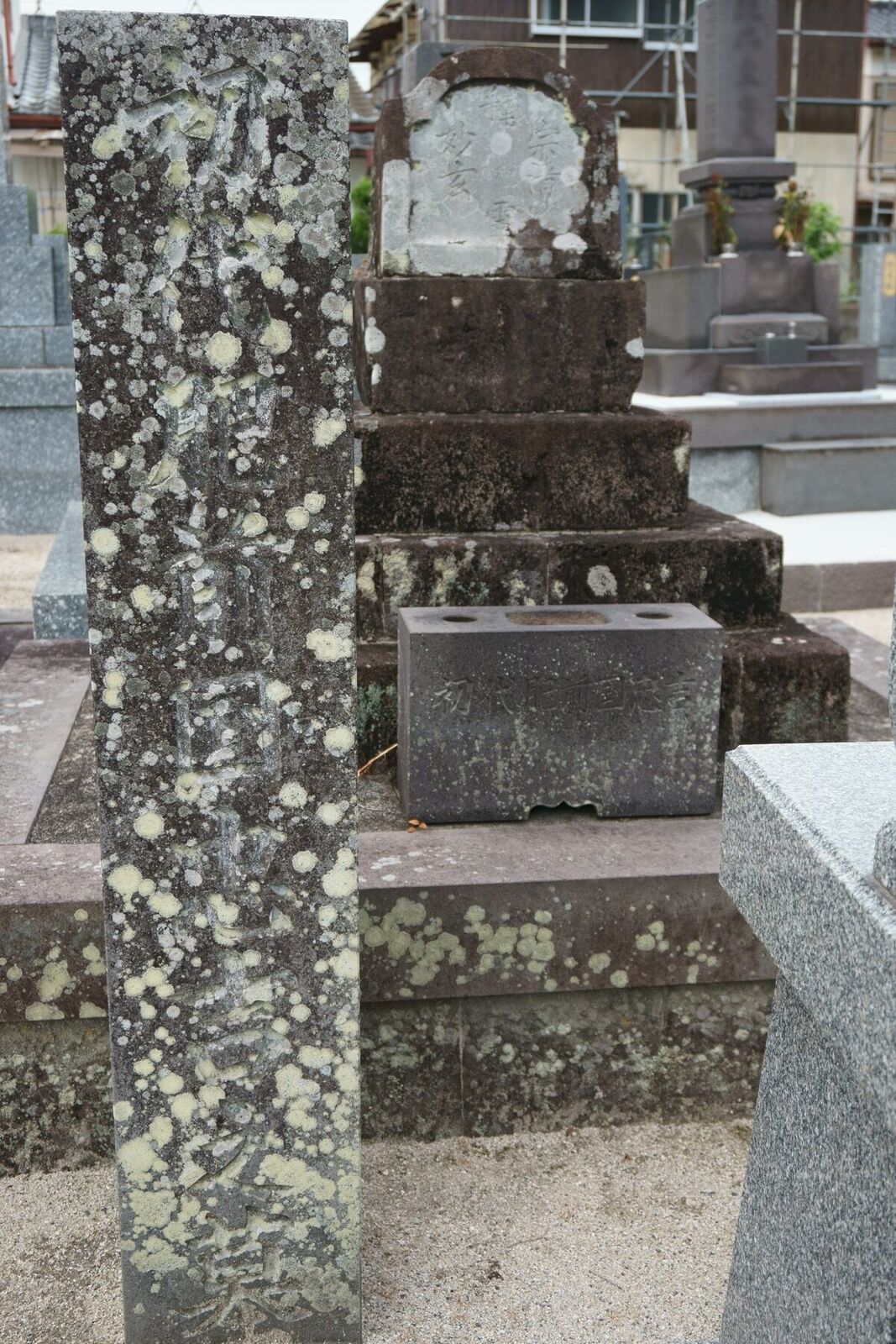
The grave of the first Hizen Tadayoshi, at the Shinkakuji temple in Saga. Pekachu, CC BY-SA 4.0, via Wikimedia Commons · CC BY-SA 4.0 · source 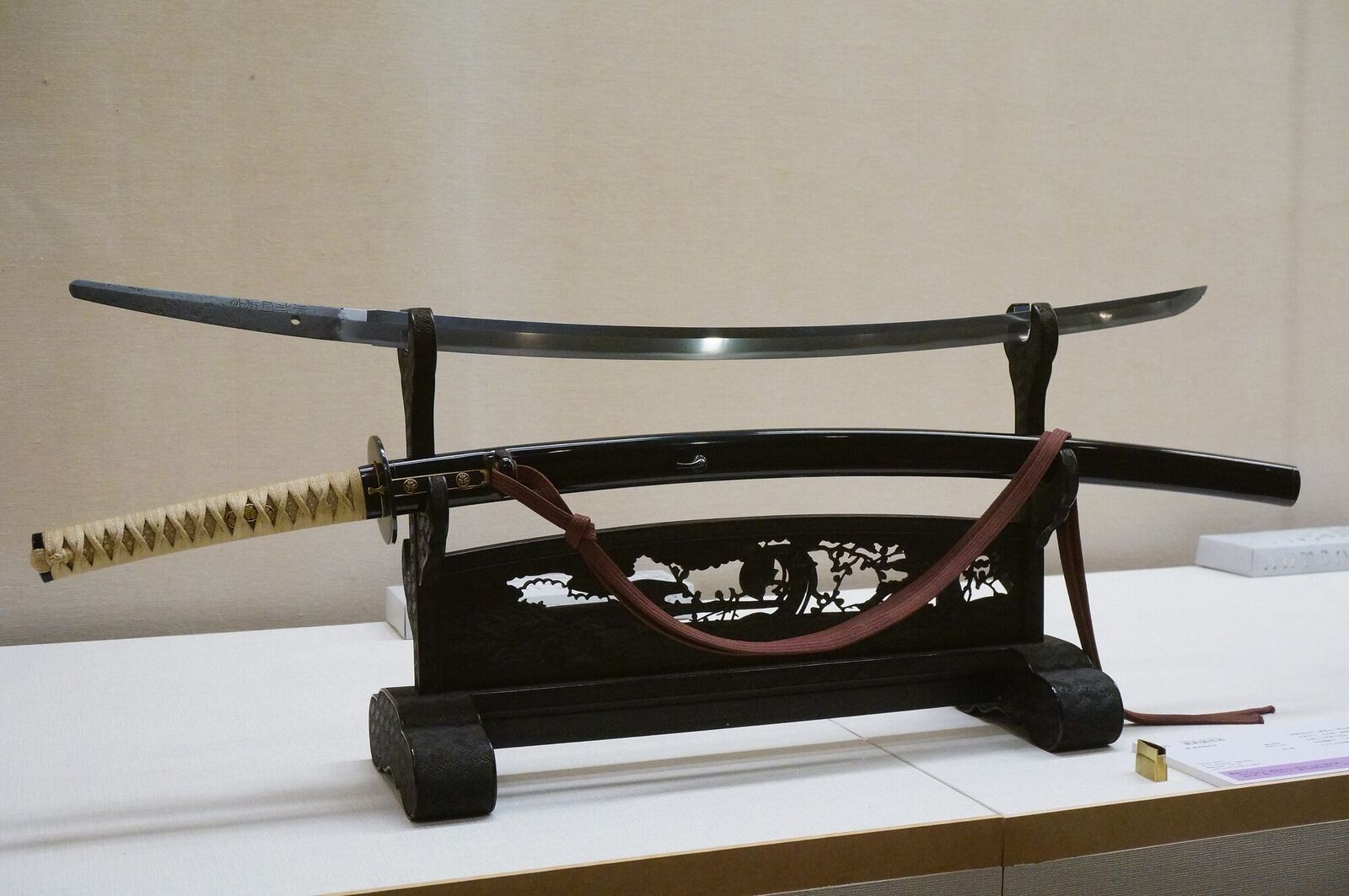
Katana by the first Hizen Tadayoshi and its mounting from the late Edo period, at an exhibition. SLIMHANNYA, CC BY-SA 4.0, via Wikimedia Commons · CC BY-SA 4.0 · source

