On this page
What the documents say
- His name appears for the first time in the 銘尽 (Meizukushi), the oldest sword-appraisal treatise, which the Japanese Wikipedia dates to 1316: it places him in the genealogy of the Sagami swordsmiths as a pupil of Shintōgo Kunimitsu. The surviving copy, the Kanchi-in-bon of 1423, is an Important Cultural Property, is in the National Diet Library and calls him “Gorō Nyūdō”.
- The Shakuso ōrai, of the middle of the Muromachi, already praises him as a master.
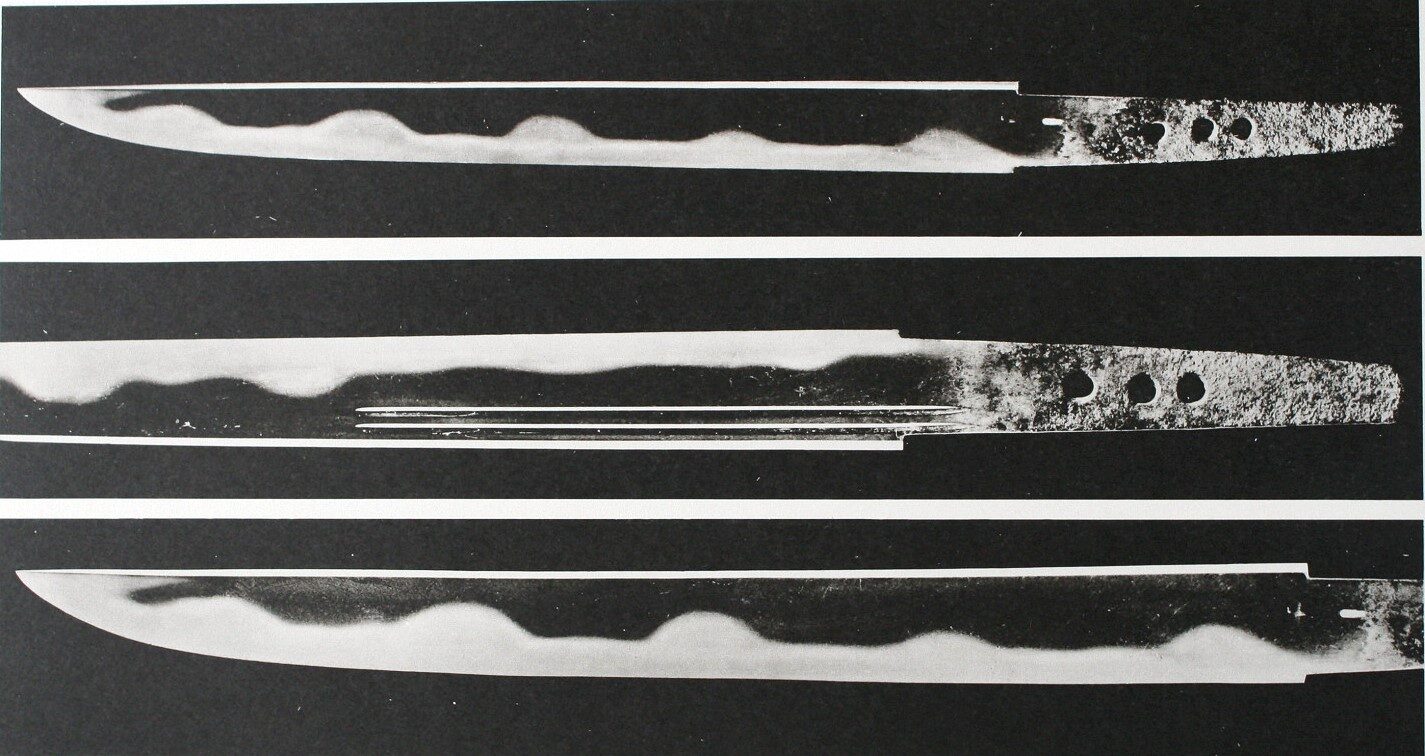
- Two tantō bore a date in a long signature (長銘, nagamei): the Ōsaka chōmei Masamune, of 1328 (Karyaku 3), reforged by Echizen Yasutsugu after the fire of Osaka and today at the Tokugawa Art Museum, and the Edo chōmei Masamune, of 1314 (Shōwa 3), lost and known only from the Kyōhō meibutsuchō. No healthy blade with a date survives.
His dates
- The register of the dead (過去帳, kakochō) of a “Gorō Nyūdō Masamune” gives his death on the eleventh day of the first month of 1288 (Shōō 1), at the age of 80, with the Buddhist name Shinryū Nichiken.
- The Kotō Meizukushi Taizen gives 1264–1343; the Japanese Wikipedia says that those dates are not held to be historical. Britannica gives them with question marks, and the English Wikipedia gives “around 1264–1343”, with most of his work between 1288 and 1328.
- The “complete” biography (he parts from his father Yukimitsu at 17, in 1280; dies in 1343 at 81; travels through the provinces) comes from a text of the end of the Edo, and the Nipponica encyclopaedia holds it to be unreliable and composed in that period.
- That he worked between the end of the Kamakura and the beginning of the Nanbokuchō is disputed by no one.
Master and family
- His master is Shintōgo Kunimitsu (新藤五国光, Shintōgo Kunimitsu), who is held to be the true founder of the Sagami school.
- His relationship with Yukimitsu (行光, Yukimitsu) is disputed: the Takeya Rian-bon manuscript, of 1579, makes him Yukimitsu’s son; another version, his younger brother and later his adopted son; another, the son of Kunimitsu. The encyclopaedias record as tradition that he was a pupil of Kunimitsu and, later, the adopted son of Yukimitsu.
- Sadamune, Hikoshirō Sadamune (彦四郎貞宗, Hikoshirō Sadamune), is taken to be his son or his adopted son and is the greatest of the Sōshū-den after him, although no signed blades of his are known. Hiromitsu and Akihiro, of the second stage of the Sōshū, are pupils of his or of his line.
- According to the English Wikipedia, some experts believe that the surname Okazaki is an invention to lend lustre to the Tokugawa, whose house came from Okazaki.
The “ten pupils”
The “ten pupils of Masamune” (正宗十哲, Masamune jittetsu) are an Edo-period list, made in imitation of the ten pupils of Confucius: the Japanese Wikipedia and Nipponica agree that their periods do not match and that there was no relationship of master and pupil. It changes according to the treatise: Gō Yoshihiro, Kinjū, Hasebe Kunishige, Kanemitsu, Chōgi, Norishige, Sa, Kaneuji, Moritaka, Rai Kunimitsu… What is real is the influence of his style throughout the country.
The thesis that he did not exist
In 1896, Imamura Chōga, appraiser to the Imperial Household, argued in the Yomiuri newspaper that Masamune had not existed, or that he was an ordinary craftsman invented by Hideyoshi and the Hon'ami. This is the “Masamune massatsu-ron” (正宗抹殺論, Masamune massatsu-ron). Nipponica gives it as refuted: the name is already in the Meizukushi and in the Shakuso ōrai, and there are reliable signatures. The Yamakawa encyclopaedia says that it is “in decline”.
Legends
- Masamune and Muramasa never met: all the versions of the duel of the blades in the stream are impossible. The two are symbols of their periods.
- The story of his one-armed son, Dankurō, comes from the puppet play Shin Usuyuki monogatari, first staged in 1741. In Kamakura they show the site of his house (Masamune yashiki), the Masamune no i well, in Sasuke-ga-yatsu, and a stone pagoda said to be his at the Hongaku-ji temple.