What the texts say
His name appears for the first time in the oldest meizukushi, the copy of the 観智院 (Kanchi-in), made in 1423 from a text that records things from around 1316. It names him together with Masamune and says that he resembles him, but it does not call him his son.
The filiation appears in later copies: the 能阿弥本 (Nōami-bon), of 1483, the Utsunomiya meikan, of 1501, and the Takeya Rian-bon, of 1579, between a hundred and fifty and two hundred years after his life. The Nōami-bon also says that he lived in Takagi, in Ōmi, and that he was called 高木彦四郎 (Takagi Hikoshirō).
For all these reasons tradition makes him the son or adopted son of Masamune and his successor at the head of the Sōshū tradition, and holds him to be a real swordsmith even though no blade with his signature survives.
The dates
His dates are not documented, and the encyclopaedias do not agree. The Japanese Wikipedia gives them as unknown and mentions 1319 and, according to another theory, 1349 as the possible year of his death; the English one says that he was born in 1298 and died in 1349. Neither of the two cites the document it takes this from.
How works are attributed to him
Since no blade bears his signature, his works are attributed to him by comparing them with those of 正宗 (Masamune), his master in the tradition, with those of 新藤五国光 (Shintōgo Kunimitsu), whom tradition makes Masamune’s master, with those of 秋広 (Akihiro), who is taken to be his son, and above all with those of 信国 (Nobukuni), the first of that name, whom tradition makes his pupil, although the old treatises do not record it.
The carvings on his blades (the sūken, the bonji and the rendai) connect, according to the Japanese Wikipedia, with those of Shintōgo Kunimitsu and later pass to Nobukuni. The English one also gives him as a pupil Kanrō Toshinaga, of Echigo.
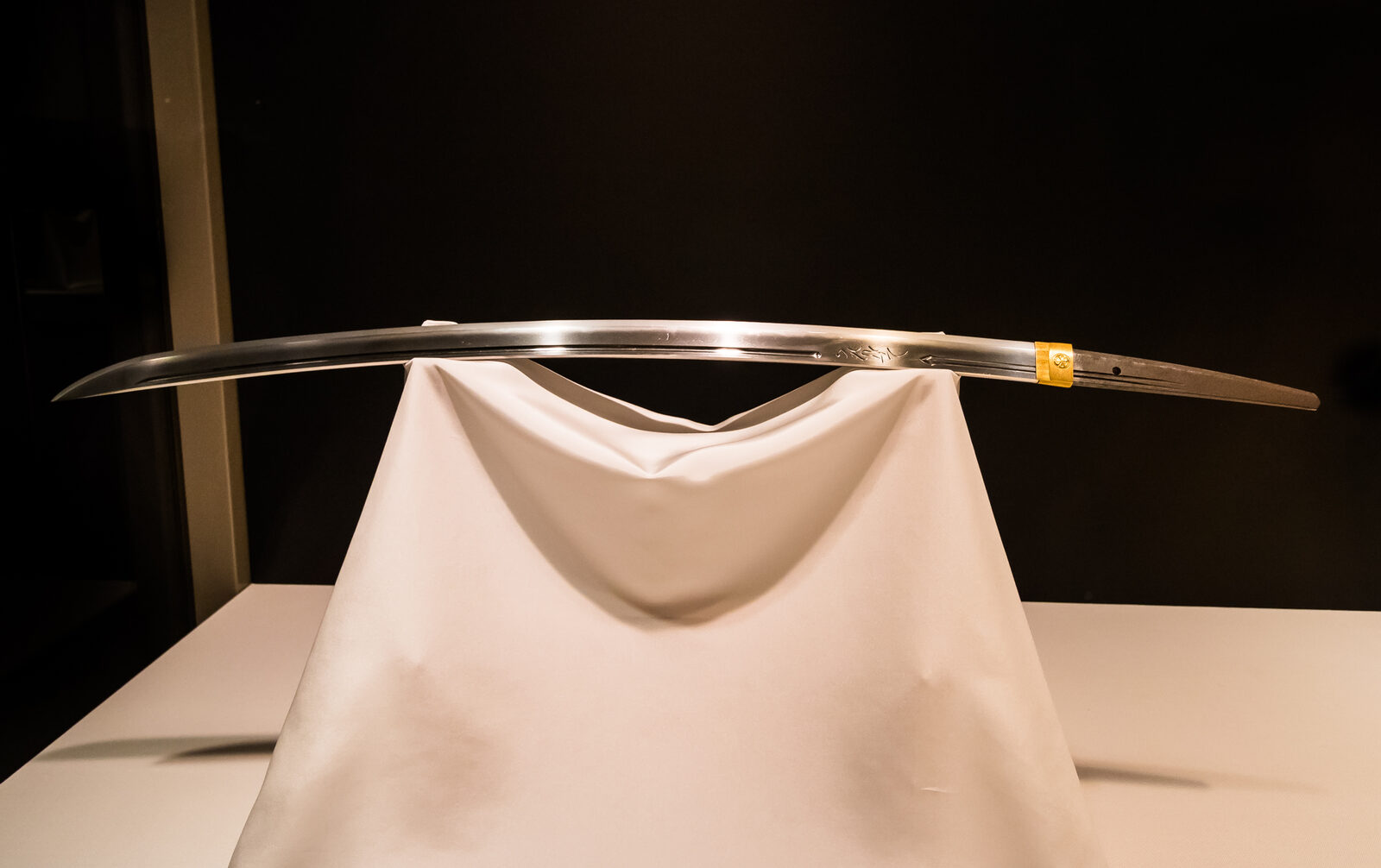
Many of his blades bear his name in red lacquer, the shu-mei (朱銘) “貞宗 本阿 (Sadamune Hon'a)” with the kaō (花押) of the Hon'ami family: it is their attribution of an unsigned blade, not the swordsmith’s signature, as on the Fushimi Sadamune.