Antique katana with NBTHK certification, selected in Japan and valued by collectors worldwide
Kantei is a catalogue of authentic Japanese swords for sale in Japan: every antique katana comes with its NBTHK paper, its mounting and a quality score explained line by line.
- 152 published katana
- 31 provinces
- by period: Kotō 25, Shintō 96, Shinshintō 30, Gendaitō 1
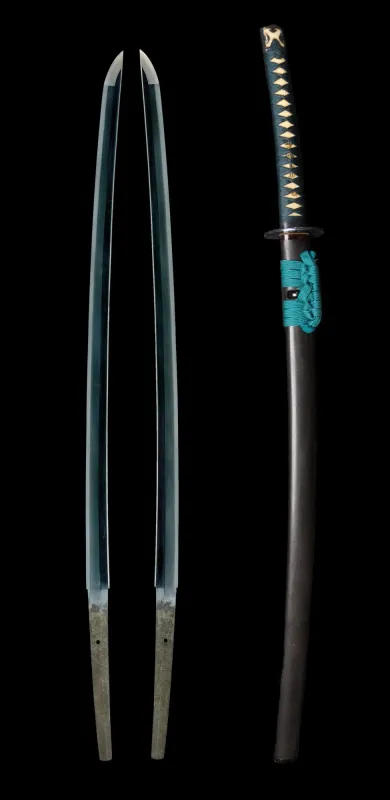
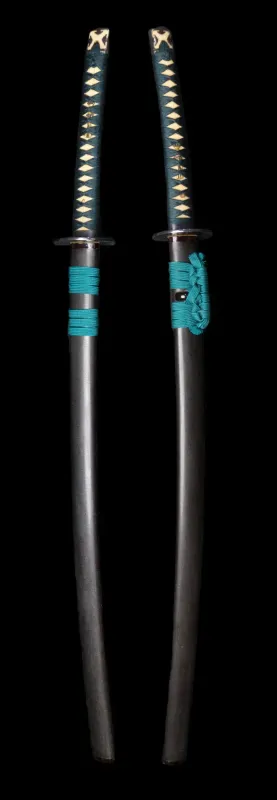
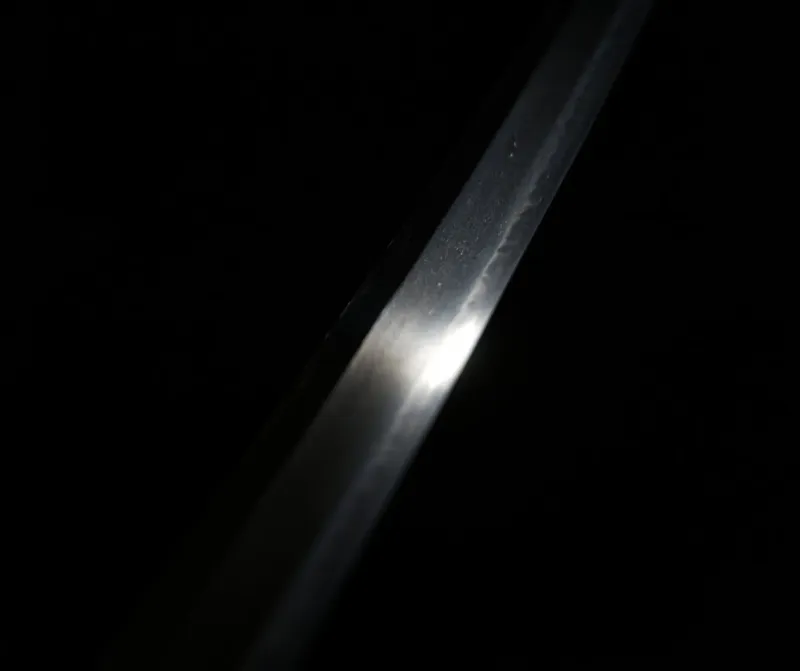
What Kantei is
Kantei is a selected catalogue of signed antique katana: nihontō more than a hundred years old, with NBTHK papers from Tokubetsu Hozon upwards and a complete koshirae. None of them is here because it looks good in a photograph: every blade passes the same gates and carries a quality score explained point by point, from the steel to the paper, so that it can be argued with instead of believed.
Read more
What you will find here
Every record describes the same authentic Japanese sword in six languages, with its measurements, its condition, its mounting and the outline of the blade drawn to real scale. Beside it there is a guide to periods, schools, papers and the parts of the koshirae, and the final price in euros: shipping from Japan and import taxes are already inside it.
How buying works
Buying a katana in Japan from the European Union follows a known path: the enquiry starts from the record itself, availability is confirmed at origin, the blade is bought in your name and the export licence is applied for, which takes about a month and a half. It then travels insured to your door. And it is not limited to this catalogue: we do not sell swords but act as a buyer’s agent, an intermediary, so we can also buy for you a sword that is for sale in Japan but not listed here, at a fixed price with everything included. The five steps, the breakdown of the price and the usual questions are in “How to buy”; the vocabulary is in the guide.
Catalogue
Every blade in this catalogue passes five gates: katana over a hundred years old, a complete mounting, a nagasa of 60 cm or more, NBTHK papers from Tokubetsu Hozon upwards and signed. The scores are computed the same way for all of them.
No piece matches the filters.
-
Aizu-jū Munekiyo
Shinshintō blade signed and dated to the eighth month of Bunka 12 (1815), with an untouched tang, Tokubetsu Hozon papers from 2025 and a period koshirae with a signed tsuba and maki-e crests. Munekiyo worked in Aizu as a retained smith (okakae-kaji) of the domain and trained under Koyama Munetsugu, one of the major names of the late Edo period; like his master, his blades had a reputation for cutting well. The tang is untouched and bears the signature 会津住宗清造之 (Aizu-jū Munekiyo kore o tsukuru) together with the date of the eighth month of Bunka 12 (1815). The blade measures 67.8 cm nagasa with 1.2 cm sori, 3.11 cm motohaba and 2.25 cm sakihaba, with a kasane of 0.64 cm at the motomachi and a shinogi-gasane of 0.67 cm. It comes with NBTHK Tokubetsu Hozon papers issued on 28 May 2025. The mounting is an uchigatana koshirae with a chirashi-nuri lacquer saya decorated in gold maki-e with two crests within circles, the tachibana and the character “i”; the fuchi-kashira is iron with camellias in silver and gold, and the tsuba is signed “Nara Toshimitsu, at the age of 75”, of the Nara school. The photographs show the mounting taken apart piece by piece: tsuba, fuchi-kashira, four seppa and habaki. A shirasaya is also included.
84.3/100
€8,960
-
Doi Shinryō, 3rd generation
Katana signed and dated Meiwa 5 (1768) by Doi Shinryō, of the Hirado line that carried on Inoue Shinkai's style, with an ubu nakago, Tokubetsu Hozon paper and a Bakumatsu mounting. Katana by Doi Shinryō, a Hirado (Hizen) lineage founded by Doi Masashige, who studied under Inoue Shinkai in Osaka and received the character "Shin" from him. For generations the school kept to Shinkai's manner, with a bright suguha-notare. According to the original seller, the Meiwa 5 date places the work in the third or fourth generation, and he leans towards the late years of the third. Shinogi-zukuri blade with a low iori-mune and chū-kissaki; nagasa 69.2 cm, sori 1.5 cm. The seller describes a well-forged itame mixed with mokume, thick ji-nie and chikei, and a ko-nie suguha-notare hamon with ashi, yō, kinsuji and sunagashi; old polish. The photographs show an ubu nakago with kurijiri, ō-sujikai yasurime and a single mekugi-ana, signed "Doi Shinryō" on the omote and dated on the ura. Uchigatana mounting dated by the seller to the Bakumatsu: black roiro kizami saya, oyazame tsuka with black ito, iron mokkō tsuba with a dragon in sukidashi-bori and gold zōgan, signed shakudō fuchi-kashira and dragon menuki. NBTHK Tokubetsu Hozon paper dated 1 December, Reiwa 7 (2025).
82/100
€15,700
-
Mutsu Aizu-jū Fujiwara Michitatsu
Shinshintō blade from the Aizu domain, signed and dated in the autumn of Bunsei 8 (1825), with a koshirae stated to be of the period. NBTHK Tokubetsu Hozon. Katana by the fourth generation of Mutsu Aizu-jū Fujiwara Michitatsu, a smith in the service of the Aizu domain. The line begins with a pupil of Miyoshi Michinaga and runs to six generations, reaching the end of the Edo period. This fourth Michitatsu learned Sōshū-den from Kaku Motooki, who had in turn learned it from Oku Motohira in Satsuma. The blade is signed and dated to the autumn of Bunsei 8 (1825); it measures 69.9 cm nagasa with 1 cm sori and 0.8 cm of thickness at the base. The temper is a gunome with pointed peaks and abundant sunagashi. It is sold with a koshirae that the original seller states to be of the period (時代拵付き, jidai-koshirae tsuki), adding that it appears to have been made to fit this blade at the time. NBTHK Tokubetsu Hozon papers are included.
81.3/100
€10,380
-
Ōmi Daijō Fujiwara Tadahiro
Katana by Ōmi Daijō Tadahiro, early Edo master of Hizen, with a signed ubu nakago, shirasaya and a black sendan-maki lacquer koshirae; blade and mounting both hold NBTHK Tokubetsu Hozon papers. A blade by Ōmi Daijō Tadahiro, second generation of the Hizen Tadayoshi line: son of the first Tadayoshi, he took over the forge at nineteen, worked as smith to the Saga domain and received the title Ōmi Daijō in 1641; he is ranked among the ō-wazamono. According to the original seller, the blade dates from the early Edo period, around 1648, and is described as sound. Shinogi-zukuri with iori-mune, 71.8 cm nagasa and 1.6 cm sori, a wide mihaba and a slightly extended chū-kissaki. Fine ko-itame with ji-nie and chikei, and a bright suguha in nie and nioi, with a straight bōshi turning back in ko-maru. The nakago is ubu, with katte-agari yasurime, one mekugi-ana and the full signature 肥前國住近江大掾藤原忠廣 (Hizen no Kuni-jū Ōmi Daijō Fujiwara Tadahiro). Two-piece gold-foil habaki. It comes with a shirasaya and an uchigatana koshirae whose saya is lacquered black in sendan-maki style, with autumn-grass fittings: fuchi-kashira with gold and silver chrysanthemums, a signed fuchi, floral menuki and a round openwork tsuba. NBTHK Tokubetsu Hozon Tōken paper (no. 122876, 1992) for the blade and Tokubetsu Hozon Tōsōgu (no. 221589, 1992) for the mounting.
80.1/100
€28,970
-
Sekizenjō Chikanori
Katana by Sekizenjō Chikanori, Mito domain smith and pupil of Naotane, signed and dated 1869, ubu, with an aogai-lacquered koshirae made for the blade according to the seller and NBTHK Tokubetsu Hozon paper. Katana by Sekizenjō Chikanori (関善定家近則), a Mito smith of the late shinshintō period. According to the seller of origin, born in 1815, he trained under Taikei Naotane, served the Mito domain as smith and inherited the Seki Zenjō line by adoption. The blade, shinogi-zukuri with iori-mune and a nagasa of 71.3 cm, is signed and dated the 8th month of Meiji 2 (1869), made to order for the Ebata family. The seller describes a tight ko-itame with ji-nie, a gunome-midare in ko-nie with ashi, and a midare bōshi with ko-maru turnback; it carries two futasuji-hi on the omote and a bō-hi with soe-hi on the ura. The nakago is ubu, with keshō sujikai yasurime, kurijiri and a single mekugi-ana, as the photographs confirm. Included are a gold-foiled copper habaki, a shirasaya and an uchigatana-koshirae with aogai mijin-nuri lacquered saya (98.7 cm) which, the seller states, was made for this blade: an iron tsuba with inlaid dragon, clouds and waves, tiger menuki in gold iroe, ‘horse from a gourd’ fuchi-kashira, white same with hemp ito and an iron kojiri. The tsuba holds a Tokubetsu Kichō Kodōgu certificate of 1970, from the now retired system. NBTHK Tokubetsu Hozon Tōken paper of 2012; published in several catalogues of Mito swords.
76.4/100
€16,020
-
Takagi Minamoto Masayuki
Shinshintō katana signed and dated to the second month of Meiji 3 (1870), with an unaltered tang, a hitatsura hamon and a late-Edo mounting with matching shibuichi fittings. Takagi Kōkichi (b. 1805) married into the household of the stirrup smith Takagi Yasuharu at Kataniwa, in Ibaraki, and rose to swordsmith of the Kasama domain under Makino Sadaaki. He trained with Tegarayama Masashige and signed Minamoto Masayuki, the same name Kiyomaro used before changing his own. The blade measures 68.2 cm nagasa with 0.9 cm sori: a broad, solid shape with an extended kissaki, carved bōhi and soe-bi, a tight ko-itame hada and a gunome-midare hamon whose tobiyaki spreads into full hitatsura in the manner of Sōshū Hiromitsu. The photographs show an ubu tang with a single mekugi-ana, a long signature on the front and the date — second month of Meiji 3 (1870) — cut into the tang itself. It comes with a late-Edo isshin koshirae: black ito over pale same, gold menuki bearing a family crest, an engraved-rim tsuba and a kashira in relief with gold inlay, on a black saya with blue-and-gold sageo. NBTHK Tokubetsu Hozon certificate issued on 20 August 2018.
76.1/100
€7,820
-
Hōki no Kami Jūdai-mago Fujiwara Nobutaka
Shinshintō blade from Owari, signed and dated in the second month of Meiji 2 (1869), with a broad ō-kissaki, an ubu tang and a black ishime-lacquered koshirae. NBTHK Tokubetsu Hozon. Katana of the Owari tradition (present-day Aichi), signed “Hōki no Kami jūdai-mago Fujiwara Nobutaka”, that is, tenth-generation descendant of Hōki no Kami Nobutaka. The tang also carries the date of the second month of Meiji 2 (1869), so the blade is both signed and dated by its maker. It measures 70.5 cm of nagasa with 1.2 cm of sori and ends in a broad ō-kissaki; the motohaba is 3.22 cm and the blade loses little width towards the point, which makes for a substantial piece in hand. The original seller describes the tang as ubu with a single mekugi-ana, and the blade as polished a few years ago, free of hagire and pitting. It comes mounted in an uchigatana koshirae with a black ishime-lacquered saya that the original seller regards as contemporary with the blade; the same and the tsuka-ito of the hilt were redone last year in the same tone. NBTHK Tokubetsu Hozon papers are included. No shirasaya is offered.
75.4/100
€12,310
-
Izumo no Kami Fujiwara Yoshitake Hōtetsu Nyūdō
Signed and dated an auspicious day of the eighth month of Tenna 2 (1682), with an ubu tang, bōhi on both faces and NBTHK Tokubetsu Hozon papers; koshirae and shirasaya. Izumo no Kami Fujiwara Yoshitake was the son of Horikawa Kunitake and trained in the Horikawa school. The signature “Hōtetsu Nyūdō” belongs to his old age, so it identifies the first of the line without ambiguity. The blade is signed and dated an auspicious day of the eighth month of Tenna 2 (1682). It measures 68.5 cm of nagasa with 2.27 cm of sori, a generous curve, and carries bōhi on both faces, finished with a rounded end above the habaki. The tang remains ubu, with yasurime cut as ornament, and shows two mekugi-ana. The original seller notes in the workmanship of the blade the mark of contact with the Hōjōji school in Edo. The blade holds NBTHK Tokubetsu Hozon papers and comes with koshirae and shirasaya, although the fittings are neither described nor dated.
74.2/100
€12,310
-
Fuji Samanosuke Minamoto Yoshimune
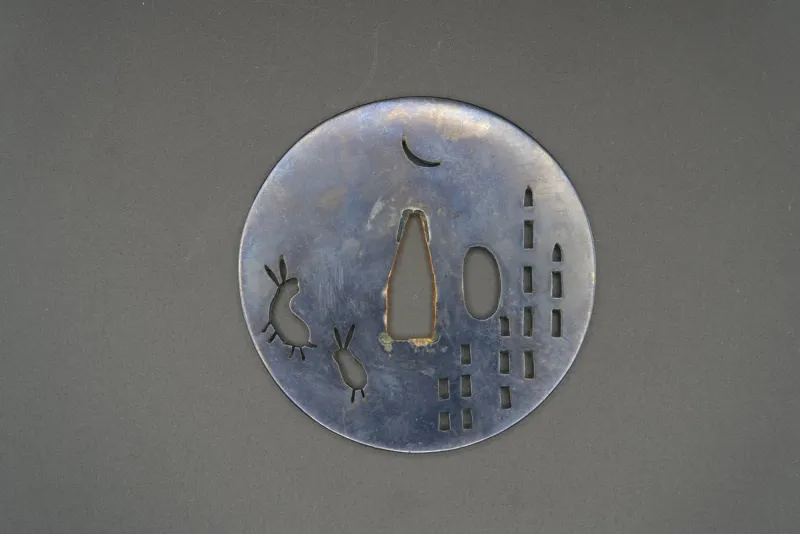
Shinshintō katana by Fuji Samanosuke Minamoto Yoshimune, dated Bunkyū 3 (1863), of very robust proportions, with a signed ubu nakago, full koshirae, shirasaya and Tokubetsu Hozon paper. Katana by Fuji Samanosuke Minamoto Yoshimune, dated the 12th month of Bunkyū 3 (1863), in the final years of the Tokugawa shogunate. The original seller presents it as a kinnōtō, the sturdy, practical blade associated with the Bakumatsu: nagasa of 77 cm, sori of 0.9 cm, motohaba of 3.35 cm, sakihaba of 2.4 cm and a kasane of 1.0 cm, well above the norm. The blade is in shinogi-zukuri with an iori-mune; according to the original seller, the jihada is a tightly knit ko-itame and the hamon a chū-suguha in nie-deki with abundant ashi. The nakago is ubu with a single mekugi-ana, and the photographs show the signature 富士左馬亮源義宗 (Fuji Samanosuke Minamoto Yoshimune) and the date 文久三年十二月日 (Bunkyū sannen jūnigatsu hi). It comes with a complete koshirae: a long tsuka with same and dark green ito, an iron openwork tsuba with hares and a crescent moon, and a black lacquered saya with a granular finish. Also included are a shirasaya, a two-piece copper habaki with gold foil and cloth bags. The NBTHK Tokubetsu Hozon paper, no. 1009880, dated December of Heisei 30 (2018), is photographed.
74.1/100
€10,380
-
Fujieda Tarō Teruyoshi
Shinshintō katana signed by Fujieda Tarō Teruyoshi and dated to the 2nd month of Keiō 2 (1866), with the mitsudomoe crest engraved on the tang, NBTHK Tokubetsu Hozon paper and a koshirae holding Tokubetsu Hozon Tōsōgu. Fujieda Tarō Teruyoshi (1823–1876), born in Kōzuke province and son of the smith Gyokurinshi Terukazu, trained under Hosokawa Masayoshi and belonged to the lineage of Tegarayama Masashige. Appointed smith to the Kawagoe domain in 1853, he was granted the surname Fujieda and, in 1861, permission to engrave his lord's mitsudomoe crest on his tangs. This katana, with a nagasa of 69.7 cm and a sori of 1.21 cm, bears that crest above the mekugi-ana, the signature Fujieda Tarō Teruyoshi tsukuru on the omote and the date Keiō 2, 2nd month (1866) on the ura. The photographs show an untouched tang with a single hole, an undulating hamon and a well-preserved bōshi; the original seller notes a couple of small kitae-kizu. The uchigatana koshirae, with a black lacquered saya in wrinkled-leather texture, unsigned auspicious-cloud fittings, a chōji-karakusa tsuba and dragon menuki, holds an NBTHK Tokubetsu Hozon Tōsōgu certificate from 2014. The blade carries an NBTHK Tokubetsu Hozon Tōken paper from 2007 and also comes with a shirasaya.
73.1/100
€28,590
-
Suishinshi Masahide
Jūyō Tōken katana by Suishinshi Masahide, signed with kaō and dated 8th month of Bunka 5 (1808), with a Sukehiro-style tōran hamon, a koshirae with shell togidashi saya and a shirasaya. Katana by Suishinshi Masahide (Kawabe Gihachirō), smith to the Akimoto clan and founding figure of the shinshintō movement, active in Musashi. The blade is shinogi-zukuri with iori-mune and chū-kissaki, with a nagasa of 69.6 cm and a sori of 1.8 cm. According to the certificate, the jihada is a tightly knit ko-itame with thick ji-nie and chikei; the hamon starts in suguha yakidashi and continues in ō-gunome mixed with notare in tōran style, with broad ashi, abundant nie, kinsuji and sunagashi and a bright nioiguchi, in the manner of the Sukehiro copies the smith pursued in his early period; the bōshi is a gentle notare with ko-maru and long kaeri. The nakago is ubu with kurijiri, ō-sujikai yasurime with keshō and a single mekugi-ana; it bears the five-character signature with kaō on the omote and the date on the ura. Designated Jūyō Tōken by the NBTHK at the 61st session (2015). It comes with a koshirae the original seller describes as a period mounting of careful workmanship: a togidashi saya with crushed shell under black lacquer and iron fittings inlaid in gold and coloured metals with gourds and rain dragons. The photographs also show the wrapped tsuka, the iron tsuba and a shirasaya.
73.1/100
€76,920
-
Tenryūshi Tachibana Hisakazu
Long 76.9 cm blade signed and dated to the summer of Keiō 1 (1865), with an untouched two-hole tang, a recent high-grade polish and a koshirae in black ishime lacquer. Tenryūshi Tachibana Hisakazu was a pupil of Ozaki Suketaka. Born in Katakai in Echigo, he also lived in Musashi and in Yamada of Ise, and forged between the Keiō and Meiji eras, working as well in Hikone and Sakai. The untouched tang carries the signature 天龍子橘久一作 (Tenryūshi Tachibana Hisakazu saku) and the date of the summer of Keiō 1 (1865); it is long and was made from the outset with two mekugi-ana. The blade measures 76.9 cm nagasa with 1.15 cm sori, motohaba 31.9 mm and motokasane 9.0 mm, with sakihaba of 27.8 mm at the monouchi and 24.8 mm at the yokote; it weighs 1,276 g bare and 1,652 g mounted. It shows a clear difference between moto and saki and an extended point, a ko-itame hada with mokume standing out in places, and a hamon based on suguha with ko-notare and gunome mixed in, ashi reaching inwards and abundant fine activity along the edge; the bōshi is straight with a round turnback. It has just received a museum-grade polish. The mounting is an uchigatana koshirae with a black ishime saya and a suaka habaki, tight, with no play in the hilt and no rattle from the tsuba, and comes with shirasaya and tsunagi.
72.9/100
€12,560
-
Chikuzen Nobukuni Yoshikane
Nobukuni school of Chikuzen, Kanbun era, with an ubu tang of a single mekugi-ana, 2.1 cm of sori, NBTHK Tokubetsu Hozon papers, koshirae and shirasaya. A work of the Nobukuni school of Chikuzen, one of the two principal shintō lines of that province, placed by the original seller in the Kanbun era (1661-1673). The blade measures 70.4 cm of nagasa with a sori of 2.1 cm: a pronounced curve for a piece of its period, giving the outline a clearly visible arc. Sunagashi and kinsuji can be seen along the edge, activities that speak of careful forging. The tang remains ubu, unshortened, with a single mekugi-ana, so the signature survives in full; it bears no date. The blade carries NBTHK Tokubetsu Hozon papers. It comes with koshirae and shirasaya, although the original seller does not describe the fittings of the mounting and makes no statement about the blade's state of preservation.
72.7/100
€9,730
-
Hosokawa Tadamasa
Signed and dated the eighth month of Keiō 4 (1868), with an ubu tang bearing a single mekugi-ana, NBTHK Tokubetsu Hozon papers, and both koshirae and shirasaya. Hosokawa Tadamasa was the eldest son of Hosokawa Tadayoshi and worked as a smith for the Nobeoka domain in Hyūga province; the signature ties his activity to Shimōsa and to Nobeoka. The blade measures 72.1 cm of nagasa with a sori of 1.1 cm, giving a long, barely curved outline, and it is broad and substantial in weight: 920 g bare and 1,300 g when mounted. The tang remains ubu, unshortened, with a single mekugi-ana, so the signature survives in full. It is dated the eighth month of Keiō 4 (1868), the year of the Meiji Restoration, an uncommon detail that fixes the work to a precise moment. The blade carries NBTHK Tokubetsu Hozon papers. It comes with koshirae and shirasaya, although the original seller gives no detail on the fittings of the mounting and makes no statement about the blade's state of preservation.
72/100
€7,820
-
Tsunahiro
The Tsunahiro house of Sagami, heir to the Sōshū line, with NBTHK Tokubetsu Hozon papers and an uchigatana koshirae in black rō-nuri lacquer, with shirasaya and tsunagi. The Tsunahiro house of Sagami carried on the Sōshū line and kept the name through several generations within the Edo period. This blade measures 70.0 cm of nagasa with 1.9 cm of sori, a generous curve, and holds NBTHK Tokubetsu Hozon papers. The signature bears no date and the original seller makes no statement about the tang, which shows a single mekugi-ana. The mounting is an uchigatana koshirae with a saya in black rō-nuri lacquer, described in unusual detail: the kerria-coloured gilding is well preserved, the hilt has no play and the tsuba barely rattles. The ō-seppa carry a rising-sun motif, originally raised in suaka and gilt. The set is completed by a shirasaya and a tsunagi, so the mounting can stay assembled while the blade rests in its wooden case.
72/100
€9,020
-
Iga no Kami Fujiwara Kinmichi II
Katana by the second-generation Iga no Kami Kinmichi (Mishina school, Kyoto), with imperial chrysanthemum and signature on an ubu tang, NBTHK Tokubetsu Hozon paper and an uchigatana koshirae with a tsuba signed Higo-jū Masasato. Katana by the second-generation Iga no Kami Fujiwara Kinmichi, head of the Mishina school in Kyoto, who received his title in Kan'ei 14 (1637) and from then on engraved the imperial chrysanthemum on his tangs; the original seller places the sword in the early Edo period. The blade has a nagasa of 74.5 cm and a sori of 1.8 cm; according to the original seller, the hada is itame with masame in the shinogi-ji and abundant ji-nie, and the hamon opens with a long Kyoto-style yakidashi before running in notare with gunome, togari-ba, hako-ba and yahazu-ba, with a Mishina bōshi. The tang is ubu with a single mekugi-ana, katte-sagari yasurime and a kengyō tip; above the hole it bears the sixteen-petal chrysanthemum and below it the signature Iga no Kami Fujiwara Kinmichi, visible in the photographs. It comes with an uchigatana koshirae: a scabbard lacquered in vermilion tame-nuri with broad stripes (yatara), a tsuka of white same with hishimaki wrap, fuchi-kashira in shakudō nanako with gold kiri-mon, crane menuki and an openwork iron tsuba with paulownia motifs signed Higo-jū Masasato, with an NBTHK Hozon Tōsōgu paper; gilt habaki and shirasaya are also included. The blade holds an NBTHK Tokubetsu Hozon Tōken certificate, legible in the photographs.
71.8/100
€17,630
-
Ozaki Gengoemon Suketaka
Shinshintō katana by Ozaki Suketaka, signed and dated Kansei 6 (1794), with a tōran-style hamon, ubu nakago, complete late-Edo koshirae per the seller and a Tokubetsu Hozon Tōken certificate. Katana by Ozaki Gengoemon Suketaka, a Settsu smith of the shinshintō period. According to the original seller, Suketaka (1753–1805) was a pupil of Kuroda Takanobu, received the title Nagato no Kami in 1798 and ranked among the great tōran-ba specialists of his day. The blade, in shinogi-zukuri with iori-mune and chū-kissaki, has a nagasa of 72.8 cm and a sori of 1.5 cm. The hada is a tight ko-itame with abundant ji-nie and chikei; the hamon is a gunome-midare in tōran style with ko-gunome and kataochi-gunome, a bright nioiguchi, ashi, nie-suji and tobiyaki; the bōshi is notare with a broad turn-back. The nakago is ubu, with one mekugi-ana, ō-sujikai yasurime with keshō and an iriyamagata tip; it bears the signature "Ozaki Gengoemon Suketaka" and the date of the 2nd month of Kansei 6 (1794), both legible in the photographs. Silver double habaki; the seller describes an older polish and a very healthy blade, and the photographs do not contradict this. It comes with a complete uchigatana-koshirae (102.5 cm) that the seller places in the late Edo period: matte red-and-black ishime lacquered saya, shibuichi and shakudō fittings, same-covered tsuka with dark brown wrap, iron fuchi-kashira with a dragon, copper menuki and a Shingen-style iron tsuba with brass wire wrap. NBTHK Tokubetsu Hozon Tōken certificate, photographed.
71.6/100
€18,600
-
Miyoshi Izu no Kami Minamoto Naokuni
Katana signed and dated 1798 by Miyoshi Izu no Kami Minamoto Naokuni, of the Ōsaka-shintō lineage. Ubu nakago, black-lacquered koshirae with an iron tsuba and a photographed Tokubetsu Hozon Tōken origami. Katana signed by Miyoshi Izu no Kami Minamoto Naokuni and dated the eighth month of Kansei 10 (1798). According to the original seller, Naokuni trained under Sukenao and therefore belongs to the Ōsaka-shintō lineage of Sukehiro, whose second-generation pupil he was. The blade, 67.8 cm nagasa and 1.78 cm sori, is shinogi-zukuri with iori-mune, little difference between moto and saki and an extended chū-kissaki; the jigane is ko-itame with mokume and flowing masame, and the hamon a notare with gunome in ko-nie showing ashi, kinsuji and sunagashi, tightening and turning pointed towards the tip. The photographs confirm an ubu nakago with a single mekugi-ana, the signature on the omote and the date on the ura. It comes with an uchigatana koshirae: black-lacquered saya, hilt wrapped in black ito over same, iron tsuba carved with Niō figures and shibuichi koiguchi, kurikata and kojiri, together with a shirasaya and tsunagi, a gilt double habaki and an older copper habaki. The photographed NBTHK origami classifies it as Tokubetsu Hozon Tōken.
71.5/100
€7,300
-
Hamabe Fujiwara Toshihide
Shinshintō blade from Inaba, signed and dated in the second month of Kaei 4 (1851), 73.4 cm nagasa, ubu tang and a black-lacquered koshirae. NBTHK Tokubetsu Hozon issued December 2025. A work by Hamabe Fujiwara Toshihide, signed “Hamabe Fujiwara Toshihide saku” and dated to the second month of Kaei 4 (1851). Toshihide trained under the third Hamabe Toshiyuki and, on his master's death, was entrusted with the stewardship of the line while Toshimitsu, the fourth head of the house, was still too young; he used the art name Minryūshi. The Hamabe school, founded by Mino no Kami Toshinori, is the line that brought Bizen-den to Inaba during the shinshintō period: kinship between the Ikeda of Bizen and the Ikeda lords of the Inaba domain put the two groups of smiths in contact. The succession runs Toshinori, Toshizane, Toshiyuki and Toshimitsu. The blade measures 73.4 cm of nagasa with 1.4 cm of sori, motohaba 3.18 cm and sakihaba 2.03 cm, with motokasane 0.80 cm and shinogi-gasane 0.82 cm. The tang is ubu (茎生ぶ, nakago ubu). It is sold with an uchigatana koshirae with black-lacquered saya and NBTHK Tokubetsu Hozon papers issued on 1 December 2025. Japanese registration Hyōgo no. 55224, 1968.
71.4/100
€7,300
-
Ōmi Daijō Fujiwara Tadahiro
Katana by the second-generation Tadahiro of Hizen, signed and ubu, with Tokubetsu Hozon papers and a vermilion-saya koshirae whose fuchi-kashira, signed Masakuni, also carries Tokubetsu Hozon papers. Blade by Ōmi Daijō Fujiwara Tadahiro, second generation of the main Hizen line and son of Hizen Tadayoshi, who received the title Ōmi Daijō in Kan'ei 18 (1641) and worked until Genroku 6 (1693). It measures 70.1 cm in nagasa with 1.2 cm of sori. According to the original seller, the jigane is a very tight ko-itame showing the school's characteristic konuka-hada, and the hamon is a chū-suguha with a bright, even nioiguchi ending in a ko-maru bōshi. The tang is ubu with a single mekugi-ana and bears the signature Hizen no Kuni-jū Ōmi Daijō Fujiwara Tadahiro, undated. The photographs show the NBTHK Tokubetsu Hozon origami for the blade. The katana is mounted in a koshirae with a vermilion-lacquered saya, a tsuka of white ito over same, an iron tsuba with radiating grooves and openwork, and a fuchi-kashira signed Masakuni depicting a hawk on the watch and a monkey hiding in a cave, which has its own Tokubetsu Hozon fittings paper. It comes with a shirasaya, cloth bags and a silver-foil habaki.
71.2/100
€14,740
-
Chikuzen-jū Minamoto Nobukuni Yoshikane
An early Edo work by a smith to the Kuroda house, with an ichimai bōshi, funbari preserved at the tang and a condition the original seller calls exceptional. Yoshikane worked in Chikuzen as a smith to the Kuroda house and was the father of Shigekane, who forged the sword of the shōgun Yoshimune. This katana, early Edo and without a carved date, measures 69.1 cm nagasa with 1.3 cm sori. The original seller singles out its state of preservation: it keeps an ichimai bōshi and the funbari at the tang, a degree of health he considers remarkable for some 350 years. He also notes the rarity of the work, a broad suguha over koshiba that he reads as a copy of Yosozaemon Sukesada, and states a single mekugi-ana. NBTHK Tokubetsu Hozon papers accompany the blade, which comes with koshirae and shirasaya.
70.7/100
€11,700
-
Echigo no Kami Kunitsugu
Shintō katana signed by Kunitsugu with the added inscription 'made with nanban iron', holding an NBTHK Tokubetsu Hozon Tōken origami, a shirasaya with sayagaki and a complete koshirae with signed fittings. According to the original seller, Kunitsugu was the foremost pupil of Dewa Daijō Kunimichi, with whom he also produced joint works; he first received the title of Echizen Daijō and later that of kami, and in his later years he moved to Higo province, where he continued to forge. The seller places this blade around the Kanbun era (1661–1673). It is a broad, sturdy katana of 77.58 cm nagasa and 1.52 cm sori, with a short kissaki, a jigane of tightly packed ko-itame and ko-mokume with fine chikei, and a sugu-ha hamon in nie with nijūba and sunagashi. The photographs show an intact nakago with a single mekugi-ana and a seven-character signature, accompanied on the reverse by the inscription 以南蛮鉄 (nanbantetsu o motte; nanban iron). The piece comes with a shirasaya bearing a sayagaki and with a complete koshirae: ribbed black lacquered saya, tsuka wrapped over same with shell-and-wave menuki and Three Kingdoms fuchi-kashira, an iron tsuba and a gilt double habaki. The NBTHK origami certifies the blade as Tokubetsu Hozon Tōken; the fuchi-kashira and the menuki each hold their own Hozon Tōsōgu.
70.7/100
€22,460
-
Hosokawa Minamoto Tadayoshi
A shinshintō work signed and dated 1851, with an ubu tang holding a single hole, ko-chōji-midare with sunagashi and a condition the original seller calls excellent. A shinshintō blade by Hosokawa Minamoto Tadayoshi, active in Sōshū, signed and dated to the Kaei era, 1851, the date cut on the reverse of the tang. It measures 70.2 cm nagasa and 1.6 cm sori, and reaches 103 cm when mounted. The hamon is a ko-chōji-midare with togariba and visible sunagashi. The tang is ubu, with a single mekugi-ana. The original seller describes the condition as excellent: no hagire, no troublesome ware, no pitting and a good polish. NBTHK Tokubetsu Hozon papers accompany the blade. The mounting carries a pierced iron tsuba and a fuchi with a dragonfly motif; the original seller himself states that, although tsuba and fittings are Edo-period, the ensemble was probably assembled in Meiji or later, and that the saya appears to postdate Edo. No shirasaya is included.
70.4/100
€12,240
-
Jōunsai Hayama Enshin
Gendaitō of April 1915 signed by Hayama Enshin, with a kijimomo-gata tang and a single mekugi-ana, NBTHK Tokubetsu Hozon, shirasaya and koshirae. Jōunsai Hayama Enshin was born in Edo in 1845 under the civil name Suzuki Masahiro and learned the craft from Suzuki Masao, a pupil of Kiyomaro. He was among the best-regarded smiths of the Meiji and Taishō eras, with one distinctive trait: instead of tamahagane he worked Swiss carbon steel, a material he was held to master better than anyone. He was known for his utsushi of celebrated blades, among them works by Awataguchi Kuniyoshi. This katana is signed and dated April of Taishō 4 (1915), in Musashi, present-day Tokyo. It measures 71.1 cm nagasa with 1.4 cm sori. The tang is kijimomo-gata — “pheasant thigh” — its abrupt step clearly visible in the photographs, in original unshortened form and with a single mekugi-ana. It comes with an NBTHK Tokubetsu Hozon certificate, shirasaya and koshirae, and the photographs show the whole ensemble in very good order.
70.2/100
€8,960
-
Yokoyama Sukekane
Katana by Yokoyama Sukekane of Bizen Osafune, signed and dated 1860, with NBTHK Tokubetsu Hozon papers and a complete koshirae that the original seller describes as a period mounting. Katana by Yokoyama Sukekane, a smith of Osafune in Bizen who, according to the original seller, carried on the Sukesada line and styled himself the 58th-generation descendant of Tomonari; his known work spans roughly 1834 to 1872. The blade has a nagasa of 72 cm and a sori of 2.2 cm, with a motohaba of 3.17 cm and a kasane of 0.67 cm. The seller describes a well-forged ko-itame jigane with ji-nie and a nioi-deki hamon of chrysanthemum chōji, with abundant ashi and a bright nioiguchi. The nakago, intact according to the photographs and with a single mekugi-ana, is signed «Bizen Osafune jū Yokoyama Sukekane saku» and, on the ura, «Tomonari gojūhachi-dai mago» with the date of the 2nd month of Man'en 1 (1860). The photographs show a complete koshirae, which the seller describes as a period mounting: senda-kizami lacquered saya with mother-of-pearl, an iron tsuba with a shakudō rim depicting Kōsekikō and Chōryō, shakudō menuki of the peaches of the immortals and a signed fuchi-kashira with warriors from the Tamagawa school of Mito. It is accompanied by an NBTHK Tokubetsu Hozon Tōken certificate from 1983.
70.1/100
€17,230
-
Osafune Moromitsu
Blade by Osafune Moromitsu of the Bizen Kozori group, signed and dated Shitoku 2 (1385) and designated Jūyō Tōken; ubu nakago, with shirasaya and a koshirae whose tsuba holds Tokubetsu Hozon Tōsōgu papers. Blade by Osafune Moromitsu, a Bizen smith of the Kozori group, active in the late Nanbokuchō period; the NBTHK documentation shown in the photographs describes him as the son of Tomomitsu and the father of Morimitsu. Shinogi-zukuri with iori-mune, a deep sori of 2.2 cm and chū-kissaki, over a nagasa of 65.6 cm. The jigane is a tightly forged itame mixed with mokume, with thick jinie, abundant chikei and faint utsuri; the hamon combines ko-chōji, ko-gunome and ko-notare with ashi and yō, nioi-deki with ko-nie and fine sunagashi. The bōshi runs in notare and midarekomi, returning in komaru. The nakago is ubu, with kurijiri tip, katte-sagari yasurime and two mekugi-ana; it is signed “Bishū Osafune Moromitsu” and dated on the reverse to the 3rd month of Shitoku 2 (1385). The NBTHK records it as a tachi. It comes with a shirasaya and a koshirae: black lacquered saya with gold flecks, full-wrap same on the tsuka, gilt shishi menuki and fuchi-kashira with plum blossoms; the tsuba, an unsigned iron Akasaka piece, has its own Tokubetsu Hozon Tōsōgu paper. Designated Jūyō Tōken at the 64th session (November 2018).
70.1/100
€66,950
-
Kawachi-no-Kami Kunisuke
Katana signed Kawachi-no-Kami Kunisuke, second generation of the Ōsaka shintō school, with a black-lacquered uchigatana koshirae and NBTHK papers for both blade and mounting. Katana by Kawachi-no-Kami Kunisuke, attributed by the original seller to the second generation, “Naka-Kawachi” (1628–1698), of the Ōsaka shintō school and famed for his kobushi-chōji. The blade, with a nagasa of 70.6 cm and a sori of 1.9 cm, is wide, with little taper and a long chū-kissaki; according to the original seller, the hada is itame turning to ko-itame with abundant ji-nie, and the hamon mixes gunome, kobushi-chōji and yahazu above a long Ōsaka-style yakidashi, with sunagashi and tama-yaki. The tang is ubu, of tanago-bara shape, with one mekugi-ana, ō-sujikai yasurime and the signature 河内守国助 (Kawachi no Kami Kunisuke), which the photographs confirm. The original seller warns of an old polish with areas of wear and slight rust. It comes with an uchigatana koshirae with a black-lacquered ribbed saya, a shakudō tsuba with kiri-mon over karakusa and a gold fukurin, shakudō fuchi-kashira with hanabishi and manji in a checkered pattern, sankozuka-ken menuki and a tsuka of white same wrapped in raw silk in hineri-maki, all unsigned; the set holds an NBTHK Hozon Tōsōgu certificate, visible in the photographs. The blade carries an NBTHK Tokubetsu Hozon Tōken certificate and an older Kōshu Tokubetsu Kichō from 1977, of the retired system. A gold-foil habaki and a shirasaya are included.
69.8/100
€22,460
-
Chikugo Aoki Ōmi no Suke Minamoto Kiyohide
Shinshintō katana signed and dated 1847 by Kiyohide, a smith in the service of the Arima clan in Chikugo. It retains a koshirae with black lacquer saya, mokkō tsuba with gold kiri-mon, and an NBTHK Tokubetsu Hozon origami. Shinshintō katana by Chikugo no Kuni Aoki Ōmi no Suke Minamoto Kiyohide, a smith of Chikugo province who, according to the original seller, served the Arima clan of the Kurume domain and received the court title of Ōmi no Suke in 1845; his work is associated with the Bizen tradition and its chōji midare hamon. The blade measures 63.6 cm nagasa and 1.7 cm sori, and the photographs show a clean polish, a well-defined undulating temper line and an intact bōshi. The tang is ubu with a single mekugi-ana, signed 筑後国青木近江介源清秀 (Chikugo no Kuni Aoki Ōmi no Suke Minamoto Kiyohide) on the omote and dated 弘化四年二月日 (Kōka yonen nigatsu hi) on the ura. The koshirae, described but not dated by the original seller, comprises a black roiro lacquer saya, a lacquered-cord tsuka with menuki of a mounted warrior, kikusui fuchi-kashira and a mokkō tsuba with gold kiri-mon; the sageo is a replacement. An NBTHK Tokubetsu Hozon Tōken origami, legible in the photographs, and a shirasaya accompany the sword.
69.6/100
€10,700
-
Harima Daijō Tadakuni
Katana by Harima Daijō Tadakuni of the Hizen school, dated Kan'ei 18 (1641), with a rare suguha blade, bonji and ken carvings, ubu tang and a complete koshirae. Katana by Harima Daijō Tadakuni, a Hizen smith who worked for the Ogi domain, a branch of the Nabeshima of Saga, and a member of the first Tadayoshi's circle. Best known for chōji midare, this blade in chū-suguha is, according to the original seller, one of his scarcer works. Shinogi-zukuri with iori-mune, funbari at the base, a fairly deep sori and an extended chū-kissaki. The seller describes a ko-itame hada with dense ji-nie and fine chikei, a chū-suguha hamon with ko-ashi, ko-nie, kinsuji and sunagashi, and a straight bōshi with ko-maru. The photographs show carvings of bonji and a hoko with dragon on the omote, and bonji with gomabashi on the ura. The tang is ubu, with ōsujikai yasurime, kengyō tip and one mekugi-ana, signed on the omote and dated Kan'ei 18 on the ura. It comes with an uchigatana koshirae: fancy-lacquered saya with koshi-kizami, iron tsuba with gold-inlaid waves and plovers, matching fuchi-kashira and kojiri, gold shishi menuki and a bahari with autumn insects, plus a habaki with double kiri-mon and a shirasaya. The original seller states an NBTHK Tokubetsu Hozon paper issued in 1999.
69.6/100
€16,020
-
Hamabe Minryūshi Toshizane
Shinshintō katana by Hamabe Minryūshi Toshizane, retainer smith of the Inaba (Tottori) clan, signed and dated in the 8th month of Bunka 14 (1817), with koshirae and shirasaya. Shinshintō-period katana by Hamabe Minryūshi Toshizane, a smith of the Hamabe school in the service of the Inaba (Tottori) clan. The blade has a nagasa of 71.2 cm and a sori of 1.2 cm. The photographs show an irregular gunome midare hamon running the full length of the blade and a moderately proportioned kissaki. The nakago, recorded as ubu in the piece data, shows a single mekugi-ana in the photographs, the long signature on the omote (因藩臣濱部眠龍子壽実, probable reading: Inpan-shin Hamabe Minryūshi Toshizane) and the date on the ura, the 8th month of Bunka 14 (1817); both faces also carry later inscriptions in red lacquer. The sword comes with a shirasaya and a complete koshirae known only from the photographs: black lacquered saya with a teal sageo, tsuka wrapped in black ito with gilt shishi menuki, black fuchi and kashira, a round iron tsuba and a silver habaki with diagonal file marks. The mounting is neither described nor dated. The piece is recorded with an NBTHK Tokubetsu Hozon paper, which does not appear in the photographs.
68.8/100
€12,630
-
Hōki no Kami Ason Masayuki
Shinshintō katana from Satsuma signed Hōki no Kami Ason Masayuki and dated to the 2nd month of Kansei 7 (1795), with NBTHK Tokubetsu Hozon paper, a koshirae with a Higo-school tsuba and a shirasaya. Katana by Hōki no Kami Ason Masayuki, a smith of Satsuma province (present-day Kagoshima) who, according to the original seller, trained in the Miyahara Masachika school, adopted the signature “Hōki no Kami Ason Masayuki” in Kansei 1 (1789) and ranks, together with Motohira, among the leading names of Satsuma shinshintō. The blade has a nagasa of 71.52 cm and a sori of 1.82 cm: wide, thick and with a long kissaki. The seller describes a well-worked ko-itame with ji-nie and chikei on a darkish jigane, a gunome-midare hamon with togari-gunome, a thick nioiguchi, sunagashi and kinsuji, and a notare bōshi with hakikake; the photographs of the hamon are consistent with this. The nakago appears ubu in the photographs, with one mekugi-ana, signed Hōki no Kami Taira Ason Masayuki and dated to the 2nd month of Kansei 7 (1795); the seller states the blade has been polished, and it carries a gold-foiled double habaki. The koshirae, which the seller describes without dating, has a kawari-nuri saya, an openwork iron Higo-school tsuba with a plum tree, gold-coloured dragon menuki and copper fuchi-kashira with plum blossoms in gold; a shirasaya is included. The photographed NBTHK origami certifies Tokubetsu Hozon Tōken (issued 1999).
68.8/100
€17,950
-
Jirōtarō Naokatsu
Jūyō Tōken katana by Jirōtarō Naokatsu, pupil and adopted son of Naotane, signed and dated Tenpō 13 (1842), with ubu tang, shirasaya and black-lacquered koshirae. Katana by Jirōtarō Naokatsu (Shōji Jirōtarō), pupil and later adopted son of Taikei Naotane, smith to the Akimoto family of the Tatebayashi domain. A large shinshintō blade in shinogi-zukuri with iori-mune, nagasa 80.3 cm and sori 2.1 cm; according to the original seller, a rare, powerful piece whose workmanship stands beside Naotane's own. Ko-itame hada mixed with mokume, thick ji-nie, chikei and a faint utsuri; hamon of notare with gunome, chōji and togari-leaning elements, with a soft nioi-guchi, abundant ashi and yō, kinsuji and sunagashi. The tang is ubu with a single mekugi-ana, signed 次郎太郎直勝 (Jirōtarō Naokatsu) on one side and dated 天保壬寅年十月日 (Tenpō mizunoe-tora-doshi jūgatsu hi) on the other; the photographs confirm both signature and date. Designated Jūyō Tōken by the NBTHK at the 68th session; the certificate, the oshigata and the explanatory text are photographed. Supplied with a shirasaya and an uchigatana-koshirae with black roiro-lacquered saya, same-covered tsuka with brown ito, openwork iron tsuba and horn kashira, which the seller describes but does not date.
68.6/100
€41,970
-
Soushi Chikuzen Daijo Taikei Naotane
Shinshintō katana by Taikei Naotane, signed with kaō and dated Bunsei 12 (1829), showing utsuri, with a complete shakudō koshirae, shirasaya and NBTHK Tokubetsu Hozon Tōken. Katana by Taikei Naotane (Shōji Naotane), a shinshintō smith whom the original seller ranks as saijō-saku, pupil of Suishinshi Masahide and active in Edo (Musashi). According to the original seller he was born in Dewa province, received the title Chikuzen Daijō around Bunsei 4 and that of Mino no Kami in Kaei 1, and mastered both the Bizen and the Sōshū traditions. The blade has a nagasa of 68.64 cm and a sori of 1.21 cm; it is broad and thick, with an elongated kissaki. The seller describes a koitame jigane with ji-nie and chikei showing utsuri, unusual in late Edo work, and a nie-based hamon of chōji-midare mixed with gunome-midare, with abundant ashi and kinsuji; the bōshi is midarekomi with a round turnback. In the photographs the tang is ubu, with a single mekugi-ana, signed “Sōshi Chikuzen Daijō Taikei Naotane” with kaō and dated the second month of Bunsei 12 (1829). It comes in shirasaya together with a complete koshirae: mokkō-shaped shakudō tsuba with plant motifs, shakudō fuchi-kashira with arabesques, menuki and kurigata bearing the kuyō-mon, shakudō kojiri and a saya lacquered in red and black. It holds an NBTHK Tokubetsu Hozon Tōken certificate, photographed, and comes with a box.
68.5/100
€23,740
-
Suifu-jū Katsumura Tokukatsu
Katana signed and dated 1863 by Katsumura Tokukatsu, smith to the Mito domain, with an NBTHK Tokubetsu Hozon certificate and a koshirae with black-lacquered saya bearing gold crests. Katana by Katsumura Tokukatsu (勝村徳勝), a smith in the service of the Mito domain in the late Edo period. According to the original seller, he was born in 1806 as the son of a Mito samurai, learned forging from the domain smith Sekinai Tokumune and, by order of Tokugawa Nariaki, went to Edo in 1852 to train under Hosokawa Masayoshi and Unju Korekazu; from 1861 he worked at the domain residence in Koishikawa. The blade, with a nagasa of 70.6 cm and a sori of 2.0 cm, is signed “Suifu-jū Katsumura Tokukatsu saku kore” and dated to the 8th month of Bunkyū 3 (1863). The original seller describes it as an unusual work within his output: tightly knit ko-itame, an ō-notare midare hamon with abundant kinsuji and sunagashi, and a bōshi returning almost in ichimai, in the manner of the great Sōshū masters such as Gō Yoshihiro. In the photographs the tang appears intact, with a single mekugi-ana and an even patina. It comes with a koshirae featuring a black-lacquered saya decorated with gold crests, a tsuka with same and black wrap, an iron tsuba and a green sageo. The blade holds an NBTHK Tokubetsu Hozon Tōken certificate, whose origami is shown in the photographs.
68/100
€17,310
-
Hachimanyama Fujiwara Kiyohira
Shintō katana of 72.1 cm, signed on the front and dated on the back to the second month of Jōkyō 5 (1688), with an unaltered tang and a period mounting in black lacquer. Kiyohira, civil name Tsujimura Gorōemon, was the fourth son of the first Kanewaka of Kaga. Born in Kaga in 1621, he moved down to Edo around 1652 and entered the service of the Inaba house when Inaba Masakatsu received the Odawara fief, signing there as “Sōshū Hachimanyama Kiyohira”. When the Inaba moved to Takada in 1685 he returned to Edo, and this blade was forged there in 1688, in his sixty-seventh year. It measures 72.1 cm nagasa with 1.8 cm sori, showing a well-forged itame hada and a gunome-midare hamon in nioi with nie; the originating seller places it very close to his father's work. The photographs show a sound tang with even patina and no visible retouching, a kurijiri end, one mekugi-ana per face, the long signature on the front and the date 貞享五年二月日 (Jōkyō gonen nigatsu hi) cut on the back. NBTHK Tokubetsu Hozon certificate. It comes with a restrained Edo-period koshirae whose saya is finished in black rō-iro lacquer.
67.9/100
€7,820
-
Fujiwara Yoshihide
A 72.0 cm shinshintō blade in which both the blade and the mounting hold their own NBTHK Tokubetsu Hozon papers; shirasaya, travel bag and maintenance kit included. A shinshintō katana signed by Fujiwara Yoshihide. It measures 72.0 cm of nagasa with 1.5 cm of sori, a long outline of moderate curvature. What sets the piece apart is its documentation: the blade and the koshirae each hold their own NBTHK Tokubetsu Hozon paper. The set also includes a shirasaya, a travel bag and a maintenance kit, so the blade can rest in storage while the mounting stays assembled. The original seller does not give the smith's province, makes no statement about the tang or the number of mekugi-ana, and the signature bears no date. On condition, he declares several small patches of black rust spread over the blade, which are worth examining in detail photographs before deciding.
67.7/100
€12,760
-
Ōmi Daijō Fujiwara Tadayoshi, 4th generation
Katana by the fourth-generation Hizen Tadayoshi, Ōmi Daijō Fujiwara Tadayoshi, of the main line of the Hizen Tadayoshi school. According to the original seller, he was born in 1667, the son of the third Tadayoshi (Mutsu no Kami) and grandson of Tadahiro, for whom he forged blades as daisaku, and he received the title Ōmi Daijō in 1700, during the Genroku era. The blade, in shinogi-zukuri with an iori-mune, has a nagasa of 71.8 cm and a sori of 2 cm; the seller describes a very fine, uniform konuka-hada and a chū-suguha of fine, bright nie. The tang is ubu, with a single mekugi-ana, and bears the signature “Hizen Kuni jū Ōmi Daijō Fujiwara Tadayoshi”. It comes with a koshirae the seller dates to the Edo period, with matching dragon-themed fittings —tsuba, fuchi-kashira, menuki and kurigata— and a black lacquered saya with a section of kizami. The photographs also show a shirasaya, its cloth bags and a two-piece habaki in shakudō and silver foil. NBTHK Tokubetsu Hozon paper, no. 123103, dated July of Heisei 4 (1992).
67.7/100
€16,020
-
Hizen Kawachi no Kami Masahiro
Second-generation Kawachi no Kami Masahiro of Hizen, with an ubu tang holding a single hole, the school's tight ko-nuka-hada and a period mounting with a full matching set of fittings. Son of the first Kawachi Daijō Masahiro, the second Masahiro was named Sadenjirō and first signed “Masanaga”. He received the title Musashi Daijō in 1660 and Musashi no Kami in 1661; on his father's death in 1665 he took the name Masahiro and the title Kawachi no Kami. He died in 1699, aged 73. The blade, signed 肥前國河内守藤原正廣 (Hizen no Kuni Kawachi no Kami Fujiwara Masahiro), is shinogi-zukuri with iori-mune, broad mihaba, moderate sori and chū-kissaki: 71.5 cm nagasa, 1.5 cm sori, 3.12 cm motohaba, 764 g. The hada is a very tight ko-itame — the Hizen ko-nuka-hada — with abundant ji-nie and fine chikei; the hamon consists of linked gunome with ashi, well-set nie and sunagashi, and the bōshi is straight with a rounded turnback and hakikake. The tang is ubu, with suji-kai yasurime, an iri-yamagata tip and a single mekugi-ana. NBTHK Tokubetsu Hozon papers dated 11 May 2000. The koshirae is an uchigatana with kuro-kawari-nuri saya, an iron tsuba pierced with pines and kin-zōgan, hō-ō menuki in shakudō with gold iroe, and matching fuchi-kashira, koiguchi, kurigata and kojiri in polished shibuichi. Shirasaya and a one-piece gilt suaka habaki are included.
67.6/100
€9,800
-
Bizen Osafune Kiyomitsu
Signed and dated katana by Kiyomitsu of Osafune, sue-Bizen, with an ubu tang and an uchigatana mounting with a black ishime lacquer saya. Katana signed by Kiyomitsu of the Osafune school in Bizen province, a name widely used among the sue-Bizen smiths of the late Muromachi period. The blade measures 67.1 cm nagasa with 1.6 cm sori and is made in hon-zukuri with iori-mune. The original seller describes a tightly packed itame with mokume, fine ji-nie, chikei and a faint midare-utsuri; the hamon is a hiro-suguha with a gentle undulation, gunome and ko-midare, well-set ko-nie, yubashiri, active ko-ashi and yō, frequent kinsuji and sunagashi and a bright nioiguchi, features he attributes to the characteristic work of this workshop. The photographs show an ubu tang with a single mekugi-ana and the characters of the signature and the date cut on its two faces. The blade comes with a complete uchigatana mounting, with a black ishime lacquer saya, an openwork iron tsuba, fuchi-kashira and menuki over same and wrap, plus a spare shirasaya. The original seller states a Tokubetsu Hozon Tōken certificate for the blade.
67.5/100
€11,980
-
Hitachi no Kami Muneshige
Shintō blade from Settsu of the Kanbun era, forged in nanban-tetsu by a pupil of Tsuda Echizen no Kami Sukehiro. With period koshirae and shirasaya. NBTHK Tokubetsu Hozon. Signed 常陸守宗重 以南蛮鉄作之 (Hitachi no Kami Muneshige, nanban-tetsu o motte kore o tsukuru), “Hitachi no Kami Muneshige, made with nanban-tetsu”, this shintō blade from Settsu belongs to the Kanbun era, around 1670. Muneshige, known as Tada Uhei and later Sohei, was the father of the second Munehide of Himeji; he moved down to Osaka and joined the school of Tsuda Echizen no Kami Sukehiro, living between Himeji and Obama. The original seller holds that he worked as daisaku for Sukehiro and sees the proof in this blade: a clear, lively ko-mokume hada and a suguha whose edge he compares to torn hōsho paper, with kinsuji inside the temper. It is forged in nanban-tetsu, the imported iron also used by Echizen Yasutsugu and extremely costly at the time. The shape is the typical Kanbun-shintō outline with little sori: 69.2 cm nagasa, 1.1 cm sori, motohaba 3.07 cm and sakihaba 1.96 cm. The photographs show the whole tang from both sides, with a single mekugi-ana, a symmetrical kurijiri nakago-jiri and the signature set well clear of the hole, all features of an ubu tang. Koshirae, shirasaya and NBTHK Tokubetsu Hozon papers are included.
66.8/100
€6,980
-
Esshū Tsuruga-jū Kaneshige
Late Edo blade, signed and dated to the second month of Genji 2 (1865), with an untouched tang carrying a single mekugi-ana and Tokubetsu Hozon papers from August 2024. The blade is signed 越州敦賀住金重 (Esshū Tsuruga-jū Kaneshige) and dated 元治乙丑年二月吉日 (Genji kinoto-ushi-doshi nigatsu kichijitsu), an auspicious day of the second month of Genji 2 (1865), with the shogunate already in its final years. The signature reads Esshū Tsuruga-jū Kaneshige: 越州 (Esshū) stands for the province of Echizen, where Tsuruga lies, in present-day Fukui prefecture. The original seller suggests a possible link to the Nanbokuchō-period Kaneshige (Kinju) of Mino, whom one tradition holds to be the founder of the Seki school: a monk named Michiami, said to have entered Masamune's workshop at the age of 61 to learn the Sōshū-den. The blade measures 74.6 cm nagasa with a low sori of 0.9 cm. The hamon is gentle and set in nie, and the surface looks sound in the photographs. The tang, photographed at full resolution, is untouched and retains a single mekugi-ana. It comes with NBTHK Tokubetsu Hozon papers from August 2024, issued for the blade, and the gallery includes a photograph of the certificate itself. Shirasaya and koshirae are included.
66.5/100
€9,890
-
Munetsugu
Shinshintō katana by Koyama Munetsugu, signed Bizen no Suke Fujiwara Munetsugu and dated to the first month of Kaei 2 (1849), with NBTHK Tokubetsu Hozon certificate and a chrysanthemum-themed koshirae. Katana by Koyama Munetsugu, one of the leading swordsmiths of the late Edo period. According to the original seller, he was born in Shirakawa (Mutsu Province), the third son of Koyama Munehira, served the Matsudaira family of Shirakawa and in 1845 received the honorary title Bizen no Suke. The blade has a nagasa of 71.2 cm and a sori of 1.67 cm, with a slender form and a long kissaki; the jigane is mokume with ō-itame and pronounced chikei, which the seller compares to Norishige and considers unusual in this smith's work, and the hamon is a ko-gunome midare in ko-nie with ko-ashi, yō and kinsuji. The seller ranks it as jōjō-saku within Munetsugu's output and states that it shows no forging flaws. The nakago is ubu, with one mekugi-ana, signed Bizen no Suke Fujiwara Munetsugu and dated to the first month of Kaei 2 (1849), as the photographs show. It has a gilt habaki. The koshirae, described but not dated by the seller, has an iron tsuba with chrysanthemums, a shakudō nanako fuchi-kashira with chrysanthemums and menuki of the same motif; the photographs show a textured dark green lacquered saya and a green-wrapped tsuka. The seller also mentions a shirasaya that does not appear in the photographs. NBTHK Tokubetsu Hozon Tōken certificate, legible in the photograph of the origami.
66.1/100
€20,970
-
Hizen Iyo no Jō Minamoto Munetsugu
Work of the first Iyo no Jō Munetsugu of Hizen, with an untouched tanago-bara tang, a suguha hamon with utsuri, and a han-tachi koshirae whose tsuba is signed Umetada. The first Iyo no Jō Munetsugu, whose civil name was Sakai San'emon, came from a family of priests at the Tenmangū of Nagase, the birthplace of the first Tadayoshi; he later moved to Nagase-machi beside Saga castle and then to Isahaya. A document kept by his descendants dates the grant of the Iyo no Jō title to 1606. Within the Hizen school he is an exception: he almost always finishes the bōshi in midare-komi, works in a Sōshū idiom after Shizu, and gives the tang the tanago-belly shape. This blade, by contrast, is in suguha, which is rare for him: a bluish ko-itame hada with mokume and ji-nie, running masame along the edge and utsuri across the whole surface, at its liveliest in the lower part, with a clear nioiguchi of ko-nie, fine ashi and pronounced sunagashi. It measures 70.9 cm nagasa with 2.1 cm sori; motohaba 31.0 mm and motokasane 7.35 mm; it weighs 829 g bare and 1,126 g mounted. The koshirae is han-tachi in black lacquer, with fuchi-kashira and tsuba engraved in katakiri-bori with geese flying through a storm, a shakudō fukurin, and the signature 埋忠 (Umetada) on the tsuba. Shirasaya and tsunagi are included.
66/100
€12,560
-
Fujiwara Yoshikuni
Early Edo blade signed “Fujiwara Yoshikuni saku”, with an ubu tang of a single mekugi-ana, Tokubetsu Hozon papers and a period uchigatana koshirae with a gold-inlaid tsuba. An early Edo blade signed “Fujiwara Yoshikuni saku”; the original seller does not state the smith's province. It measures 70.7 cm of nagasa with 1.5 cm of sori, 31.0 mm of motohaba and 7.7 mm of motokasane, with a clear taper from base to point and a somewhat elongated chū-kissaki. The hada is ko-itame with mokume, well forged and slightly standing; the hamon is notare with gunome, with fine activity along the edge, ashi and yō in the heads of the temper line, and a burnt gunome below the yokote; the bōshi runs straight to a round point. The tang remains ubu, clean and with no visible retouching, with a single mekugi-ana. The NBTHK Tokubetsu Hozon paper was issued in August 2025. The blade comes with an uchigatana koshirae: dark chestnut lacquered saya, black ito over same, gold menuki and a round iron tsuba with bamboo inlaid in gold, two gilt seppa, a gold habaki, plus shirasaya and tsunagi. It weighs 781 g bare and 1,097 g mounted.
65.9/100
€7,820
-
Koyama Munetoshi
Katana signed and dated Bunkyū 3 (1863) by Koyama Munetoshi of Shirakawa (Mutsu), with NBTHK Tokubetsu Hozon certificate, a complete spider-web themed koshirae and a shirasaya. Katana by Koyama Munetoshi, a smith of Shirakawa in Mutsu province whom the original seller places within the family of Koyama Munetsugu, a master of the late Edo period; the seller identifies him as the second of two smiths of that name, active between 1854 and 1868. Shinshintō blade with a nagasa of 71.85 cm and a sori of 1.4 cm, of thick kasane, with ko-itame jigane and a gunome hamon rich in ashi; the seller declares it free of any flaw in ji and ha, and the photographs show a clean polish. The tang is ubu with a single mekugi-ana, signed Mutsu Shirakawa jū Koyama Munetoshi and dated the 8th month of Bunkyū 3 (1863). It is mounted in an uchigatana koshirae with a red-brown ishime lacquered saya, a large kojiri with scrolling foliage, a round tsuba and fuchi-kashira decorated with spider webs, spiders and a wasp, a tsuka with same and brown wrap, and a gilt copper habaki; the seller states that no part has been replaced and that it has accompanied the blade, though without dating it. It comes with a shirasaya and tsunagi, the NBTHK Tokubetsu Hozon Tōken certificate and a 1984 certificate from a Japanese collectors' association.
65.9/100
€21,550
-
Kiyoshige
Katana signed by Sekishū Masuda-jū Kiyoshige and dated Kyōwa 2 (1802), with an ubu nakago, NBTHK Tokubetsu Hozon Tōken certificate and a black-lacquered koshirae with crest-bearing fittings. Katana signed by Sekishū Masuda-jū Kiyoshige (石州益田住清繁), a smith from Iwami province (Sekishū, today Shimane), and dated the 8th month of Kyōwa 2 (1802), in the shinshintō period. According to the original seller, Kiyoshige, born Yoshii Hachizaemon, first signed Kiyoshige (清重) and, after moving to Edo in 1795 and studying under Tegarayama Masashige, changed his signature to 清繁 (Kiyoshige). The blade has a nagasa of 70.4 cm and a sori of 1.0 cm; the photographs show an undulating gunome hamon in dense nioi and an intact bōshi. The nakago is ubu, with a single mekugi-ana, the signature on the omote and the date on the ura, and keeps its patina. It comes with a shirasaya and a koshirae with a black-lacquered saya, an iron tsuba with pierced chrysanthemums, a fuchi-kashira bearing the Goka ni Karabana crest and dragon menuki with gold inlay, which the original seller describes without dating. NBTHK Tokubetsu Hozon Tōken certificate issued on 23 August 2024 (no. 1023282), visible in the photographs. The original seller notes a few light black rust spots on the blade.
65.8/100
€11,660
-
Kashū-jū Fujiwara Iehira
Katana signed and dated to the second month of Kanbun 13 (1673) by a smith working for the Maeda of Kaga, with an untouched tang, a single mekugi-ana and a complete mounting. Iehira worked in Kanazawa as a smith for the Maeda house, lords of Kaga. The blade measures 69.5 cm nagasa with 0.9 cm sori, the very straight outline typical of Kanbun-era shintō, and weighs 630 g. The hada is mokume and the hamon a bright gunome-midare in ko-nie. The tang is ubu, with a single mekugi-ana, and carries both the signature and the date: an auspicious day of the second month of Kanbun 13 (1673). NBTHK Tokubetsu Hozon papers accompany the blade. The mounting is complete: saya in reddish-brown lacquer, tsuka wrapped in black silk over isogusa lacquer, menuki and a tsuba with gold inlay. The original seller places tsuba and menuki between the middle and the end of the Edo period, unsigned and without tōsōgu papers, and declares one small rust spot on the sashi-omote. No shirasaya is included.
65.3/100
€8,960
-
Omi no Kami Minamoto Hisamichi
Kyoto shintō katana signed with the kikumon by Ōmi no Kami Minamoto Hisamichi, with ubu nakago, Tokubetsu Hozon paper and a koshirae with tiger-and-bamboo fittings. Ōmi no Kami Hisamichi, first generation according to the original seller, studied under the second-generation Iga no Kami Kinmichi and is counted among the five great Kyoto smiths of the Mishina school; the court allowed him to engrave the chrysanthemum on the tang. The blade measures 71.8 cm in nagasa with 1.1 cm of sori, a motohaba of 3.2 cm and a sakihaba of 2.1 cm. The original seller describes a tight ko-itame with abundant ji-nie and chikei, a gunome midare hamon with long ashi, thick nie and kinsuji, and a straight bōshi with a small turn-back. The photographs show an ubu nakago with a single mekugi-ana, the kikumon and the signature "Ōmi no Kami Minamoto Hisamichi" on the omote. The blade comes with a double silver-foiled habaki and a complete koshirae: black lacquered saya, tsuka with green ito over same, and tsuba, fuchi and kashira engraved with a tiger, bamboo and water, the tsuba and fuchi signed Sōmin. The NBTHK Tokubetsu Hozon origami is dated the 27th day of the 8th month of Reiwa 3 (2021).
65.2/100
€14,740
-
Muramatsu no Omi Shigetsugu
Shinshintō katana of 81.6 cm, signed and dated to the eighth month of Ansei 4 (1857), with an ubu tang bearing a single mekugi-ana and a complete 110 cm mounting. A long blade forged in Ansei 4 (1857), in the closing years of the Edo period, by Shigetsugu, a smith of Echigo province. The signature reads “Muramatsu no Omi Shigetsugu respectfully made this” and the reverse is dated “Ansei 4, eighth month, an auspicious day”; both faces can be read in the photographs. It measures 81.6 cm nagasa, of shinogi-zukuri construction, and retains its original unshortened tang with a single mekugi-ana, stated by the originating seller and visible in the images. An NBTHK Tokubetsu Hozon certificate accompanies it. The mounting is a complete koshirae of 110 cm which the originating seller believes to be of roughly the same date as the blade: a reddish lacquered saya with kurigata and black sageo, a tsuka wrapped in black ito with gilt menuki, and an iron tsuba. The ensemble is photographed on a stand beside the NBTHK paper and its oshigata.
65/100
€15,760
-
Hizen Bitchū Daijō Fujiwara Masanaga
Shintō blade from Hizen, Enpō era, with an ubu tang, kuro-ishime-nuri koshirae, shirasaya and tsunagi. NBTHK Tokubetsu Hozon plus an older Kōshu Tokubetsu Kichō Tōken paper. Signed 肥前國備中大掾藤原正永 (Hizen no Kuni Bitchū Daijō Fujiwara Masanaga), this shintō blade from Hizen belongs to the Enpō era, from 1673 onwards. Bitchū Daijō Masanaga was the eldest son of the second Kawachi no Kami Masahiro; known in civil life as Denbei, he first signed “Hironaga”. He went up to the capital with his father in 1665 and received the title of Bitchū Daijō. In 1699 he inherited the headship of the Masahiro house of Hizen and in 1701 petitioned for a change of title, but died in 1704 at the age of sixty before the matter was settled, so he never signed “Masahiro”. Works bearing his own signature are not plentiful, since he spent most of his career producing daisaku-daimei for the second Masahiro. The blade measures 71.0 cm nagasa with 1.97 cm sori and a good taper from motohaba (33.3 mm) to sakihaba (26.5 mm at the monouchi), with an elongated point; it weighs 858 g bare and 1,132 g mounted. The hada is a tight ko-itame with fine, dense ji-nie and small chikei, the refined Hizen ji-gane, while the suguha is luminous, with fine sunagashi, kinsuji, inazuma and gunome ashi; the bōshi is straight with a round turnback. The tang is ubu, with two mekugi-ana.
64.8/100
€12,560
-
Nagato no Kuni Han Ōfuka Gozaemon Kinryūshi Fujiwara Tamakiku
Dated the second month of Bunkyū 4 (1864), from the Chōshū domain, with an inscription declaring a forging of fifteen layers and NBTHK Tokubetsu Hozon papers. A late Edo blade signed “Nagato no Kuni Han Ōfuka Gozaemon Kinryūshi Fujiwara Tamakiku saku”, from the Chōshū domain in Nagato province, today Yamaguchi prefecture. The reverse of the tang carries the inscription 文久四年甲子二月日鍛甲伏十五枚 (probable reading: Bunkyū yonen kinoe-ne nigatsu hi, kitau kōbuse jūgomai): the second month of Bunkyū 4 (1864) and, beyond the date, a statement of method — the blade was forged from fifteen superimposed layers, a point the smith chose to record in the steel itself. The blade measures 70.1 cm of nagasa with 1.1 cm of sori. The signature runs the length of the tang and reads clearly on both faces; there are two mekugi-ana. The blade carries NBTHK Tokubetsu Hozon papers. It comes with a blue-lacquered koshirae with a dragon tsuba, a travel bag and a maintenance kit. The photographs show the edge clean on both sides, with a complete bōshi and a crisp yokote, free of chips and hagire.
64.4/100
€10,050
-
Bitchū no Kuni Mizuta-jū Kunishige
Katana signed by Kunishige of Mizuta (Bitchū), early Edo period, with an intact nakago bearing a single mekugi-ana, shirasaya and a complete koshirae. Katana signed by Kunishige of the Mizuta school of Bitchū province; the original seller places it in the early Edo period (shintō). The blade measures 70.9 cm in nagasa with 1 cm of sori. The photographs show a blade without hi, with a medium kissaki, a hamon of notare combined with gunome, and a hada with visible activity in the ji. The nakago keeps its original shape and tip, with a single mekugi-ana, and carries the full signature 備中國水田住國重作 (Bitchū no Kuni Mizuta-jū Kunishige saku), with no engraved date. It comes with a shirasaya and a koshirae documented only in the photographs: tsuka with black ito over same, plain black fuchi and kashira, an iron tsuba decorated with willow branches and a swallow, a black lacquered saya with green sageo, and a ribbed copper habaki. The original seller offers it with an NBTHK Tokubetsu Hozon paper, which does not appear in the photographs.
64.1/100
€8,960
-
Onizuka Kurō Minamoto Katsukuni
Forged before the deity of the Hachiman shrine in Mito on New Year's Day of Ansei 7 (1860), with an ubu tang, a solid silver habaki and a han-tachi koshirae. The inscription reads “Onizuka Kurō Minamoto Katsukuni, resident of Mito, Hitachi province. Made with spirit at the age of twenty-nine”, and on the reverse: “forged before the deity of the Hachiman shrine on New Year's Day, first month of Ansei 7 (1860), year of the monkey”. The original seller is explicit about what is not known: Katsukuni does not appear in the indexes of smiths, nor is any Onizuka family recorded among the retainers of the Mito domain; his hypothesis is a smith brought in from another province for the Shirahatayama arms manufactory, built beside the shrine itself in 1857. The blade measures 71.9 cm nagasa and 1.5 cm sori, with 3.2 cm motohaba, 2.4 cm sakihaba and 0.8 cm munekasane, and shows a very regular succession of togari-gunome. The tang is ubu, with kiri yasurime, ha-agari kurijiri and a single mekugi-ana; the habaki is solid silver with koshi-yūjō yasurime. NBTHK Tokubetsu Hozon papers dated 31 May 2024. The koshirae is han-tachi, 101.3 cm long: gold-lacquered saya with a mushikui motif, a brass mokkō-gata tsuba with an oni and Shōki in katakiri-bori, amaryū menuki in shibuichi with gold iroe, shibuichi chirimen-ji fuchi-kashira with senbori and two crests, and a white same tsuka with tsumami-maki in willow-green silk.
64.1/100
€12,310
-
Sagami no Kami Fujiwara Morinaga
Shintō katana signed Sagami no Kami Fujiwara Morinaga of Mino (Seki), with bo-hi, a tang that appears intact in the photographs and a complete koshirae with lacquered saya. Shintō-period katana signed Sagami no Kami Fujiwara Morinaga (相模守藤原盛永), a smith of Mino province working in the Seki tradition. The blade has a nagasa of 68.9 cm and a sori of 2.2 cm, with bo-hi on both sides. The photographs show a notare hamon with broad undulations and a medium kissaki. The tang keeps its shape, its yasurime and a single mekugi-ana; the signature is chiselled on the omote and there is also an inscription on the ura. It comes with a shirasaya and a complete koshirae: brown lacquered saya, tsuka with green ito over same, shakudō fuchi-kashira with figures in gilt relief, iron tsuba and gilt habaki. The original seller neither describes nor dates the mounting, which is recorded only in the photographs. According to the piece data it holds an NBTHK Tokubetsu Hozon paper, although the certificate does not appear in the photographs.
63.6/100
€7,170
-
Yamashiro Daijō Kunishige
Shintō katana of the Jōkyō era, broad and heavy (853 g bare blade), with an ubu tang and a single mekugi-ana, an uchigatana koshirae in black lacquer, shirasaya and tsunagi. Yamashiro Daijō Kunishige was the brother of Ōtsuki Yogorō Kunishige; he received his title in 1645 and worked in Edo and Tsuyama as well, so that together with the second Yamashiro Daijō he forms what is known as the Edo Mizuta group. The blade measures 70.04 cm nagasa with 1.3 cm sori, 33.8 mm motohaba and 8.4 mm motokasane, and weighs 853 g bare and 1,144 g mounted: a stout construction with a moderate difference between moto and saki. The hada is ko-itame with mokume, well worked and tight; the hamon is gunome-midare over a notare base with abundant ara-nie, kinsuji and yō within the temper; the bōshi is straight with nie-suji and a rounded tip. The tang is ubu according to the originating seller, with a single mekugi-ana. NBTHK Tokubetsu Hozon certificate. It comes with an uchigatana koshirae whose saya is finished in black rō-nuri lacquer, a double suaka habaki plated in silver, shirasaya and tsunagi.
63.2/100
€11,150
-
Hōshū Takada-jū Fujiwara Muneyuki
Work of the second generation Muneyuki of the Takada school of Bungo, with an untouched single-hole tang and an unusual saya: a net stretched over it, lacquered and polished to a honeycomb. The Takada school of Bungo begins in the Nanbokuchō period with Tomoyuki, a pupil of Sa Monji of Chikuzen. Kotō blades sign with the Taira surname and, from the shintō period onwards, with Fujiwara. It is a school with a long reputation for working swords: during the Sengoku it forged for Ōtomo Sōrin and rivalled Seki and Osafune in output. Muneyuki, civil name Nakama Shingorō, received a character of his name from the daimyō Ōtomo Yoshimune, is regarded as the founder of Takada shintō and is classed wazamono. This blade is attributed to the second generation: a strong shape with broad saki-haba and an extended point, a slightly dark ko-itame hada with flowing grain and faint utsuri, a tight, luminous suguha with occasional ko-notare, frequent ashi and yō of archaic feel, and a straight bōshi with a broad, round turnback. It measures 69.9 cm nagasa with 1.22 cm sori, motohaba 30.8 mm and motokasane 7.2 mm; it weighs 704 g bare and 1,037 g mounted. The koshirae is uchigatana in kuro-rō-nuri with a kawari ami-maki saya: a net was stretched over the scabbard, lacquered over and polished back to leave a honeycomb pattern. The fittings form an isshin set in shibuichi migaki-ji. Shirasaya and tsunagi are included.
62.7/100
€8,440
-
Bitchū Mizuta Kunishige
A special commission signed and dated the seventh day of the fifth month of Meireki 2 (1656), with visible mune-yaki, an ichimai bōshi and a han-tachi koshirae with tiger menuki. The Mizuta school of Bitchū begins around 1521 and descends from the line of Ōtsuki Yogorō Kunishige, a leading name of shintō-period Sōshū-den. This blade, signed 備中水田国重作 (Bitchū Mizuta Kunishige saku), carries an individual signature and a date — Meireki 2, fifth month, seventh day (1656) — and was made as a special commission. It measures 69.6 cm nagasa and 1.5 cm sori, with 2.85 cm motohaba and 2.19 cm sakihaba: little difference between moto and saki, in the older kotō manner. The hada is a refined itame; the hamon a gunome-midare in nie with sharp peaks that opens above into a broad ō-notare of coarse nie, with an ichimai bōshi and a deep turnback, plus mune-yaki — hardening on the back as well. The photographs show the mune-yaki clearly, as they do the two mekugi-ana in the tang, with signature and date divided between the two faces. NBTHK Tokubetsu Hozon papers. The koshirae is an Edo han-tachi with matching shibuichi fittings and tiger menuki. Shirasaya included.
62.7/100
€10,700
-
Tsuramitsu
Katana signed and dated 1489 by Osafune Tsuramitsu, an extremely rare Sue-Bizen smith, published in the Meitō Zukan; ubu nakago, declared NBTHK Tokubetsu Hozon and an itomaki-no-tachi koshirae with kiri crests. Katana by Osafune Tsuramitsu, a smith of the Osafune school of Bizen from the late Muromachi period, of whom hardly any works are known: the original seller notes that this may be the only one he has examined and that the signature is almost identical to that of Ukyō-no-suke Katsumitsu, suggesting a connection between the two. The blade is published in Fujishiro's Meitō Zukan (1937) and in the Nihon Tōkō Jiten, where the smith is rated jō-saku. Shinogi-zukuri, iori-mune, deep sori, thick kasane and chū-kissaki, with bō-hi and soe-hi on both sides; nagasa 64.5 cm, sori 2.9 cm. According to the original seller, tight ko-itame with thick ji-nie; a suguha-based hamon with ko-gunome, kuichigai-ba and ko-midare in ko-nie, with a bright nioiguchi; sugu bōshi with ko-maru. Ubu nakago with two mekugi-ana; signed “Bizen no kuni jū Osafune Tsuramitsu” with the invocation “Hachiman Daibosatsu” and, on the ura, the date of the 8th month of Chōkyō 3 (1489) and the owner's name, Fujiwara Wakamiya. NBTHK Tokubetsu Hozon Tōken certificate declared by the seller. It comes with an itomaki-no-tachi koshirae with a kin-nashiji lacquered saya strewn with gold kiri crests, silver fittings with chrysanthemums, a shitogi-type tsuba and kiri menuki, plus a gold habaki.
62.7/100
€32,320
-
Kashū-jū Kanewaka
Attributed to the second Kanewaka generation of Kaga, Meireki era, with an ubu tang, NBTHK Tokubetsu Hozon papers issued in December 2025, uchigatana koshirae and shirasaya. The Kanewaka line of Kaga begins with Jinroku, a smith who came from Mino and claimed descent from Shizu Saburō Kaneuji; he received the title of Etchū no Kami and thereafter signed “Etchū no Kami Takahira”. The succession continues with Matasuke, the second generation, and Shirōemon, the third. Because the periods in which each generation signed “Kanewaka” overlap, and daisaku and daimei are common, attributing an undated blade is difficult; the original seller reports that recent research places this piece with the second generation, Matasuke, in the Meireki era (1655-1658). The blade measures 69.9 cm of nagasa with 1.3 cm of sori, 3.11 cm of motohaba, 0.65 cm of motokasane, 0.70 cm of shinogi-kasane and 2.10 cm of sakihaba. The tang remains ubu. The NBTHK Tokubetsu Hozon paper was issued on 1 December 2025. An uchigatana koshirae with a kuro-kawari-nuri saya and a shirasaya accompany the blade.
62.4/100
€11,020
-
Hisakatsu
Mino katana signed by Hisakatsu of the Akasaka Senjuin school and dated 1513, with NBTHK Tokubetsu Hozon, shirasaya and a modern tachi-style koshirae. Katana from Mino province signed Nōshū Sōdōjima Sugawara no Jō Hisakatsu and dated to the tenth month of Eishō 10 (1513), in the late Muromachi period. According to the original seller, Hisakatsu worked between the Meiō and Eishō eras within the Akasaka Senjuin school, a branch of the Yamato tradition settled in Mino, and his work retains traits of that tradition. The blade measures 73.9 cm nagasa with 2.7 cm sori. In the photographs the tang is ubu, with a single mekugi-ana, the long signature on the omote and the date on the ura. The original seller warns of a couple of kitae-kizu on the mune and of a mark it interprets as a homare-kizu; the photographs show those small flaws on the back. The blade holds an NBTHK Tokubetsu Hozon Tōken certificate, issued on 4 December 2024 under no. 1023378 and legible in the photographs. It comes in shirasaya together with a tachi-style koshirae that the original seller itself presents as a decorative mounting: nashiji lacquered saya with chrysanthemum and paulownia mon, a mokkō tsuba with inome openings on a nanako ground, and fittings bearing crests. The whole mounting looks modern, with no dating and no papers of its own.
62.4/100
€23,740
-
Nagashima Yoshikatsu
Katana by Nagashima Yoshikatsu of the Katsumura workshop serving the Mito domain, dated early 1865, with an ubu tang, koshirae and shirasaya, and NBTHK Tokubetsu Hozon papers. Nagashima Yoshikatsu worked for the Mito domain in Hitachi province as a pupil of Katsumura Norikatsu within the Katsumura workshop, which forged at the clan's residence in Koishikawa, Edo. According to the original seller, he acted as daisaku for the first two Norikatsu, which explains why his signed work is scarce. Shinogi-zukuri blade with iori-mune, 76.9 cm nagasa and 1.3 cm sori, with an extended chū-kissaki. The original seller describes a well-forged itame with ji-nie and chikei, and a gunome hamon with togariba, plentiful ashi and a deep, bright nioiguchi; the bōshi runs in midare and turns back in komaru. The tang is ubu, with sujikai yasurime and one mekugi-ana, signed “Suifu-jū Nagashima Yoshikatsu kore o tsukuru” and dated “Genji ni-nen kinoto-ushi chūshun”. It comes with a silver habaki, a shirasaya and an uchigatana-koshirae with black lacquered saya, openwork iron tsuba with a gilt rim, dark fuchi-kashira engraved with flowers and gilt menuki. NBTHK Tokubetsu Hozon Tōken paper (2019). The photographs also include its plate in a publication devoted to Mito swords and fittings.
62.3/100
€19,790
-
Nagamitsu
Sue-Bizen katana signed by Jirōbyōe-no-jō Nagamitsu of Osafune and dated to the 8th month of Eiroku 4 (1561), with an intact nakago, a declared Tokubetsu Hozon paper and a complete koshirae. Katana from the Osafune school of Bizen, the work of Nagamitsu (永光), Jirōbyōe-no-jō, one of the Sue-Bizen smiths of the Eiroku era. The blade has a nagasa of 70.0 cm and a sori of 1.5 cm; according to the original seller it is of shinogi-zukuri construction with iori-mune, an itame hada with tightly packed ko-itame and utsuri rising towards the shinogi, and a broad suguha hamon in ko-nie with koshiba, ashi and nioi-kuzure; the bōshi is of the same character, with hakikake and a short kaeri. The photographs show the whole blade, the elongated kissaki and the nakago, with a single mekugi-ana, katte-sagari yasurime and kurijiri, apparently intact. Long signature on the omote, “Bizen no kuni jū Osafune Jirōbyōe-no-jō Nagamitsu saku”, and date on the ura, “Eiroku 4 nen 8 gatsu kichijitsu” (1561). The seller states an NBTHK Tokubetsu Hozon paper, which does not appear in the photographs. It comes with a complete koshirae: black-lacquered saya with sageo, tsuka with same and brown silk wrap, dark fuchi-kashira with gold flowers and an iron tsuba pierced with circular and floral motifs; the seller includes it without describing or dating it.
62.3/100
€24,390
-
Tsushima no Kami Tsunemitsu
Jūyō Tōken katana by Tsushima no Kami Tsunemitsu of the Edo Ishidō school, signed and dated Kanbun 1 (1661), with ubu tang, gold nashiji lacquer koshirae bearing family crests, and shirasaya. Katana by Tsushima no Kami Tsunemitsu, one of the masters of the Edo Ishidō school, the shintō line that revived the chōji-midare of the old Ichimonji smiths. According to the original seller, Tsunemitsu, of the Heki family, came from Ōmi and worked in Edo alongside Mitsuhira and Munehiro. The blade, with a nagasa of 74.2 cm and a sori of 1.4 cm, shows a chōji-midare hamon mixed with jūka-chōji and gunome, with abundant ashi and yō, typical of the smith. The tang is ubu, with kurijiri and a single mekugi-ana; it bears the signature “Tsushima no Kami Tachibana Tsunemitsu” on the omote and the date “a day in the eighth month of Kanbun 1” (1661) on the ura. The blade was designated Jūyō Tōken by the NBTHK at the 22nd session (June 1974); the photographs show the certificate, the zufu page and the oshigata. It comes with a koshirae featuring a gold nashiji lacquer saya decorated with family crests (mon), a tsuka wrapped in gold silk over same, a dark tsuba with bamboo in gold relief and a matching sageo, together with a shirasaya. The original seller neither describes nor dates the mounting.
62.3/100
€55,690
-
Wakasa no Kami Ujifusa
Jūyō Tōken katana by Wakasa no Kami Ujifusa, a Mino smith in the service of Oda Nobunaga, with an ubu tang signed and dated Genki 2 (1571), handachi-koshirae and shirasaya. Katana by Wakasa no Kami Ujifusa, a Mino smith of the late Muromachi period. According to the original seller, he was the third son of Zensai Kanefusa, first signed as Kanefusa, worked as a retained smith of Oda Nobunaga and later moved to Owari. Shinogi-zukuri blade with iori-mune, nagasa of 71 cm and sori of 1.6 cm, with bōhi on both sides. The original seller describes an itame with mokume, thick ji-nie, chikei and a faint nie-utsuri; the hamon is notare with gunome, chōji and stretches of togari, with kinsuji, sunagashi and a bright nioiguchi. The photographs show an ubu tang with sujikai yasurime and kurijiri, the long signature “Wakasa no Kami Ujifusa saku” on the omote and the date “a day in the 8th month of Genki 2” (1571) on the ura; two mekugi-ana are visible, one of them plugged. Designated Jūyō Tōken at the 16th NBTHK session (1967); the certificate, the oshigata and the zufu page are photographed. It comes with a shirasaya and a handachi-koshirae with a black ishime-lacquered saya, shakudō nanako fittings with gold flowers and a gold habaki; the original seller describes the mounting without dating it.
62.2/100
€56,340
-
Tango-no-kami Fujiwara Toshinaga
A long, robust katana by the first Toshinaga of Owari, early Edo period, with a signed ubu tang, Tokubetsu Hozon paper and an uchigatana koshirae with burgundy saya. The original seller attributes this work to the first Tango-no-kami Fujiwara Toshinaga, a smith born in Seki (Mino) who settled in Owari and served the Owari Tokugawa house; the sayagaki on the shirasaya identifies him as the shodai. Shinogi-zukuri blade with iori-mune, nagasa of 76.2 cm and sori of 1.2 cm, wide at the base with little taper and an extended chū-kissaki; it weighs 802 g without habaki. Bo-hi are carved on both sides. The original seller describes itame-hada with masame, abundant ji-nie and chikei, and a hamon of gunome and togari-ba with tobiyaki, ashi and sunagashi. The tang is ubu, with a single mekugi-ana, iriyama tip, ō-sujikai yasurime and a long signature on the shinogi-ji, as the photographs confirm. It comes with an uchigatana koshirae: burgundy lacquered saya with a granular surface, iron mokkō tsuba with gold and silver inlay, oborogin fuchi-kashira with cherry blossoms, shakudō menuki and a white rayskin tsuka with grey-blue ito, plus a shirasaya with sayagaki. NBTHK Tokubetsu Hozon paper dated 4 December, Reiwa 6.
62.1/100
€11,340
-
Fuyuhiro
Katana signed Fuyuhiro saku, Wakasa province, late Muromachi period, with an ubu tang, shirasaya and a koshirae with a black-lacquered saya. A kotō katana signed "Fuyuhiro saku" (冬廣作), the work of the Fuyuhiro line of Wakasa province (Obama), attributed to the late Muromachi period; the blade carries no inscribed date. It measures 71.5 cm in nagasa with 2.2 cm of sori. The photographs show a visible itame hada in the ji and a notare hamon mixed with gunome, with marked nie activity along the edge, and a complete bōshi at the point. The tang, with a single mekugi-ana, keeps a continuous shape and file pattern and a legible signature on the omote, consistent with an ubu condition. The blade comes with a shirasaya and a koshirae: tsuka with green ito and same, gilt menuki, shakudō fuchi-kashira decorated with animals and pines in gold, a round iron tsuba pierced with small holes, a silver habaki with a nashiji pattern, and a black-lacquered saya with sageo. The original seller states a Tokubetsu Hozon paper, which does not appear in the photographs.
62/100
€11,340
-
Inaba no Kuni-jū Fujiwara Kanesaki
A blade published in the Shōwa Tōken Meibutsuchō, with Tokubetsu Hozon papers, an ubu tang of a single mekugi-ana, a complete crested koshirae and a shirasaya bearing sayagaki. Signed “Inaba no Kuni-jū Fujiwara Kanesaki”. The Kanesaki line came from Mino, and this generation worked for the Ikeda domain of Tottori, in Inaba province, around the Genroku era (c. 1701); the smith is ranked as wazamono. The blade measures 69.8 cm of nagasa with 1.7 cm of sori, 3.13 cm of motohaba and 0.7 cm of motokasane. The hada is a clear ko-itame and the hamon a suguha-chō with abundant ko-ashi and yō. The photographs show an ubu tang with a single mekugi-ana lined with brass sekigane, an angular nakago-jiri and a long, crisp signature. Besides the NBTHK Tokubetsu Hozon paper, the piece is published in the Shōwa Tōken Meibutsuchō and comes with a second certificate, dated 1979, that ranks it as wazamono. The koshirae brings together shakudō nanako fuchi-kashira with a family crest, a pierced iron tsuba with the five-and-three paulownia, menuki in the form of horse tack, a shakudō nanako kozuka bearing the same crest, and a kawari-nuri saya. The shirasaya carries sayagaki.
62/100
€11,530
-
Chōunsai Tsunatoshi
Shinshintō blade from Edo, signed and dated 1846 by one of the leading names of the period, mounted in a koshirae with an unusually shaped iron tsuba. NBTHK Tokubetsu Hozon. Katana by Chōunsai Tsunatoshi, one of the leading names of the shinshintō period, active in Edo. The blade is signed and dated 1846, so it carries the date cut by the smith himself. It measures 71.2 cm nagasa with 2 cm sori, a pronounced curvature for a blade of its period. It is sold mounted in a koshirae with an unusually shaped iron tsuba with a raised rim, fuchi-kashira bearing phoenixes, flower-cart menuki and a black-lacquered saya. The original listing includes a complete oshigata of the blade, useful for reading the tang and the temper before seeing it in person. NBTHK Tokubetsu Hozon papers are included.
62/100
€12,310
-
Ōmi no Kami Fujiwara Tsuguhiro
Shintō katana of 75.6 cm from the Echizen Shimosaka school, Kanbun era, with an ubu tang and one mekugi-ana, NBTHK Tokubetsu Hozon, shirasaya and a koshirae whose tsuba is engraved with a sutra. Ōmi no Kami Fujiwara Tsuguhiro belonged to the Echizen Shimosaka school and was active mainly in the Kanbun era (1661-1673). He worked in Echizen but also in Edo and in Ōmi, a sign of a wide clientele. He trained under the third Echizen Yasutsugu, head of the school: the first Yasutsugu, born at Shimosaka in what is now Shiga, followed his lord to Echizen, where he was taken under the patronage of Matsudaira Hideyasu, third son of Tokugawa Ieyasu — the source of the line's standing. The blade measures 75.6 cm nagasa with 1.21 cm sori. The photographs show a clean tang with a single mekugi-ana and a signature on both faces, with no sign of shortening. It comes with an NBTHK Tokubetsu Hozon certificate, a shirasaya and a koshirae whose tsuba bears an engraved sutra inscription.
61.8/100
€10,610
-
Izumi no Kami Rai Kinmichi / Hokkyō Rai Eizen
Father-and-son collaborative katana by the Rai Kinmichi family of the Kyoto Sanpin school, with a signed ubu tang, uchigatana mounting and Tokubetsu Hozon paper. A joint work of the Rai Kinmichi family of the Kyoto Sanpin school (Yamashiro province): the omote bears the signature of the third-generation Izumi no Kami Rai Kinmichi with the imperial chrysanthemum, the ura that of the second generation, Hokkyō Rai Eizen. The original seller places it in the early Edo period, around the Jōkyō era. The blade is shinogi-zukuri with iori-mune and chū-kissaki, wide and thick, with a deep ha-machi; nagasa 70.3 cm, sori 1.5 cm. The seller describes a tight ko-itame jihada with ji-nie and a hamon starting in Kyō-suguha and turning into notare-based gunome midare with ko-nie. The tang is ubu according to the seller, as the photographs confirm: sujikai yasurime, kurijiri and a single mekugi-ana. Gold-plated copper habaki. The uchigatana mounting has a golden kawari-nuri lacquered saya, an iron tsuba with wood-grain surface and fans in gold and silver nunome-zōgan, plum-blossom menuki, shakudō nanako fuchi-kashira with chrysanthemums, and a tsuka of white same with black ito. The photographs also show a shirasaya with tsunagi. NBTHK Tokubetsu Hozon paper of 2022.
61.6/100
€16,020
-
Harima Daijō Fujiwara no Shigetaka
Shintō katana from Echizen signed by Harima Daijō Fujiwara no Shigetaka, with NBTHK Tokubetsu Hozon papers, shirasaya and a complete koshirae with a pierced iron tsuba. Katana signed by Harima Daijō Fujiwara no Shigetaka, a shintō-period smith working in Echizen. According to the original seller, he was a student or descendant of Kanenori of Seki in Mino and was active in the early Edo period, between the Kan'ei and Kanbun eras. The blade has a nagasa of 71.3 cm and a sori of 1.3 cm, with a motohaba of 3.07 cm, a sakihaba of 1.98 cm and a weight of 713 g without mounts. The original seller describes it as sound and free of rust; the photographs show no flaws, although they do not allow the hamon to be studied in detail. The tang, with a single mekugi-ana and continuous file marks, appears intact in the photographs and bears the signature 越前住播磨大掾藤原重高 (Echizen-jū Harima Daijō Fujiwara Shigetaka) on the omote. The blade is kept in a shirasaya and comes with a complete koshirae: tsuka with black ito over pale same and fuchi-kashira with gilt chrysanthemums, a pierced mokkō iron tsuba with gold-inlaid bamboo, and a black lacquered saya. The mounts are documented only by the photographs: the seller neither describes nor dates them. NBTHK Tokubetsu Hozon Tōken papers dated 25 February Reiwa 3 (2021).
61.3/100
€14,670
-
Ishidō Fujiwara Korekazu
Seventh-generation Korekazu of Edo, rated jōjō-saku, with bōhi on both sides, an ubu tang holding a single hole and a sayagaki by Hon'ami Mitsumago dated 1953. Nephew of Ishidō Unju Korekazu and known as Masatarō, he succeeded as the seventh-generation Korekazu in Edo. No blades of his are known after the sword-wearing ban; he died on 24 November 1891, aged 75. He is rated jōjō-saku and worked in Bizen-den and Sōshū-den, above all in Sōden-Bizen. The blade, signed 石堂藤原是一精鍛之 (probable reading: Ishidō Fujiwara Korekazu kore o seitan su), measures 70.3 cm nagasa and 1.5 cm sori, with 2.94 cm motohaba, 0.59 cm kasane and 580 g; it carries bōhi on both sides and a slightly elongated kissaki. The hada is a clean, well-forged ko-itame; the hamon a suguha leaning to nioi-deki with scattered ko-ashi, in the manner of a copy of an older blade (kotō utsushi); the bōshi is round with a double line. Ubu tang with a single mekugi-ana and a one-piece gold habaki. A sayagaki by Hon'ami Mitsumago, dated January 1953, attributes it to Edo Ishidō Korekazu. NBTHK Tokubetsu Hozon papers. The koshirae has a black-lacquered saya bearing a family crest, an iron mokkō-gata tsuba with animals and plum in high relief with gold inlay, iron fuchi-kashira and shakudō menuki with a tool motif and gold inlay. Shirasaya included.
60.9/100
€11,660
-
Kanefusa
Late fifteenth-century kotō katana of the Sue-Seki group, 76.2 cm long, with NBTHK Tokubetsu Hozon for the blade and an NBTHK Hozon tōsōgu paper for its han-tachi koshirae. Kanefusa is a name that recurs in Sue-Seki from the middle of the Muromachi period into shintō times. According to the indexes, the smith who signs “Kanefusa saku” was a grandson of the first Kaneyoshi and the eldest son of the Kanefusa (Seizaemon) of the Eikyō era; his given name was Shirō and he worked in the late fifteenth century, around the Bunmei era, with works dated Bunmei 10 and 16. The blade is shinogi-zukuri with iori-mune, a broad mihaba, sakizori and an extended chū-kissaki: 76.2 cm nagasa, 1.6 cm sori, 3.22 cm motohaba and 923 g in weight. The hada is a varied itame with ji-nie and shirake-utsuri; the hamon a gunome with togari and chōji, plentiful ko-ashi and yō, nie and tobiyaki; the bōshi differs on each face. The tang is suriage, with a lightly cut kuri-jiri end, katte-sagari yasurime except on the shinogi-ji of the reverse, which is suji-kai, and three holes. What sets the ensemble apart is its double certification: NBTHK Tokubetsu Hozon for the blade (27 August 2021) and NBTHK Hozon tōsōgu for the 108 cm han-tachi koshirae (2 April 2021), with a saya in black ishime-ji lacquer, mantis-on-autumn-grasses menuki and a tsuka covered in aya cloth with flat nandō-coloured tsukamaki. A shirasaya with cover and a one-piece silver habaki are included.
60.6/100
€11,980
-
Masao
Katana signed and dated by Minamoto Masao, a pupil of Kiyomaro, forged in the 8th month of Ansei 6 (1859) from Ezo iron sand. Tokubetsu Hozon paper, shirasaya and a koshirae with gold crests. Katana by Minamoto Masao (Suzuki Jirō Masao), a shinshintō smith who, according to the original seller, studied under Kiyomaro from the time the master still signed Masayuki and set up on his own in Edo in Kaei 6 (1853). The tang, ubu with a single mekugi-ana, carries a long inscription on both sides: the signature "Minamoto Masao", the date of the 8th month of Ansei 6 (1859), the name of the patron who commissioned it and a note that the blade was forged from iron sand of Ezo (Hokkaidō), which the seller reads as steel smelted by the smith himself for the loyalists who travelled north to defend Ezo. The blade measures 70.5 cm of nagasa with a sori of 2.0 cm; the seller describes a midare hamon rich in sunagashi and kinsuji, with bright nie and fine workmanship, and the photographs show a polished blade with the bōshi intact. It comes in a shirasaya with an inscription and with a complete koshirae: iron sukashi tsuba, fuchi, kashira and menuki bearing gold crests, a saya covered in a brocade-pattern finish and a sageo. The mounting is documented only in the photographs: the seller neither describes nor dates it. NBTHK Tokubetsu Hozon Tōken certificate, photographed.
60.5/100
€23,740
-
Osafune Sōzaemon no Jō Sukesada
Kotō katana from the Osafune school of Bizen, signed by Sōzaemon no Jō Sukesada around the Genki era, with an intact tang with a single mekugi-ana, shirasaya and complete koshirae. A kotō-period blade forged at Osafune, Bizen province, by Sōzaemon no Jō Sukesada, one of the leading masters of the last generation of Sukesada smiths, active around the Genki era. The nagasa is 70.9 cm and the sori 1.6 cm. The photographs show a notare hamon with gunome in nioi deki and a kissaki of moderate proportions. The tang, with a rounded tip, retains a single mekugi-ana and bears a long signature on the omote: Bizen no Kuni jū Osafune Sōzaemon no Jō Sukesada; there is no engraved date. The piece comes with a shirasaya and a complete koshirae: black lacquered saya, tsuka with same and black ito wrapping, a lobed iron tsuba with four small openings, dark fuchi and kashira decorated with karakusa and a mon of three bars within a circle, and a white-metal habaki with a textured lower section. According to the source data, the blade holds an NBTHK Tokubetsu Hozon paper, which does not appear in the photographs.
60.4/100
€13,270
-
Yamato no Kami Yoshimichi, 2nd generation
Ōsaka katana of the Enpō era signed by the second-generation Yamato no Kami Yoshimichi, with a gunome-chōji hamon, an uchigatana-koshirae with a black-lacquered saya bearing a skeleton motif, and a declared Tokubetsu Hozon paper. Katana signed by the second-generation Yamato no Kami Yoshimichi, an Ōsaka smith of the Mishina school active in the early Edo period, son of the first Yamato no Kami Yoshimichi and of the lineage of Tanba no Kami Yoshimichi of Kyōto. He served the Honda family, lords of Himeji castle, hence the nickname “Himeji Yamato”; his work is rated wazamono. According to the original seller, the blade dates from the Enpō era (1673–1681), Settsu province: 75.48 cm nagasa, 1.88 cm sori, wide and thick, with a chū-kissaki. Ko-itame hada with chikei and abundant ji-nie; gunome-chōji hamon with a long yakidashi, tight chōji, undulating gunome and layered sections, with bright nie; ko-maru bōshi. The nakago appears intact in the photographs, with a single mekugi-ana and a boldly cut signature. According to the original seller, the current polish was shown at the 2025 sword craftsmen exhibition. It comes with a gold-foiled double habaki, a shirasaya and an uchigatana-koshirae with a black ishime-ji lacquered saya decorated in kage-makie with a nozarashi (weathered bones) motif, iron fuchi-kashira of Satsuma taste, shakudō menuki of a dragon coiled around a sword, an iron tsuba with gold inlay and an iron kojiri with karakusa. NBTHK Tokubetsu Hozon Tōken paper declared.
60.4/100
€19,240
-
Echizen-jū Hōki no Kami Fujiwara Hirotaka
Shintō blade of the Echizen Shimosaka school by a smith ranked wazamono. 71.6 cm nagasa, with purple-lacquered koshirae and shirasaya. NBTHK Tokubetsu Hozon. Katana signed “Echizen-jū Hōki no Kami Fujiwara Hirotaka” (越前住伯耆守藤原汎隆). Hirotaka is one of the leading names of the Echizen Shimosaka school and trained under Kanetane, among the most celebrated smiths of the province; the title of Hōki no Kami was granted only to craftsmen of standing. He is further ranked as wazamono, the category of smiths whose blades were tested and certified as especially sharp. Echizen prospered under the Matsudaira, direct kin of the Tokugawa, and drew many Mino smiths — Hirotaka's master among them — known collectively as Echizen Seki: hence the togari, the peaks rising out of the hamon, a Mino-den trait. The blade measures 71.6 cm nagasa with 1.06 cm sori. The photographs show a clean tang, signed on both faces and with a single mekugi-ana, features of an ubu tang; the frames devoted to kizu reveal no flaws. It is supplied with NBTHK Tokubetsu Hozon papers, shirasaya and a koshirae with purple saya and gilt tsuba, together with a carrying case and a maintenance kit.
60.3/100
€12,310
-
Awataguchi Ōmi no Kami Tadatsuna
Second generation Tadatsuna, the smith known as Ikkanshi, on a Kanbun-era blade with an ubu tang and a single mekugi-ana. With koshirae and shirasaya. NBTHK Tokubetsu Hozon. Katana by the second generation of Awataguchi Ōmi no Kami Tadatsuna, the smith known as Ikkanshi and one of the great names of Osaka. The blade belongs to the Kanbun era (1661-1673) and measures 71.0 cm nagasa with 1.3 cm sori; the motohaba is 2.97 cm. The original seller points out a useful detail of the signature: when Tadatsuna carves no horimono he signs “Ōmi no Kami Tadatsuna” rather than “Ikkanshi”, which is the case on this tang, so the blade bears no carving. The temper is a gunome-chōji with ashi reaching well into the edge. The tang is ubu and retains a single mekugi-ana. It is sold with koshirae and shirasaya, and with NBTHK Tokubetsu Hozon papers.
60.2/100
€12,310
-
Kanesada
Katana signed Ōshū Aizu jū Kanesada and dated 8th month of Ansei 3 (1856), with masame jigane and a sanbonsugi-style hamon; NBTHK Tokubetsu Hozon Tōken paper, shirasaya and iron-mounted koshirae with azuki-coloured ishime saya. Shinshintō katana signed “Ōshū Aizu jū Kanesada” and dated the eighth month of Ansei 3 (1856), which the original seller attributes to the tenth generation of the Aizu Kanesada line and ranks as jōjō-saku within his work. The blade has a nagasa of 70.9 cm and a sori of 1.8 cm; it is wide, of solid kasane, with a slightly extended kissaki. The seller describes a well-forged masame jigane with chikei, reminiscent of the Sendai Kunikane smiths, and a nie-based sanbonsugi-style hamon with kinsuji and sunagashi; the bōshi is midarekomi with a turn-back. In the photographs the nakago appears intact, with a single mekugi-ana, the signature on the omote and the date on the ura. The habaki is a two-piece copper one with silver. The sword comes in shirasaya together with a koshirae that the photographs show complete: an iron tsuba with characters inlaid in gold, iron fuchi, kashira and kojiri, menuki of a bird and moon highlighted in gold, and an azuki-coloured ishime lacquered saya; the seller describes it without dating it. It is accompanied by an NBTHK Tokubetsu Hozon Tōken certificate, legible in the photograph of the origami, and a full oshigata of the blade.
59.9/100
€21,490
-
Shimousadaijo Fujiwara Kanemasa
Shintō katana from Echizen province signed by Shimōsa-daijō Fujiwara Kanemasa, with NBTHK Tokubetsu Hozon Tōken, a recently declared polish and a complete black-lacquer koshirae. Katana signed by Shimōsa-daijō Fujiwara Kanemasa, a smith of Echizen province active in the Edo period, around the Enpō era. According to the original seller, his civil name was Hattori Kichibei and he was a fifth-generation descendant of the Kanenori line of Seki, in Mino; he worked in Echizen, Edo and Hikone. The blade, with a nagasa of 64.6 cm and a sori of 0.7 cm, is of shinogi-zukuri construction, restrained in outline and shallow in curvature; the photographs show a clear, continuous undulating gunome hamon and a rounded bōshi. The nakago appears intact in the photographs, with a single mekugi-ana, an even patina, a rounded end and a signature on both faces, with no engraved date. The original seller states a recent polish and excellent condition, which the images confirm. A complete koshirae accompanies it: black-lacquer saya with spiral fluting, leather-wrapped hilt with fuchi-kashira and a central band of light hammered metal bearing dragons in relief, and an iron tsuba with brass inlay. The blade holds an NBTHK Tokubetsu Hozon Tōken certificate.
59.7/100
€8,450
-
Izumo Daijō Yoshitake
Shintō katana by Izumo Daijō Yoshitake of the Horikawa school, with NBTHK Tokubetsu Hozon Tōken papers, shirasaya with a sayagaki by Kanzan and a complete koshirae with a papered tsuba. Katana signed by Izumo Daijō Yoshitake, a Horikawa school smith who, according to the original seller, was the son of Horikawa Kunitake of Kyoto and later moved to Edo, where he left a collaborative work with Hōjōji Masateru. The blade dates from the early to mid Edo period (shintō) and measures 71.5 cm in nagasa with 0.9 cm of sori: a restrained curve and a slightly extended kissaki. The original seller describes a ko-itame and ko-mokume jigane with fine chikei and jinie, and a ko-gunome midare hamon in nie with sunagashi and kinsuji and a broad, bright nioiguchi; the photographs show a lively irregular hamon along the whole blade. The nakago, with a single mekugi-ana, bears the signature 出雲大掾藤原吉武 (Izumo Daijō Fujiwara Yoshitake) and appears intact in the photographs. It comes with a shirasaya bearing a sayagaki by Kanzan (Shōwa 41, 1966) and a koshirae with a black lacquered saya, purple ito on the tsuka, gilt menuki and a brass Higo tsuba with waves, the latter with its own Hozon Tōsōgu paper. The blade holds NBTHK Tokubetsu Hozon Tōken papers and a gilt double habaki.
59.7/100
€23,520
-
Jinroku Kiyomitsu
Bizen Osafune katana signed by Jinroku Kiyomitsu and dated Tenshō 6 (1578), with horimono, an intact single-ana nakago, shirasaya and a Kasen-style koshirae. Tokubetsu Hozon according to the seller. Katana by Jinroku Kiyomitsu, a smith of the Osafune school of Bizen working in the Sengoku period (Sue-Bizen). According to the original seller, Kiyomitsu smiths are known by personal names such as Gorōzaemon-no-jō or Magoemon, and the zokumyō “Jinroku” is very rare. Shinogi-zukuri blade of 69.7 cm with a sori of 1.0 cm, high shinogi and an elongated kissaki close to ō-kissaki; the omote carries a sankoken with bonji and the ura gomabashi. The seller describes an itame mixed with mokume, chikei and utsuri, a suguha-based hamon in ko-nie with ashi, and a ko-maru bōshi with a deep return. The nakago, with a single mekugi-ana, katte-sagari yasurime and kurijiri, appears intact in the photographs; it is signed “Bizen no kuni jū Osafune Jinroku Kiyomitsu saku kore” and dated to the 8th month of Tenshō 6 (1578). It comes with a shirasaya and a koshirae the seller describes as modelled on the Kasen koshirae: leather-wrapped tsuka over same, iron mokkō tsuba with gold nunome and a dark, stone-textured lacquered saya with a brown sageo. NBTHK Tokubetsu Hozon Tōken paper according to the seller; it does not appear in the photographs.
59.6/100
€23,680
-
Jirōtarō Naokatsu
Shinshintō katana signed and dated by Jirōtarō Naokatsu in the 2nd month of Tenpō 10 (1839), with NBTHK Tokubetsu Hozon paper and a complete koshirae. Jirōtarō Naokatsu, born in Yamagata, trained in Edo under Taikei Naotane, married his daughter and became his adopted heir; like his master, he served the Akimoto family. According to the original seller, he made many substitute works for Naotane in the latter's final years, and because he died early (1859) relatively few of his works survive. The blade has a nagasa of 70.3 cm and a sori of 1.88 cm, wide and thick, with fine koitame jigane and a gunome-midare hamon with a tight nioiguchi, abundant sunagashi and kinsuji; the bōshi is midare with a turn-back. The photographs show a nakago that appears ubu, with a single mekugi-ana, the signature “Jirōtarō Naokatsu” on the omote and the date, spring, 2nd month of Tenpō 10, on the ura. It comes with a one-piece copper habaki, a shirasaya and a koshirae with black lacquered saya, tsuka wrapped in black ito over same, an iron tsuba pierced with chrysanthemums and paulownia, shakudō fuchi, horn kashira and menuki of a figure with a dog. The NBTHK Tokubetsu Hozon paper, dated 2 December Reiwa 1 (2019), is photographed.
59/100
€17,310
-
Hōki no Kami Taira Ason Masayuki
Shinshintō katana from Satsuma, signed and dated 2nd month of Kansei 6 (1794), with complete koshirae and a sayagaki by Satō Kanzan; the original seller declares NBTHK Tokubetsu Hozon Tōken. Masayuki, born Ijichi Masayoshi (the third of that name), trained under Masachika and received the title Hōki no Kami in Kansei 1; together with Motohira he is one of the two leading figures of the Satsuma school in the shinshintō period. The blade has a nagasa of 67.6 cm and a sori of 1.82 cm; it is broad and thick, with a slightly extended kissaki. According to the original seller the jigane is a fine, dark ko-itame; the hamon is a nie-deki gunome-midare with a deep nioiguchi, sunagashi and kinsuji, and the bōshi is hakikake. The photographs show an intact nakago with a single mekugi-ana, signed 伯耆守平朝臣正幸 (Hōki no Kami Taira no Ason Masayuki) and dated 寛政六年寅二月 (Kansei rokunen tora nigatsu; 2nd month of Kansei 6, 1794), the smith being 63 at the time according to the seller; single gold-foil habaki. The shirasaya bears a 1957 sayagaki by Satō Kanzan, per the original seller. The koshirae, shown complete in the photographs, comprises a kenjō-style shakudō tsuba with gold rim, shakudō nanako fuchi-kashira with gold spools, shakudō menuki of a bird in a tree and a black-lacquered saya with a wrinkled texture; the seller describes it but does not date it. An NBTHK Tokubetsu Hozon Tōken certificate is declared but does not appear in the photographs.
58.9/100
€17,310
-
Ōmi no Kami Tadayoshi, 5th generation
Shintō katana from Hizen signed by the fifth Tadayoshi, with bō-hi and suguha, NBTHK Tokubetsu Hozon paper, full koshirae and shirasaya. A blade of the Hizen Tadayoshi school by the fifth generation (1696–1775), who, according to the original seller, received the title Ōmi no Kami in 1750 and thereafter signed “Hizen no Kuni Ōmi no Kami Tadayoshi”, the signature found on this tang. Iori-mune, restrained sori and a broad sugata, with a motohaba of 3.1 cm, a sakihaba of 2.2 cm and a kasane of 0.8 cm; the bō-hi on both sides, visible in the photographs, lightens the blade. The original seller describes a fine, tightly forged konuka-hada jigane and a chū-suguha hamon that widens towards the kissaki. The photographs show an intact tang with a rounded tip, continuous yasurime and two mekugi-ana. It comes with a complete koshirae: a round iron tsuba carved with a dragon among clouds heightened in gold, fuchi and kashira with waves, a tsuka wrapped in yellow ito over white same, and a black lacquered saya with a granular texture. A shirasaya and a silver-foiled habaki are also included. NBTHK Tokubetsu Hozon Tōken paper, no. 1025558, issued in Reiwa 7 (2025).
58.6/100
€8,700
-
Hizen jū Harima Daijō Fujiwara Tadakuni
Shintō katana by Tadakuni of the Hizen school, with a signed ubu nakago, Tokubetsu Hozon paper and a complete mounting with fittings by Sendai metalworkers. Blade by Harima Daijō Fujiwara Tadakuni, a smith of the Hizen school. According to the original seller, his name was Hashimoto Rokurōzaemon; he received the title Harima Daijō in Kan'ei 11 (1634) and worked in the service of the Ogi domain. It measures 75.1 cm in nagasa with a sori of 0.9 cm. The original seller describes a ko-nie midareba with ko-ashi, sunagashi and kinsuji, and a well-forged ko-itame jigane with ji-nie and tobiyaki; the photographs show a lively irregular hamon along the whole blade. The nakago is ubu, with a single mekugi-ana and a signature on the omote: Hizen jū Harima Daijō Fujiwara Tadakuni. It comes with a shirasaya and a koshirae with a red-lacquered saya, a tsuka wrapped in green and white ito, a round tsuba inlaid in gold with peonies, and fuchi and kashira with gold and silver flowers; the original seller attributes the fittings to Sendai metalworkers. The NBTHK Tokubetsu Hozon paper, dated the 16th day of the 2nd month of Reiwa 8 (2026), appears in the photographs.
58.5/100
€16,020
-
Tachibana Enryūshi Fujiwara Kunihide
Shinshintō katana of 80.6 cm, signed and dated Tenpō 14 (1843) by Tachibana Enryūshi Kunihide, with a long votive inscription, Tokubetsu Hozon paper, koshirae and shirasaya. A blade by Tachibana Enryūshi Fujiwara Kunihide, who describes himself in his signature as a descendant of the Sōshū Masamune line. Dated to the second month of Tenpō 14 (1843), it belongs to the shinshintō period. The tang carries a long inscription on both faces: besides the signature and date, an oath sworn before the gods and a dedication to Koitabashi Fujiwara Masayasu of Annaka castle in Kōzuke. According to the original seller, the blade commemorates the smith reaching the full maturity of his craft. It measures 80.6 cm in nagasa with 1.6 cm of sori, 3.36 cm motohaba and 1.17 cm kasane, and weighs 1385 g without mounts: a broad, robust shape. The original seller describes a tightly packed ko-itame and a suguha hamon mixed with gunome midare, rich in sunagashi and kinsuji. The photographs show an intact tang with a single mekugi-ana. It comes with a koshirae with an iron tsuba, a tsuka wrapped in brown ito over white same, and a black lacquered saya with reddish highlights and metal bands, as well as a shirasaya. NBTHK Tokubetsu Hozon Tōken paper issued in 2019.
58.5/100
€19,150
-
Mutsu-Daijō Tachibana Morimune
Shintō katana signed by Mutsu-Daijō Tachibana Morimune, smith to the Hirosaki domain, with an ubu tang, NBTHK Tokubetsu Hozon paper, shirasaya and a complete koshirae. According to the original seller, Morimune of Mutsu province descends from the Mokusa line and served as retained smith to the Hirosaki (Tsugaru) domain, a pupil of the third-generation Tsunahiro of Sagami; the first generation worked around the Genna era. The blade, in shinogi-zukuri with iori-mune and a slightly extended chū-kissaki, measures 71.2 cm with 1.5 cm of sori. The seller describes a well-forged itame with ji-nie and a nie-deki hamon of gunome and chōji midare with ashi, yō, kinsuji and sunagashi, rising towards the point; the bōshi continues in midare and turns back round. The photographs show the ubu tang, with sujikai file marks and a single mekugi-ana, signed Mutsu Daijō Tachibana Morimune. It comes with a two-piece silver habaki, a shirasaya and an uchigatana koshirae with a brown ishime-lacquered saya, a pierced iron tsuba with a floral design, fuchi-kashira bearing a tiger highlighted in gold and gilt floral menuki. NBTHK Tokubetsu Hozon Tōken paper, issued in 2024.
58.2/100
€17,230
-
Chikuzen no Kami Nobuhide
Katana signed by Kurihara Chikuzen no Kami Nobuhide, a pupil of Kiyomaro, dated the 8th month of Keiō 2 (1866), with NBTHK Tokubetsu Hozon paper, a sayagaki by Tanobe and a koshirae. Katana by Kurihara Nobuhide, a late Edo-period smith born in Echigo province and a pupil of Minamoto Kiyomaro who, according to the original seller, was granted the title Chikuzen no Kami in 1865. The blade has a nagasa of 71.21 cm and a sori of 1.67 cm: wide and thick, with a large kissaki, in the shinshintō manner. The jigane is itame with ji-nie and chikei; the wide hamon is a gunome-midare with ashi, abundant nie, sunagashi and kinsuji, and the bōshi ends in ōmaru on the omote and komaru on the ura, as described in the sayagaki by Tanobe on the shirasaya. In the photographs the tang appears untouched, with a single mekugi-ana, the five-character signature 筑前守信秀 (Chikuzen no Kami Nobuhide) and the date 慶応二年八月日 (Keiō ninen hachigatsu hi). The original seller ranks it as jōjō-saku within the smith's output. It comes with a koshirae comprising an openwork iron tsuba, dark fuchi-kashira with gold motifs, gold-coloured menuki, a tsuka with same and black wrap, and a lacquered saya in reddish and black tones; some metal fittings bear a mon. The NBTHK Tokubetsu Hozon Tōken certificate is legible in the photographs.
58/100
€29,100
-
Tōtōmi no Kami Fujiwara Kanehiro
Hizen katana signed by Tōtōmi no Kami Fujiwara Kanehiro, ubu nakago with one mekugi-ana, wide hako-midare hamon, with koshirae and declared Tokubetsu Hozon paper. Katana signed Tōtōmi no Kami Fujiwara Kanehiro, a Hizen smith whom the original seller places in the Tadayoshi school as the second Kanehiro of the line (the first was Yamato Daijō Kanehiro), active between Genroku and Kyōhō. Shinogi-zukuri blade with iori-mune, nagasa 61.2 cm, sori 1.65 cm and kasane 0.78 cm; the seller describes it as thick, with little taper towards the point and very healthy. Jihada of tight ko-itame tending to mokume, with some masame near the mune. Wide hamon with a deep nioiguchi and ko-nie: hako-midare on a notare base mixed with gunome-chōji, abundant yō and ashi, tōran-like and matching on both sides; bōshi slightly pointed with hakikake and a deep kaeri. The nakago is ubu, with a single mekugi-ana and kiri yasurime, and the photographs show it intact with the signature clearly legible. It comes with a koshirae: tsuka wrapped in dark green ito over same, figurative menuki with gold accents, iron tsuba with gold inlay of plant and animal motifs, and a dark lacquered saya with sageo. The original seller neither describes nor dates the mounting, and also mentions a shirasaya. Tokubetsu Hozon Tōken paper declared; it does not appear in the photographs.
57.9/100
€10,380
-
Chikushū-jū Fujiwara Shimosaka Kanenobu
Shinshintō katana of 75.5 cm from the Shimosaka line after its move to Chikushū, with an ubu tang and one mekugi-ana, NBTHK Tokubetsu Hozon, shirasaya and a restrained koshirae. The signature on this katana, Chikushū-jū Fujiwara Shimosaka Kanenobu, points to the Shimosaka school, founded by the first Yasutsugu in the late Muromachi period and formally moved to Kitanoshō, in Echizen, by Yūki Hideyasu, son of Tokugawa Ieyasu. The school rose to prominence with Echizen Yasutsugu, who was granted the privilege of using the aoi-mon, the Tokugawa mallow crest. The “Chikushū-jū” of the signature shows that this smith was already working in Chikuzen and Chikugo, in present-day Fukuoka, where the tradition had since spread. The NBTHK dates the blade to the shinshintō period (1781-1876) without narrowing it further. It measures 75.5 cm nagasa with 1.4 cm sori. The photographs show a sound tang with a single mekugi-ana and no sign of shortening. It comes with an NBTHK Tokubetsu Hozon certificate, a shirasaya and a koshirae of restrained design.
57.8/100
€11,660
-
Banzai Hisanori
Katana by Banzai Hisanori of Ōmi province, dated Bunkyū 3 (1863) and dedicated on the tang to a samurai of the Koga domain; Tokubetsu Hozon paper and koshirae. Banzai Hisanori, known as Ikeda Reitarō, worked at Takagi in Gōshū (Ōmi province), earlier at Kanzaki and also in the castle town of Kōfu; according to the original seller he was the elder brother of Kaga Hisanori. This shinshintō katana has a nagasa of 76.5 cm with 1.1 cm of sori, a motohaba of 3.4 cm and a kasane of 0.85 cm: a broad, thick blade with restrained curvature. The omote of the tang bears the signature "Ōmi no kuni Banzai Hisanori" with kaō; the ura carries the dedication to Teraoka Fujiwara Yoshiyuki of the Koga domain in Sōshū and the date Bunkyū 3, year of the water boar (1863). The photographs show an intact tang with two mekugi-ana, a notare midare hamon and a well-preserved bōshi. The blade is published as no. 39 in the catalogue "Kogahan no bugu" (The Arms of the Koga Domain), whose page is reproduced. It comes with a koshirae featuring an iron tsuba with gold inlay, silver fuchi and kashira with plum blossoms, green ito and a black lacquered saya, as well as a shirasaya. NBTHK Tokubetsu Hozon paper no. 1024174, issued February 2025.
57.4/100
€8,770
-
Satō Kiyosa
Kotō katana by Satō Kiyosa, a Satsuma smith of the Sengoku period, signed as a tachi-mei and dated Kyōroku 2 (1529), with a declared Tokubetsu Hozon paper and a black-lacquered koshirae. Katana by Satō Kiyosa, a Satsuma smith of the Sengoku period who, according to the original seller, trained under Kiyomitsu of Osafune and forged Hosokawa Yūsai's 'Yaedatami'. The blade, in shinogi-zukuri with a high shinogi and iori-mune, has a nagasa of 67.7 cm and a sori of 2.3 cm, deeply curved, with a chū-kissaki. The seller describes an itame jihada with mokume and stretches of ayasugi, with bō-utsuri rising from the base; an ito-suguha hamon in ko-nie with a tight nioiguchi and some nijūba; and a bōshi togari on the omote and ko-maru on the ura. The tang, short in proportion to the blade, ends in a kurijiri with kiri yasurime and a single mekugi-ana; it bears the signature 'Sasshū-jū Kiyosa' as a tachi-mei and the Kyōroku 2 date on the other side, both legible in the photographs; the seller suggests it may have been conceived as a tachi. The blade comes in shirasaya and is accompanied by a koshirae with a black-lacquered saya, a tsuka with same and black wrap, a dragon kashira and an iron sukashi tsuba, documented only in the photographs. It carries an NBTHK Tokubetsu Hozon Tōken certificate declared by the seller; the paper is not photographed.
57.4/100
€13,980
-
Izumi no Kami Fujiwara Kaneshige
Signed katana by Izumi no Kami Fujiwara Kaneshige, from the early shintō period, with an ubu tang, Tokubetsu Hozon papers and a Matsushiro-style koshirae dated by the original seller to the late Edo period. Katana by Izumi no Kami Fujiwara Kaneshige, a smith of the earliest shintō years whom the original seller places around the Kan'ei era, presents as the teacher of Kotetsu, and whose work is rated for its superior cutting ability (ryōwazamono). The blade is in shinogi-zukuri with iori-mune, a somewhat wide mihaba, marked taper and a slightly compact chūkissaki; nagasa 70.75 cm, sori 1.7 cm. According to the seller, the jihada is itame mixed with mokume, partly nagare and masame, with dense ji-nie and abundant chikei; the hamon is ko-notare with gunome, thick ashi, deep nioi, ko-nie and sunagashi, and the bōshi runs straight to komaru with a short kaeri. The photographs show goma-bashi on the omote and futasuji-hi on the ura. The tang is ubu according to the seller and the photographs: kurijiri tip, ō-sujikai yasurime, a single mekugi-ana and a six-character signature. It comes with a Matsushiro-style koshirae that the seller dates to the late Edo period: tsuka with dark ito and gilt menuki, mokkō tsuba with gilt rim, and black lacquered saya. NBTHK Tokubetsu Hozon papers, visible in the photographs.
57.2/100
€19,880
-
Kanefusa
Kotō katana from Mino signed Kanefusa and dated Eishō 9 (1512), with NBTHK Tokubetsu Hozon Tōken and a koshirae whose matching fittings bear the gosan-no-kiri crest. Kotō katana signed 'Kanefusa saku', a name carried by several generations of smiths in Seki, Mino province, and dated to the eighth month of Eishō 9 (1512), which places it in the late Muromachi period. The first Kanefusa, active in the Eikyō era, was the son of Kaneshige of the Yoshisada school and gave his name to the 'Kanefusa-midare'. The blade has a nagasa of 68.4 cm; the photographs show a suguha-based hamon with undulations, an intact bōshi and a presentable polish. The tang, with two mekugi-ana (one plugged) and a rounded end, appears unshortened; the signature and date cannot be read in the tang photographs, but they are recorded in the certificate's oshigata and on the photographed registration card. NBTHK Tokubetsu Hozon Tōken certificate (no. 147828, 16 January 2003), legible in the photograph. According to the original seller, the mounting has fuchi-kashira, menuki and tsuba with the gosan-no-kiri crest and karakusa, a kōgai with the same crest, and a dark red lacquered saya which the seller believes to be aka tsuishu-nuri (Wakasa-nuri); the mounting is not dated. A shirasaya is also included, according to the original seller.
57.2/100
€27,820
-
Fujiwara Tadahiro
Hizen katana signed "Hizen no Kuni jū Fujiwara Tadahiro", attributed to the second-generation Tadahiro, with declared Jūyō Tōken papers, in uchigatana-koshirae and with shirasaya. Katana of the Hizen school signed "Hizen no Kuni jū Fujiwara Tadahiro", which the original seller attributes to the second-generation Tadahiro (Ōmi Daijō Tadahiro), son and pupil of Musashi Daijō Tadayoshi, and places in the Kan'ei era. The signature omits the Ōmi Daijō title, which the seller reads as a presentation signature (kenjō-mei) for a special commission. Blade in shinogi-zukuri with iori-mune, 71.8 cm nagasa, 1.2 cm sori and 0.78 cm kasane. According to the seller, the hada is a tight ko-itame turning to mokume, with abundant ji-nie; the hamon is an open-valleyed gunome-midare with slightly elongated chōji and frequent ashi, in nioi-deki with a deep nioiguchi and long kinsuji, and the bōshi is ko-maru with a hakikake tendency. The photographs show an ubu tang with kiri yasurime and two mekugi-ana, one of them plugged; the seller declares the blade sound. It is mounted in an uchigatana-koshirae with a dark brown lacquered saya, tsuka with green ito over same, chrysanthemum menuki and an iron sukashi tsuba with sayagata pattern; the seller neither dates nor describes the mounting. A shirasaya accompanies the piece according to the seller. NBTHK Jūyō Tōken papers from the 9th session are declared; the origami does not appear in the photographs.
57/100
€83,360
-
Ōmi Daijō Fujiwara Tadahiro
Ubu katana signed by Ōmi Daijō Fujiwara Tadahiro, second generation of Hizen Tadayoshi, with Tokubetsu Hozon Tōken certificate, a sayagaki attributed to Satō Kanzan and an aogai koshirae described as a period mounting. Katana signed Hizen no Kuni jū Ōmi Daijō Fujiwara Tadahiro, the work of the second generation of the Hizen Tadayoshi house, who received the title Ōmi Daijō in 1641 and is ranked among the shintō smiths as jōjō-saku and ō-wazamono. A long shinogi-zukuri blade with a nagasa of 76.6 cm and a sori of 1.2 cm, with an ubu tang, a single mekugi-ana and the complete signature, as the photographs show. According to the original seller, the jigane is the konuka-hada characteristic of Hizen and the hamon a custom-order gunome-midare, unusual for this smith, with chōji-ashi, sunagashi and kinsuji; the photographs show a recent polish and a clear, undulating temper line. The blade holds an NBTHK Tokubetsu Hozon Tōken certificate, legible in the photographs, and comes with a shirasaya bearing a sayagaki attributed to Satō Kanzan. It is accompanied by a koshirae the seller describes as a period mounting: a black-lacquer saya with aogai, a maki-same hilt with dragon menuki and gilt fuchi-kashira, and an openwork iron tsuba with pine and plum motifs.
56.9/100
€29,100
-
Awataguchi Ōmi no Kami Tadatsuna
Shintō katana signed Awataguchi Ōmi no Kami Tadatsuna, attributed by the original seller to Ikkanshi Tadatsuna, with an ubu tang, Tokubetsu Hozon paper, shirasaya and a red-lacquered koshirae. Katana signed Awataguchi Ōmi no Kami Tadatsuna. The original seller attributes it to Ikkanshi Tadatsuna, son of the first Tadatsuna and second generation of the Osaka school in Settsu province, also renowned as a blade engraver, and places it in the mid-Edo period, around 1688. The blade measures 61.1 cm in nagasa with 1.6 cm of sori: shinogi-zukuri, iori-mune and chū-kissaki, of healthy shape according to the seller. The jigane is ko-itame with ji-nie and fine chikei; the hamon is a tall ashinaga-chōji mixed with gunome, with a deep, bright nioiguchi, and the bōshi runs straight with a round turn-back. The tang is ubu, with sujikai file marks and keshō-yasuri, a single mekugi-ana and the signature on the omote, as the photographs show. It comes with a one-piece gold-foiled habaki, a shirasaya and an uchigatana koshirae with a shu-tame-nuri scabbard, plain round tsuba, dark fuchi-kashira and menuki with gilt shishi in relief; the seller describes the mounting but does not date it. NBTHK Tokubetsu Hozon Tōken paper no. 1021045, issued August 2023.
56.9/100
€30,250
-
Chikuzen Fukuoka-jū Moritsugu
An Enpō-era (1673-81) work by a smith of the Kuroda clan, with an ubu tang, suguha of very clear nioiguchi and a mounting with a carved vermilion saya. Moritsugu forged for the Kuroda clan during the Enpō era and is ranked among the best of the Fukuoka Ishidō school of Chikuzen, which together with the Nobukuni school forms the summit of the province's shintō work. He died on the sixth day of the fifth month of 1701, aged 69. The blade, signed 筑前國福岡住守次 (Chikuzen no Kuni Fukuoka-jū Moritsugu), is shinogi-zukuri with iori-mune, broad mihaba, deep sori — a school trait — and chū-kissaki: 72.1 cm nagasa, 1.8 cm sori, 3.26 cm motohaba, 830.5 g. The hada is a tight ko-itame with surface masame and ji-nie; the hamon a chū-suguha mixed with ko-gunome, ko-ashi and a very clear nioiguchi; the bōshi straight with a ko-maru turnback. The tang is ubu, with suji-kai yasurime, a kuri-jiri tip, two mekugi-ana and a slightly advanced machi. The signature mixes block, running and cursive script. NBTHK Tokubetsu Hozon papers dated 2 July 2010. The koshirae has a vermilion-lacquered saya with koshi-kizami carving, an iron tsuba with namako-sukashi and kin-zōgan, catfish menuki in carved suaka, and iron fuchi-kashira and kojiri. Shirasaya and a two-piece gilt suaka habaki are included.
56.8/100
€10,700
-
Chikuzen Fukuoka-jū Morimasa
An uncommon signed work of the Fukuoka Ishidō school, around the Kyōhō era (1716), with an ubu tang holding a single hole and a gunome-chōji hardened very high. Morimasa was a smith to the Kuroda clan within the Fukuoka Ishidō school. His father Moritsugu, head of the school, was held to be a seventeenth-generation descendant of Norimune of Fukuoka Ichimonji. The original seller stresses how rare a signed example is: many Morimasa blades had their signatures removed in the Edo period so they could pass as early Fukuoka Ichimonji. The piece, signed 筑前国福岡住守昌 (Chikuzen no Kuni Fukuoka-jū Morimasa), dates from around Kyōhō (1716) and measures 69.9 cm nagasa with 1.9 cm sori, 3.07 cm motohaba and 0.71 cm motogasane. The hada is itame mixed with masame and a faint utsuri; the hamon a showy, shifting gunome-chōji with pointed heads and inverted chōji, hardened very high: the close-up shots show it bright and well defined. The photographs show a tang with a single mekugi-ana, kurijiri and an uncluttered signature. NBTHK Tokubetsu Hozon papers dated 16 February 2026. The mounting, which the original seller does not describe, appears complete in the photographs: a glossy black fluted saya, a round iron tsuba with hitsu-ana, matching fuchi-kashira and fan-shaped menuki in white metal. No shirasaya is included.
56.7/100
€6,980
-
Kazusa-no-suke Kaneshige
Shintō katana signed Kazusa-no-suke Kaneshige with a gold-inlaid cutting-test inscription by Yamano Nagahisa (1661), NBTHK Tokubetsu Hozon certificate, shirasaya with sayagaki and a koshirae with shakudō and gold fittings. Katana signed Kazusa-no-suke Kaneshige, a shintō smith whom the original seller places in Edo during the Kanbun era; the seller points out that the signature is cut in reisho (clerical) script, something they say they had not seen before on this smith. The blade has a nagasa of 73.9 cm and a sori of 1.0 cm. According to the seller, the jigane is a tight ko-itame with nie, and the hamon a gentle notare mixed with gunome, with thick ashi, deep nioi and, on the ura towards the monouchi, yubashiri reaching the shinogi-ji and sunagashi. The tang is ubu with two mekugi-ana and bears on the ura a gold-inlaid cutting-test inscription: two bodies cut in the second month of Manji 4 (1661) by Yamano Kaemon-no-jō Nagahisa. The sword comes with an NBTHK Tokubetsu Hozon Tōken certificate, legible in the photographs, and a shirasaya with sayagaki. It is accompanied by a koshirae with a textured black-lacquer saya, a tsuka with pale ito over same, and shakudō fittings with gold dragons among clouds; the tsuba carries a signature legible in the photographs, which reads as Yanagawa Naotoki. The seller adds that the sword was used at an appreciation meeting at NBTHK headquarters, and the photographs include pages of the related publication with the oshigata of the tang.
56.7/100
€33,610
-
Noriyuki
Shintō katana signed by Fujiwara Noriyuki of Bungo province, with an NBTHK Tokubetsu Hozon Tōken certificate. It comes with a red-lacquer koshirae and also a shirasaya. Shintō katana signed "Bungo jū Fujiwara Noriyuki", from the Takada group of smiths in Bungo province, active from Muromachi times to the end of the Edo period; the original seller places the start of the Noriyuki line around the Kanbun era and follows it through six generations. The blade measures 67 cm nagasa and 1.5 cm sori, with 3.75 cm motohaba and 2.35 cm sakihaba. The photographs show a suguha hamon with gentle undulations, a bōshi that turns back evenly and a polish that lets the edge be read without difficulty. The nakago, dark and evenly patinated, keeps a single mekugi-ana and the full signature, with no sign of shortening. The NBTHK origami, photographed, certifies the Tokubetsu Hozon Tōken level. The photographs also record a complete mounting — iron tsuba with relief work and gilt accents, tsuka wrapped in black ito over same, light-metal fuchi-kashira bearing a cross-in-circle mon, silver habaki and red-lacquer saya with its sageo — together with a wooden shirasaya.
56.2/100
€7,490
-
Nodagoro Fujiwara Kanesada
Katana signed by Nodagoro Fujiwara Kanesada, a Mino smith of the Genroku era, with an intact tang, Tokubetsu Hozon paper and a full mounting as well as a shirasaya. Katana signed "Nodagoro Fujiwara Kanesada" (野田五郎藤原金定). According to the original seller, Kanesada was a smith from Mino province, active in the mid-Edo period, who also worked in Owari; the NBTHK paper places him in Mino around the Genroku era. The blade has a nagasa of 69.2 cm with 2.1 cm of sori, a motohaba of 2.8 cm and a sakihaba of 1.9 cm, in shinogi-zukuri with a medium kissaki. The photographs show a tang that appears intact, with a kurijiri tip, a single mekugi-ana and the signature in one long line on the omote. It comes with a gilt habaki, a shirasaya and a complete koshirae: a lacquered saya with a granular finish, a same-covered tsuka wrapped in purple ito with figurative menuki, and a round iron tsuba with gilt mon plates, a motif repeated on the fuchi. The Tokubetsu Hozon paper, dated 23 May Reiwa 1 (2019), is photographed.
56.1/100
€7,620
-
Kawachi no Kami Kunisuke
Katana signed by Kawachi no Kami Kunisuke, in the Osaka shintō tradition, with an NBTHK Tokubetsu Hozon Tōken paper, a complete aka-ishime koshirae and a shirasaya. Katana by Kawachi no Kami Kunisuke, one of the leading names of Osaka shintō; the original seller attributes the blade to the second generation, known as Naka Kawachi, active between 1658 and 1673. The blade measures 60.8 cm nagasa with 0.7 cm sori; the photographs show a clean polish, a crisp hamon and a well-preserved kissaki, along with the kitae-kizu and light black rust the seller declares. The tang, photographed on both faces, keeps its original end and continuous yasurime, with two mekugi-ana and the signature of Kawachi no Kami Kunisuke on the omote. It comes with a complete koshirae: black and red aka-ishime saya with a chigai-bishi kojiri, round iron tsuba with hanabishi in sukashi, fuchi-kashira bearing the Big Dipper in gold dots and kuyō-mon menuki over a dark green ito that has been rewrapped. An NBTHK Tokubetsu Hozon Tōken origami, legible in the photographs, and the original shirasaya are included.
56/100
€10,380
-
Kawachi no Kami Sukesada
Bizen Osafune, Genroku era: kikumon and the character ichi before the signature, a horimono with the Heart Sutra formula, 2.7 cm of sori and NBTHK Tokubetsu Hozon papers. Yokoyama Jinzaemon, who signed Kawachi no Kami Sukesada, was one of the leading names of the Osafune school in the shintō period; he received the title of Kawachi no Kami in the fifth month of 1701 and places before his signature the sixteen-petal chrysanthemum followed by the character ichi, the kiku-ichimonji mark of the Yokoyama family. The blade measures 66.4 cm of nagasa with 2.7 cm of sori, a very deep curve, and 2.81 cm of motohaba, giving a slender outline. The hada is a tight ko-itame with faint utsuri and the hamon a deliberately restrained suguha-chō, in keeping with what distinguishes this blade: a horimono carved with the formula “Maka Hannya Haramita”, from the Heart Sutra, beside a motif of bamboo and plum. The photographs show a sound tang with kurijiri, even patina, a single mekugi-ana and a crisply cut kikumon. NBTHK Tokubetsu Hozon papers; supplied with an Edo-period koshirae with kawari-nuri saya and with a shirasaya.
55.6/100
€11,980
-
Osafune Kiyomitsu
Bizen Osafune katana signed by Kiyomitsu and dated the 2nd month of Tenbun 22 (1553), with Tokubetsu Hozon papers and a complete mounting shown in the photographs. Katana of the Osafune school of Bizen province by Kiyomitsu, one of the best-known names of mid-Muromachi Sue-Bizen. Based on the date and workmanship, the original seller attributes it to Gorōzaemon-no-jō Kiyomitsu. The blade has a nagasa of 70.0 cm with 2.6 cm of sori, a motohaba of 3.15 cm and a sakihaba of 2.38 cm; its 0.9 cm motokasane makes it, in the original seller's words, a robust blade. The photographs show a medium kissaki and bōhi on both sides. The nakago bears the signature "Bizen no kuni jū Osafune Kiyomitsu saku kore" on the omote and the date "Tenbun 22, 2nd month, an auspicious day" on the ura; the tang appears to keep its original end, with three mekugi-ana. The piece comes with a complete koshirae: black lacquered saya with a crackle pattern and a kojiri with raised flames, a pierced iron tsuba, iron fuchi-kashira with waves and a tsuka with worn ito; a shirasaya is also included. The photographs show the NBTHK Tokubetsu Hozon paper issued in 2023.
55.4/100
€16,020
-
Izumi-no-Kami Hōjōji Tachibana Masatsugu
Signed katana of the Edo branch of the Hōjōji school, 62.9 cm nagasa with bō-hi on both sides, with NBTHK Tokubetsu Hozon Tōken origami and a gold-flecked lacquered saya mounting. A work by Izumi-no-Kami Hōjōji Tachibana Masatsugu, a smith of the Edo branch of the Hōjōji school, which originated in Tajima and continued the line of the kotō smith Hōjōji Kunimitsu. According to the original seller, he trained under Ōmi-no-Kami Hōjōji Tachibana Masahiro and received the Izumi-no-Kami title only after his master's death, so his signed works are very scarce. The blade, a shintō piece of about the Kyōhō era, measures 62.9 cm nagasa with 1.5 cm sori and carries bō-hi on both sides. The photographs show an ubu nakago, as the original seller states, with a crisp signature and two mekugi-ana. It is accompanied by an NBTHK Tokubetsu Hozon Tōken origami, legible in the images and issued for this signature, together with the 1951 Japanese registration. It comes with a koshirae whose saya is lacquered dark with gold mottling, a tsuka with pale ito and menuki, an iron tsuba and dark fuchi-kashira with gilt motifs, plus a shirasaya.
55.3/100
€7,300
-
Mutsu no Kami Ōmichi
Katana signed Mutsu no Kami Ōmichi (Daidō), founder of the Mishina school, with an NBTHK Tokubetsu Hozon certificate and a complete brown-lacquer koshirae with karakusa motif. Katana signed by Mutsu no Kami Ōmichi (Daidō), a Mino-province smith credited with founding the Mishina school of Kyoto, whose sons became known as the Kyōto Gokaji. The blade measures 71.9 cm in nagasa with a sori of 1.9 cm; the photographs show an undulating gunome and notare hamon in clear nioi and a well-preserved bōshi, in presentable polish. The tang appears intact, with a single mekugi-ana, visible yasurime and the five-character signature on the omote. The original seller warns of a couple of minor kitae-kizu; one of them can be seen next to the machi in a detail photograph. The mounting is a complete koshirae: brown lacquered saya with a raised karakusa pattern, engraved brass kojiri, kurikata and koiguchi, brass fuchi-kashira with karakusa, gilt menuki depicting warriors (musha-zu) and an iron tsuba with an openwork design of two overlapping masu and a brass rim; the blue-green tsuka wrap is aged, as the seller himself acknowledges. It comes with an NBTHK Tokubetsu Hozon Tōken certificate (no. 1026018, 16 February 2026) and a shirasaya.
55.3/100
€16,020
-
Kawachi no Kami Fujiwara Kunisuke
An Osaka katana signed Kawachi no Kami Fujiwara Kunisuke and dated 1647, with an intact tang, an NBTHK Tokubetsu Hozon certificate and a black-lacquered koshirae with skull-motif fittings. An early shintō katana signed Kawachi no Kami Fujiwara Kunisuke, attributed by the original seller to the second generation of the Kunisuke school of Osaka, founded by a pupil of Horikawa Kunihiro. The blade has a nagasa of 75.7 cm and a sori of 1.8 cm; the photographs show an undulating notare hamon mixed with gunome, a medium-sized kissaki and a blade in polish. The tang appears intact, with a single mekugi-ana, continuous yasurime and the signature on the omote; the ura bears the date 'Shōhō yonen hachigatsu kichijitsu', the 8th month of Shōhō 4 (1647). The blade holds an NBTHK Tokubetsu Hozon Tōken certificate, legible in the photographs and recording both signature and date, together with a Japanese registration card from 1951 and a shirasaya with sayagaki. It comes with a koshirae comprising a black-lacquered saya, a tsuka with same and pale silk wrap, an iron tsuba and fuchi-kashira with skull and insect motifs, and a gilt habaki. The original seller neither describes nor dates the mounting: it is documented only in the photographs.
55.3/100
€19,240
-
Hōki no Kami Masayuki
Katana signed and dated 2nd month of Kansei 11 (1799) by Hōki no Kami Masayuki, a Satsuma master of the shinshintō period, with Tokubetsu Hozon paper, ubu nakago and koshirae. Hōki no Kami Masayuki (1733–1819), official smith to the Shimazu clan and, together with Motohira, one of the two leading figures of the Satsuma school in the shinshintō period, signed this katana with the honorary title he received in 1789. According to the original seller, the blade is shinogi-zukuri with an iori-mune, showing an itame jihada with areas of mokume, Satsuma-gane and abundant ji-nie; the hamon is a notare-midare in nie-deki crossed by thick inazuma, the imozuru typical of the school. Nagasa 70.9 cm, sori 1.5 cm. The nakago, ubu according to the seller and intact in appearance in the photographs, keeps two mekugi-ana and bears the signature 伯耆守平朝臣正幸 (Hōki no Kami Taira no Ason Masayuki) on the omote and the date 2nd month of Kansei 11 (1799) on the ura. The photographs also show a shirasaya with sayagaki and a koshirae with an iron tsuba, a tsuka in green ito over same and a black lacquered saya, neither described nor dated in writing. The NBTHK awarded it Tokubetsu Hozon on 21 February 2024 (paper no. 1022305, photographed).
55.1/100
€15,060
-
Mutsu Aizu-jū Masanaga
A sturdy blade of about 1658 by a smith to the Katō house of Aizu, with an ubu tang and a koshirae combining a solid silver tsuba with a black ishime saya. Masanaga was a smith to the house of Katō Yoshiaki, lords of Aizu at 400,000 koku, and comes from a well-documented line: his grandfather Nagakuni studied under Harima no Kami Terahiro, a pupil of Umetada Myōju, while his father entered Myōju's school directly, making him a fellow student of the first Tadayoshi of Hizen. The blade, signed 陸奥会津住正長 (Mutsu Aizu-jū Masanaga), dates from about 1658 and shows the Kanbun-era outline: 71.2 cm nagasa, 1.0 cm sori, 3.08 cm motohaba and 1,007 g without the saya. The hada is a vigorous ko-itame and the hamon a gunome-midare in nioi with ko-nie. The original seller points to its closeness to the work of Aizu Michinaga, rated saijō ō-wazamono. The photographs show the tang ubu on both faces, with a single mekugi-ana, a clean kurijiri and a well-spaced signature. NBTHK Tokubetsu Hozon papers dated 16 February 2026; the Japanese registration was reissued in 2025 after the previous one was lost. The koshirae carries a solid silver tsuba (gin-muku) and a black ishime-ji saya with inrō-kizami carving, a navy sageo and a tsuka of dark ito over same. No shirasaya is included.
54.7/100
€6,980
-
Kōzuke Daijō Sukesada
Katana signed by Kōzuke Daijō Fujiwara Sukesada of the Osafune school (Bizen), dated the 8th month of Hōei 6 (1709). Nagasa 66.6 cm, untouched tang with a single mekugi-ana and a photographed NBTHK Tokubetsu Hozon Tōken. Katana of the Osafune school, Bizen province, signed Bizen no Kuni Osafune jū Kōzuke Daijō Fujiwara Sukesada saku and dated the eighth month of Hōei 6 (1709), well into the shintō period. According to the original seller, the smith was a son of Shichibei-no-jō Sukesada, received the Kōzuke Daijō title in Kanbun 4 and led the Sukesada workshop through its busiest years. The blade measures 66.6 cm nagasa with 1.8 cm sori, 2.88 cm motohaba and 1.85 cm sakihaba; the photographs show it polished, with a medium kissaki and a clearly readable hamon, although the original seller says nothing about its condition. The nakago appears untouched, with a single mekugi-ana and the long signature accompanied by the date on the reverse. It is mounted in a koshirae with black lacquered saya, purple ito over same and an iron tsuba, with bird-and-peony fittings highlighted in gold. An NBTHK Tokubetsu Hozon Tōken certificate is photographed with the piece.
54.7/100
€9,540
-
Kanefusa
Kotō katana by Kanefusa, of the generation settled in Seki (Mino), designated Jūyō Tōken by the NBTHK, with full koshirae and a shirasaya bearing a sayagaki. Katana signed Kanefusa, a name borne by a line of Mino smiths active from the mid-Muromachi period into the shintō era and known for "Kanefusa-midare", a gunome with broad, rounded heads. According to the original seller, the mention of Seki in the signature points to a later generation, settled in Seki after leaving Akasaka, and the blade is placed around the Tenshō era. Shinogi-zukuri blade with iori-mune, saki-zori and an extended chū-kissaki; nagasa 69.9 cm, sori 2.0 cm. The seller describes a tight itame with fine ji-nie and a hamon of large notare with gunome, ko-ashi and ko-nie; the bōshi is midare-komi with a pointed tip. The tang, ubu according to the seller, with kurijiri, taka-no-ha yasurime and two mekugi-ana, carries on the omote a signature ending in 関善良兼房作 (probable reading: Seki Zenryō Kanefusa saku) and on the ura the character 藤 (probable reading: Fuji). It comes with a koshirae: tsuka wrapped in black silk ito, black lacquered saya, iron tsuba with peonies and lion, iron fuchi with dragon and iron menuki with centipedes in gold iroe, together with a shirasaya with sayagaki. Designated Jūyō Tōken by the NBTHK at its 19th session, according to the original seller.
54.4/100
€46,890
-
Rai Kinmichi
Shintō katana by Rai Kinmichi (Yamashiro, c. 1648), signed “Daihōshi Hokkyō Rai Kinmichi”, with NBTHK Tokubetsu Hozon Tōken certificate and a koshirae with brown inrō-kizami saya. Katana signed “Daihōshi Hokkyō Rai Kinmichi”, a work of the Rai Kinmichi house of Yamashiro, one of the “five smiths of Kyoto” (Kyō-gokaji) in the Mishina tradition. According to the original seller, the blade is by the second Rai Kinmichi (Rai Eisen), younger brother of the first Iga no Kami Kinmichi, and dates from early Edo, around the Keian era (1648). Nagasa 60.6 cm and sori 1.6 cm, with bo-hi and soe-hi on both sides ending in maru-dome and a slightly extended chū-kissaki. The seller describes an itame jigane tending to masame with abundant ji-nie, chikei and faint utsuri, and a hamon with a very bright nioiguchi: suguha yakidashi turning into gunome mixed with notare, with sunagashi; bōshi in suguha with a rounded turnback. The tang, with a single mekugi-ana, appears intact in the photographs. It comes with an NBTHK Tokubetsu Hozon Tōken certificate (2025) and also retains an old Tokubetsu Kichō Tōken certificate from 1976. Uchigatana mounting with a brown-lacquered saya carved in inrō-kizami, tsuka with unohana-coloured ito, iron tsuba with a dragon among clouds and a kashira with a carp in gold; copper habaki, shirasaya and tsunagi included.
54.2/100
€11,150
-
Tokiyoshi
Shintō katana of the Shimosaka school of Echizen, signed and with an ubu nakago pierced by a single mekugi-ana, accompanied by a koshirae with green-lacquered saya. Katana by Tokiyoshi, of the Shimosaka school of Echizen province. The signature on the nakago reads Chikuzen jū Shimosaka Sakubei Tokiyoshi; the original seller suggests that the smith, a native of Fukui in Echizen, was called to Chikuzen, which would account for that residence being cut into the tang. The blade measures 63.7 cm nagasa with 1.7 cm sori. The original seller describes the hamon as sanbonsugi near the machi turning to suguha over some two thirds of the edge, in ko-nie; the photographs show that change of temper on a polish in good order. The nakago is declared ubu and the photographs bear this out: continuous shape and yasurime, a single mekugi-ana and a complete signature. The mounting brings together a green-lacquered saya, a tsuka wrapped in blue-green ito over gold-lacquered same, menuki, decorated fuchi-kashira and an iron tsuba with gold inlay. The original listing declares NBTHK Tokubetsu Hozon papers.
53.9/100
€5,370
-
Yamashiro no Kami Fujiwara Kunikiyo
Echizen blade with the kikumon chiselled ahead of the signature, attributed by workmanship and by the cut of the mei to the first generation Kunikiyo, a pupil of Horikawa Kunihiro. Yamashiro no Kami Fujiwara Kunikiyo worked in Echizen, present-day Fukui prefecture, around the Kan'ei era (1624-1644). Four generations used the name, and this blade is taken to be the work of the first, the finest of the line, an attribution the original seller rests on the workmanship and on the cut of the signature, as supported by the certificate. Kunikiyo came from Matsushiro in Shinano, the son of Sukemune, third master of the Shimada school of Suruga; he went up to Kyoto and studied under Horikawa Kunihiro. After his master's death he entered the service of Matsudaira Tadamasa, lord of Takada, and followed him to Fukui. In 1627 he received the title of Yamashiro Daijō and in 1628 that of Yamashiro no Kami, with which the blade is signed. Beneath the title is the kikumon, the chrysanthemum that records the privilege granted by the court to this line. The blade measures 69.6 cm nagasa with 1.0 cm sori. Koshirae, shirasaya and NBTHK Tokubetsu Hozon papers are included.
53.6/100
€10,860
-
Magoroku Kanemoto
Kotō Mino katana signed Kanemoto, attributed by the NBTHK to Magoroku Kanemoto (second generation), with Tokubetsu Hozon, full koshirae and shirasaya. Mino-school katana signed "Kanemoto" (兼元) on the tang. According to the original seller, the NBTHK Tokubetsu Hozon certificate attributes it to Magoroku Kanemoto, the celebrated second generation of the line, active in the late Muromachi period and credited with the sanbonsugi hamon. The blade measures 69.2 cm nagasa with 2.0 cm sori; the photographs show a pointed gunome hamon in nioi and an intact boshi. The tang has two mekugi-ana, visible file marks near the machi and an original end, with no sign of shortening. The photographed origami, no. 153476 and dated August 2008, reads 特別保存刀剣 (Tokubetsu Hozon Tōken) in the name of Kanemoto (Magoroku). The piece comes with a shirasaya and a complete koshirae: a saya lacquered in reddish brown with ishime texture, a tsuka with green ito over same, heron menuki, fuchi-kashira with a figurative scene on nanako with gold details, and an openwork iron tsuba with pine, birds and a monkey. The original seller describes the fittings but does not date them, and notes a couple of kitae-kizu on the blade.
53.5/100
€44,750
-
Kunimitsu
Shintō katana from Settsu signed Sesshū-jū Kunimitsu, of the Kunisuke school of Osaka, with a suguha in nioi, a restrained mounting and a Tokubetsu Hozon certificate according to the original seller. Katana signed Sesshū-jū Kunimitsu, a shintō work from Settsu (Osaka) that the original seller places in the early Edo period, in the Kanbun era, and assigns to the school of Kawachi no Kami Kunisuke, the house that founded Osaka shintō; according to the listing, the signature would belong to the early period of Musashi no Kami Kunitsugu, son of the first Kunisuke. The blade has a nagasa of 61.2 cm and a sori of 1.6 cm, in shinogi-zukuri with deep curvature, a profile tapering to a chū-kissaki and a nakago that is short in proportion, in the katate-uchi style of the Sengoku period. The seller describes a tight ko-itame hada with itame and masame near the mune, and a fairly wide suguha hamon in nioi with ko-nie, ashi and nioi-kuzure features; the bōshi is straight with a deep ko-maru return. The photographs show the tang with a single mekugi-ana, katte-sagari yasurime and kurijiri, with the full signature on the omote. It comes with a mounting of restrained taste: black-lacquered saya, tsuka with same and ochre wrap, dark-metal fuchi-kashira with gilt figures, menuki and an openwork iron tsuba; the seller neither dates it nor describes its fittings. It holds an NBTHK Tokubetsu Hozon Tōken certificate, according to the seller, and comes with a shirasaya.
52.9/100
€6,610
-
Awataguchi Fujiwara Tadanawa
An early signature of the first Tadatsuna, while he still signed “Tadanawa”. Well-kept tang with a single mekugi-ana, koshirae and shirasaya. NBTHK Tokubetsu Hozon. Katana signed “Awataguchi Fujiwara Tadanawa”: the early signature of the first Tadatsuna, before he adopted the name by which he is known. He had been born in Himeji, in Harima, and the “Yamashiro no Kuni” that appears in the signature indicates that by then he had moved away and returned to his native province to forge this blade. The original seller regards it as a representative work of his maturity and points out that without this first Tadatsuna there would be no Ikkanshi of the second generation. The blade belongs to the early Edo period and measures 66.4 cm nagasa with 1.5 cm sori. The tang is well kept, with a long signature in a distinctive hand, and retains a single mekugi-ana. It is sold with koshirae and shirasaya, and with NBTHK Tokubetsu Hozon papers.
52.9/100
€9,090
-
Kanekiyo
Katana signed Kanekiyo, a smith of the Tegai school, the largest of the five Yamato traditions, which grew up by the Tegai gate of the Tōdai-ji and flourished through the Nanbokuchō and Muromachi periods. According to the original seller, several generations used the name between the 14th and 16th centuries, and this signature belongs to the Kanekiyo working in the early 15th century. The blade has a nagasa of 62.2 cm and a sori of 2 cm, with a motohaba of 3.02 cm and a sakihaba of 1.84 cm; the seller describes an itame jihada with mokume and a suguha hamon mixed with gunome, ashi and konie. The photographs show a tang with a single mekugi-ana, continuous file marks and a rounded tip, with the two-character signature chiselled near the machi. It comes with an uchigatana koshirae whose black ishime-lacquered saya carries makie decoration, dated by the seller to the late Edo period: an iron tsuba with a dragon among clouds, gilt menuki, nanako fuchi-kashira and an iron kojiri with gold tendrils and leaves. The seller states an NBTHK Tokubetsu Hozon certificate.
52.8/100
€15,950
-
Sukesada
Katana signed Bishū Osafune Sukesada, mid to late Muromachi, with NBTHK Tokubetsu Hozon Tōken, an uchigatana-koshirae with black ishime saya, and shirasaya. Katana by Bishū Osafune Sukesada, a line of smiths that, together with Katsumitsu and Kiyomitsu, represents the Osafune school of Bizen at the end of the Muromachi period; the original seller places it between the mid and late Muromachi. The blade has a nagasa of 65.85 cm and a sori of 2.1 cm, with a saki-zori profile and a clear taper from base to point. According to the original seller, the jigane is well-forged mokume, slightly hadatachi with chikei; the hamon is notare with gunome, ashi, sunagashi and ko-chōji, and the bōshi runs into midare with a rounded return; the blade is declared healthy, with no notable forging flaws. The nakago, which appears ubu in the photographs, with two mekugi-ana and a kurijiri end, bears the signature "Bishū Osafune Sukesada" without a personal name. It comes with an NBTHK Tokubetsu Hozon Tōken certificate dated February 2025, legible in the photographs. The mounting is an uchigatana-koshirae with a black ishime-lacquered saya, an openwork iron tsuba with pine and hut, shakudō fuchi-kashira with gold chrysanthemums, a same-covered tsuka with dark wrap and a gold sageo; the seller describes it as in good condition, with slight play in the tsuka, and does not date it. Two-piece shakudō habaki and shirasaya with tsunagi.
52.7/100
€18,020
-
Sadonokami Kunitomi Motoyoshi
Shintō katana from Nagato province signed Sadonokami Kunitomi Motoyoshi (around the Kan'ei era), with an NBTHK Tokubetsu Hozon Tōken certificate and a complete koshirae shown in the photographs. Katana signed Sadonokami Kunitomi Motoyoshi (佐渡守國冨元喜作), a smith of Nagato province whom the original seller places around the Kan'ei era (c. 1624) as a swordsmith retained by the Chōshū domain; according to the same listing, he first signed as Kunitomi and later adopted the title Sado no Kami. Shintō blade with a nagasa of 66.6 cm and a sori of 0.9 cm, in shinogi-zukuri with a bōhi on both sides; the photographs show a restrained hamon and a medium-sized kissaki. The nakago appears unaltered, with a single mekugi-ana, yasurime and tip preserved, and the signature clearly legible on the omote. It comes with a complete koshirae: iron tsuba with a lozenge motif, tsuka with brown ito over same, metal fuchi-kashira and menuki, black-lacquered saya with a clouded decoration, metal kurikata and kojiri, and sageo; the original seller neither describes nor dates it. The blade holds an NBTHK Tokubetsu Hozon Tōken certificate, legible in the photographs.
52.5/100
€7,170
-
Ōmi no Kami Hisamichi
Shintō katana from the Mishina school of Kyoto, signed Ōmi no Kami Minamoto Hisamichi with the kiku-mon engraved on the tang, with a declared NBTHK Tokubetsu Hozon Tōken certificate and mounted in koshirae. Katana by Ōmi no Kami Hisamichi, a smith of the Mishina school settled in Kyoto (Yamashiro province) during the Edo period, within the shintō group. The blade has a nagasa of 70 cm and a sori of 1.55 cm, with a motohaba of 3.32 cm and a weight of 805 g according to the original seller's index. In the photographs the blade shows a notare hamon mixed with gunome in nie, an itame hada tending to masame along the shinogi, and a bōshi with a short return. The tang appears intact (ubu) with a single mekugi-ana, a kurijiri end and visible file marks; above the signature Ōmi no Kami Minamoto Hisamichi it bears an engraved chrysanthemum on a branch (eda-kiku-mon), the emblem of the Mishina family. There is no engraved date. The original seller declares an NBTHK Tokubetsu Hozon Tōken certificate and, in addition, an older Kōshu Tokubetsu Kichō Tōken paper from the retired system; neither appears in the photographs. The sword is mounted in a complete koshirae with a black-lacquered saya, a tsuka wrapped in black ito over same with gilt menuki, and a dark round tsuba; the seller neither describes nor dates the mounting, which is documented only by the photographs, where the saya and the ito look very clean.
52.5/100
€8,770
-
Tango-no-kami Kanemichi, second generation
Shintō katana from Settsu (Osaka), signed Tango-no-kami Kanemichi, with an ubu tang, NBTHK Tokubetsu Hozon paper, shirasaya and a koshirae with a black lacquered saya. According to the original seller, this is the work of the second-generation Tango-no-kami Kanemichi, son of the first, of the Mishina family, with dated works from around Genroku and Hōei; he is told apart from his father because he does not cut the character "ichi" or the chrysanthemum on the tang. The blade, 69.3 cm long with 2.1 cm of sori, is shinogi-zukuri with an iori-mune, a wide mihaba and a slightly extended chū-kissaki. The seller describes a fine ko-itame with ji-nie and chikei, and a hamon that starts in suguha and continues in grouped gunome mixed with notare, in tōran style, with thick ashi and deep nie-nioi; the bōshi runs straight with a round turn-back. The photographs show a clean polish and the full hamon on both sides. The tang is ubu, with keshō-sujikai yasurime, a single mekugi-ana and the signature 丹後守兼道 (Tango no Kami Kanemichi). It comes with a 2024 NBTHK Tokubetsu Hozon Tōken origami, the shirasaya, a gold-foiled two-piece habaki and an uchigatana koshirae: black roiro-lacquered saya, pierced iron tsuba with warriors beneath a pine and a gilt rim, fuchi with water plants and a dragonfly, and a tsuka in black ito over full-wrap same.
52.1/100
€21,070
-
Kashū Kanazawa-jū Fujiwara Kanewaka
Second-generation Kanewaka, smith to the Maeda of Kaga, shortened in its day by a samurai of the domain yet keeping its signature intact. The second Kanewaka, Tsujimura Matasuke, was born in 1611 as the third son of the first; he inherited the name because his elder brother Kagehira had no son. He worked for the Maeda of Kaga, and in Kanazawa it was said that a young samurai owning a Kanewaka would be granted a daughter in marriage, for what the purchase revealed of his ambition. The blade, signed 賀州金澤住藤原兼若 (Kashū Kanazawa-jū Fujiwara Kanewaka), now measures 69.7 cm nagasa with 1.2 cm sori, 3 cm motohaba and 0.65 cm motogasane. The hada is a tight itame with chikei, and the hamon the deep nioi notare “like fine drifted snow” that was Kanewaka's speciality. The original seller states that the blade was originally some 2 shaku 5 sun and that a later samurai of the Kaga domain shortened it to suit his own swordsmanship: it is suriage. The photographs show two mekugi-ana, one plugged with brass, and the full signature running close to the nakago-jiri. NBTHK Tokubetsu Hozon papers dated 16 February 2026, together with two older certificates from 1968. The koshirae is Edo work, with a kuro-yuteki-nuri saya, an iron tsuba with a gold-inlaid landscape on both faces, gilded fuchi-kashira, gilt menuki and a Kaga-style habaki with its silver cross. Shirasaya included.
51.5/100
€8,770
-
Tanba no Kami Yoshimichi
Shintō katana by Tanba no Kami Yoshimichi of Osaka, signed, with NBTHK Tokubetsu Hozon paper, mounted in koshirae and accompanied by a shirasaya. Blade by Tanba no Kami Yoshimichi, of the Osaka branch of the Yoshimichi school, working in Settsu province in the early Edo period. According to the original seller, the smith was the second son of the first Kyoto Yoshimichi, also worked in Fushimi, is ranked jōsaku among shintō smiths and is regarded as ryōwazamono. The seller places the blade around the Jōō era (1652). It measures 69.9 cm in nagasa with 1.3 cm of sori, a motohaba of 3.21 cm and a sakihaba of 2.38 cm. The seller describes a broken sudare-ba hamon with nie. The nakago bears the signature "Tanba no Kami Yoshimichi" and, in the photographs, two mekugi-ana; the tip keeps its shape. The sword comes in shirasaya and with a complete koshirae: a black textured lacquer saya, a tsuka with dark blue ito over same, gilt warrior menuki and fuchi-kashira, and a lobed iron tsuba inlaid with autumn grasses and a dragonfly. The seller neither describes nor dates the mounting. The NBTHK Tokubetsu Hozon paper is photographed, dated Reiwa 4 (2022).
51/100
€10,380
-
Tennenshi Masahira
Katana signed Tennenshi, attributed by the NBTHK to Masahira of Satsuma, with an apparently intact tang, shirasaya and a complete koshirae. Katana signed with the art name Tennenshi (天然子), which the NBTHK attributes to Masahira of Satsuma province. The original seller places it in the Edo period, in the Kansei era (around 1790), and describes it as a robust blade. It measures 72.8 cm in nagasa with 1.8 cm of sori, a motohaba of 3.4 cm, a sakihaba of 2.3 cm and a motokasane of 0.85 cm. The photographs show a nakago that appears intact, with visible file marks, an even patina, a single mekugi-ana and the three-character signature on the omote. The blade comes with a shirasaya and a silver habaki with diagonal striations. The photographs also show a complete koshirae: a pierced iron tsuba with a hammered surface, a tsuka with a dark wrap worn by use, gilt floral menuki and plain fuchi-kashira, and a black saya lacquered with an ishime texture and a blue sageo. The original seller neither describes nor dates the mounting. The photographed origami is an NBTHK Hozon Tōken paper, no. 346904, dated 2 June Heisei 9 (1997).
50.9/100
€15,890
-
Ōmi no Kami Tadayoshi, sixth generation
Katana signed by the sixth-generation Ōmi no Kami Tadayoshi of Hizen, with NBTHK Tokubetsu Hozon paper, full koshirae and shirasaya. Katana by Ōmi no Kami Tadayoshi, sixth generation of the Tadayoshi line of Hizen province. According to the original seller, the smith, Hashimoto Shinzaemon, was the son of the fifth Tadayoshi, is ranked as a jōsaku smith, and the blade belongs to the Edo period, Tenmei era. It measures 70.2 cm in nagasa with 1.4 cm of sori, a motohaba of 3.05 cm, a sakihaba of 2.25 cm and a motokasane of 0.72 cm. The photographs show a shinogi-zukuri blade without hi and a nakago that appears intact, with continuous yasurime, a single mekugi-ana and the signature 肥前国近江守忠吉 (Hizen no Kuni Ōmi no Kami Tadayoshi) on the omote. The photographs also show a complete koshirae: a garnet lacquered saya with raised karakusa and pierced metal fittings, a four-lobed tsuba engraved with karakusa, a tsuka with dark ito over white same, gilt dragon menuki and a kashira inset with same. The original seller neither describes nor dates the mounting. It comes with a shirasaya and the NBTHK Tokubetsu Hozon paper, photographed, issued in Reiwa 8 (2026).
50.5/100
€12,950
-
Izumi no Kami Fujiwara Kunisada
Signed katana by the first Ōsaka Kunisada, 75.7 cm and of robust build, in a koshirae with matching kiri-crest fittings; NBTHK Tokubetsu Hozon Tōken certificate declared by the original seller. Katana signed by Izumi no Kami Fujiwara Kunisada, the first Kunisada of Ōsaka. According to the original seller, he was born in Tenshō 18 (1590) at Obi in Hyūga, studied under Horikawa Kunihiro and trained with Echigo no Kami Kunitomo; he received the title Izumi no Kami in Genna 9 (1623), settled in Ōsaka and, together with Kawachi no Kami Kunisuke, laid the foundations of Ōsaka shintō. His second son, Inoue Shinkai, came to be called the “Masamune of Ōsaka”. The blade has a nagasa of 75.7 cm and a sori of 1.6 cm, with a robust shape; the seller describes a gunome hamon mixed with chōji, abundant nie and sunagashi, a bōshi with a deep return and muneyaki, in a showy piece of work. In the photographs the tang shows a single mekugi-ana and the signature on the omote, and appears intact. It is mounted in a koshirae with a ribbed reddish-brown lacquered saya, a tsuka of white same with black wrap and matching fittings — tsuba, fuchi-kashira, menuki, kozuka and kōgai — bearing the same gold kiri-type crest; the seller neither describes nor dates the mounting. The NBTHK Tokubetsu Hozon Tōken certificate declared by the seller does not appear in the photographs.
49.6/100
€18,600
-
Fujishima Tomoshige
Suriage katana signed Fujishima Tomoshige (Kaga, Nanbokuchō to early Muromachi), with an Imperial Japanese Navy sabre mounting bearing a tachibana mon, new shirasaya and a declared Tokubetsu Hozon Tōken. Katana signed Fujishima Tomoshige, of the Fujishima school of Kaga province, which the original seller places between the Nanbokuchō period and early Muromachi. Shinogi-zukuri blade with iori-mune, 71 cm nagasa and 2.0 cm sori, with deep curvature, saki-zori and chū-kissaki. According to the original seller, the jigane is itame with nagare and mokume, with ji-nie and a darkish tone typical of Fujishima; the hamon is gunome-midare mixed with kaku-ba and togari-ba, richly covered in nie, and the bōshi is midare-komi returning in ko-maru. The photographs show a clean, well-polished blade; the seller states a recent polish and good condition. The nakago is suriage with a kiri end, three mekugi-ana and the signature “Fujishima Tomoshige” (藤嶋友重) preserved in its lower part; the seller notes that the characters are larger than usual for Tomoshige. It comes with an Imperial Japanese Navy sabre-type mounting (kyū-guntō): rayskin grip with wire wrap, gilt brass guard, nickel-plated metal scabbard and a tachibana mon; plus a new shirasaya and tsunagi and a silver-foiled copper habaki. The original seller declares an NBTHK Tokubetsu Hozon Tōken certificate (2023), not visible in the photographs.
49.5/100
€10,890
-
Inshū-jū Kagenaga
Kotō blade of the mid-Muromachi period by a Kagenaga of Inaba, with a sayagaki by Hon'ami Chōshiki on the shirasaya. With koshirae and NBTHK Tokubetsu Hozon papers. Kotō katana by Inshū-jū Kagenaga, a line of smiths from Inaba. According to the original seller, the first Kagenaga worked in the Einin era, within the Kamakura period: known by the common name Tōzaemon, he trained under Awataguchi Yoshimitsu and signed at first as Awataguchi Yoshimasa, until he took the name Kagenaga on settling in Inshū, the province of Inaba. This blade is the work of a Kagenaga of the mid-Muromachi period (1444-1491), with a suguha in the Awataguchi manner and a bōshi tending to a point. Fukunaga Suiken's Nihontō Daihyakka Jiten records the “four traits of Kagenaga”: a bōshi like that of the Rai school, a hada in the Awataguchi manner, nie like that of the Enju school of Higo, and an outline recalling Morimitsu and Yasumitsu of Ōei-Bizen. It measures 71.5 cm nagasa with 1.7 cm sori. The saya bears a sayagaki by Hon'ami Chōshiki, who was in charge of the swords of the Imperial Household. It is supplied with shirasaya and koshirae, and with NBTHK Tokubetsu Hozon papers.
49.2/100
€10,380
-
Sukesada
Kotō katana by Osafune Sukesada, signed and dated Eishō 9 (1512), with an intact tang, a complete koshirae and a declared Tokubetsu Hozon certificate. Katana signed Bizen no kuni jū Osafune Sukesada saku and dated to the eighth month of Eishō 9 (1512), a work of the Osafune school of Bizen at the height of the Sengoku period. The blade measures 61.2 cm in nagasa with a sori of 0.9 cm, honzukuri construction, a gentle curve, slight tapering towards the point and a somewhat extended kissaki. The original seller describes a tightly packed itame with chikei and midare-utsuri rising from the base, a nioi-based koshi-hiraki midare hamon with ashi and round spots of temper between the waves, and a midare-komi bōshi with ko-maru and a short return. It carries a bō-hi with soe-hi in katachiri style, ending in kaku-dome below the machi. The tang, with kurijiri and lightly cut katte-sagari file marks, appears intact in the photographs, with three mekugi-ana, two of them plugged. It comes with a koshirae featuring a black lacquered saya, a tsuka with same and a light-toned, worn wrap, an iron tsuba with lattice openwork, dark-metal fuchi-kashira with relief motifs, decorated kozuka and kōgai and a blue-and-gold sageo; the seller neither describes nor dates it. NBTHK Tokubetsu Hozon Tōken certificate declared by the seller, not visible in the photographs; a shirasaya is also declared.
48.8/100
€30,410
-
Hizen Saga-jū Fujiwara Masanaga
Hizen blade of the Kanbun era, with a showy gunome-midare, a very legible hada and a red-lacquered koshirae. With shirasaya and NBTHK Tokubetsu Hozon papers. Katana signed 肥前佐賀住藤原正長 (Hizen Saga-jū Fujiwara Masanaga), of the Kanbun era (1661-1673). The original seller stresses that Masanaga was particularly skilled at carving. Hizen enjoyed an advantage over other provinces: Nagasaki was the only port open to foreign trade, with the Dutch, so techniques and information reached it that did not reach other schools, and its smiths earned a reputation for precision. The Kanbun era also marks the point at which the samurai ceased to be a full-time warrior and became an official: he wore a sword by obligation but rarely used it, hence the straight, barely curved outline typical of the period, which this blade shows with 1.06 cm of sori over 71.2 cm of nagasa. The hamon is a showy gunome-midare and the hada is very legible. The photographs show the tang with two mekugi-ana and mottled rust, and a clean blade in every frame. It is supplied with NBTHK Tokubetsu Hozon papers, shirasaya and a koshirae with red saya and cream tsuka, together with a carrying case and a maintenance kit.
48.4/100
€10,290
-
Yamato no Kami Yoshimichi
Shintō katana signed by Yamato no Kami Yoshimichi of the Ōsaka Mishina school, with NBTHK Tokubetsu Hozon Tōken papers and a complete koshirae with black saya. Katana signed Yamato no Kami Yoshimichi (大和守吉道), a master of the Ōsaka Mishina school active in the Kanbun era; according to the original seller he was the second son of the first-generation Ōsaka Tanba no Kami Yoshimichi and was renowned for his chōji midare hamon. The blade measures 70.6 cm nagasa with 1.6 cm sori and has a medium kissaki; the photographs show a lively midare hamon rich in nie and an intact bōshi. The nakago, with a dark patina and its original end, bears the five-character signature on the omote and has two mekugi-ana; it is undated. The sword is mounted in a complete koshirae that the original seller describes without dating: fuchi-kashira with chrysanthemums on a nanako ground, matching menuki, a tsuba with a figure and a mouse he attributes to Ōkuninushi, and a black lacquered saya; the photographs show the black-wrapped tsuka, tsuba, sageo and lacquered saya. Papers: NBTHK Tokubetsu Hozon Tōken certificate dated August 2025, legible in the photograph of the origami. The original seller warns of a couple of kitae-kizu at the tip of the blade.
48.2/100
€16,680
-
Hizen Ōmi Daijō Fujiwara Tadahiro
Hizen shintō with a single mekugi-ana and NBTHK Tokubetsu Hozon papers, in a koshirae with a square nanban tsuba of pierced dragon and gold-highlighted nō-prop fuchi-kashira. Ōmi Daijō Fujiwara Tadahiro is the name that followed the first Tadayoshi at the head of the Hizen school in Saga province, and much of the house's seventeenth-century output is signed with it. This blade measures 68.48 cm of nagasa with 1.67 cm of sori. The tang retains a single mekugi-ana and the signature bears no date. The blade holds NBTHK Tokubetsu Hozon papers. The mounting deserves attention of its own: a square nanban tsuba with a pierced dragon, an imported fitting uncommon in a Japanese koshirae; iron fuchi-kashira carved with nō theatre implements picked out in gold; menuki in the form of a jūmonji-yari; and a saya lacquered in glossy black. No shirasaya is included, so the blade can only be kept inside its mounting until one is commissioned.
47.6/100
€12,950
-
Fujiwara Masayasu
Long 75.4 cm blade of the Sakakura-Seki school, from Mino to Owari, with a koshirae described piece by piece and Tokubetsu Hozon papers. The tang has been shortened. The blade is signed Fujiwara Masayasu, a name also read Masatomo, and is placed in the Sakakura-Seki school, rooted in Mino and established in Owari. It is dated to the Enpō era (1673-1681); the signature bears no date. It measures 75.4 cm nagasa, among the longer lengths, with a low sori of 0.7 cm that gives a very straight outline, and it weighs 945 g: a sturdy blade. The tang has been shortened (suriage), with three mekugi-ana and some 3 cm of machi-okuri, meaning that the mounting point has been moved from its original position. The koshirae is described piece by piece: an iron tsuba with chrysanthemums, an iron fuchi-kashira with silver arabesques, copper menuki with lions, and a decorated lacquer saya. NBTHK Tokubetsu Hozon papers are included.
47.3/100
€7,300
-
Ise Daijō Fujiwara Kaneshige
Katana signed and dated Ansei 6 (1859) by Kinoshita Ise Daijō Fujiwara Kaneshige, a Kaga smith retained by the Maeda house, with an ubu nakago, full koshirae and NBTHK Tokubetsu Hozon Tōken certificate. Katana by Kinoshita Ise Daijō Fujiwara Kaneshige, a smith of Kaga province retained by the Maeda house. According to the original seller, he descended from the Kanemoto line of Seki (Mino), was born in 1815 as the eldest son of the eighth Kanehisa, received the title Ise Daijō in Ansei 6 and died in Bunkyū 2 at the age of 46. The blade, with a nagasa of 63.6 cm and a sori of 1.0 cm, is shinogi-zukuri with a chū-kissaki; the photographs show a suguha-based hamon with gentle undulations and a rounded bōshi. The nakago is ubu, with a single mekugi-ana, a full signature on the omote (“Kashū jū Kinoshita Ise Daijō Fujiwara Kaneshige”) and a date on the ura (“an auspicious day in the 8th month of Ansei 6”, 1859). It comes with a complete koshirae: an openwork iron tsuba with a dragon, dragon fuchi-kashira, a tsuka with same and blue wrap over gilt menuki, a black-lacquered saya and a blue-and-white sageo; the original seller neither describes nor dates the mounting. It holds an NBTHK Tokubetsu Hozon Tōken certificate, legible in the photographs.
47.3/100
€52,610
-
Kunimune
Katana signed Bishū Okayama jū Fujiwara Kunimune zō, a Bizen work of the shintō period, with NBTHK Tokubetsu Hozon Tōken papers and a complete koshirae on a macabre theme. Kunimune worked in the castle town of Okayama, in the old province of Bizen; the original seller describes him as the son of a smith in the service of the Okayama domain and places his activity in the Manji and Kanbun years, well into the shintō period. The blade measures 67.9 cm of nagasa with 1.6 cm of sori; the photographs show a very lively gunome-chōji hamon in clear nioi and a contained bōshi at the point. The nakago appears untouched in the photographs, with an even patina, two mekugi-ana and the long signature Bishū Okayama jū Fujiwara Kunimune zō, the same one recorded on the certificate. The piece retains a complete koshirae: iron tsuba, silver fuchi-kashira and menuki with skulls and bones, a hilt wrapped in purple silk over same, and a glossy black lacquer saya; a shirasaya and a gilt habaki are also included. It comes with an NBTHK Tokubetsu Hozon Tōken certificate issued in 2018.
47.1/100
€8,960
-
Yamato no Kami Antei
Shintō katana by Yamato no Kami Antei of Musashi, with the cutting-test inscription “futatsu-dō” on the tang, Tokubetsu Hozon paper and a full koshirae in addition to a shirasaya. Yamato no Kami Antei worked in Edo, Musashi province, in the mid-seventeenth century. The original seller counts him among the ō-wazamono, the smiths most renowned for cutting ability, with numerous cutting-test inscriptions, and places this blade in Keian 1648. It measures 71.2 cm in nagasa with 1.2 cm of sori, a motohaba of 3.3 cm and a sakihaba of 2.3 cm; the photographs show a notare hamon with gunome in nioi and a chū kissaki. The tang bears the signature “Yamato no Kami Antei” on the omote and the cutting-test inscription “futatsu-dō” (two bodies) on the ura, with slanting yasurime and two mekugi-ana. The blade comes with a complete koshirae: a round iron tsuba with a woven-pattern relief, matching iron fuchi-kashira, gilt figural menuki, a tsuka with dark ito over same, a black-lacquered saya and a copper habaki with diagonal lines; a shirasaya is also included. The NBTHK Tokubetsu Hozon paper, no. 1022970, dated Reiwa 6 (2024), appears in the photographs.
46.3/100
€25,670
-
Katsuie
A late-Muromachi kotō of the Kaga Darani school, with a kuro-rō-nuri koshirae commissioned specifically for this blade and three photographed documents. Katsuie of Kaga is held to be a son of Echizen Chiyozuru Kunitsugu, of the Rai Kuniyasu line; he moved to Kaga around the Ōei era (1394) and founded the Kaga Darani school, which in the Edo period enjoyed Maeda patronage until the end of the shogunate. The blade, signed 勝家 (Katsuie), is heavily shortened but keeps a good outline, with a clear difference between moto and saki: 67.7 cm nagasa, 1.3 cm sori, 29.8 mm motohaba and 6.9 mm motokasane; it weighs 696 g bare and 938 g mounted. The hada is ko-itame with mokume, finely worked and tight; the hamon a ko-notare with gunome, a clear nioiguchi and fine nie along the edge, with one gunome hardened at the level of the yokote; the bōshi is straight with a rounded tip. The tang is ō-suriage and carries five mekugi-ana, plainly visible in the photographs. Three documents accompany it: NBTHK Tokubetsu Hozon dated 22 August 2025, a 正真刀 (shōshin-tō) certificate from the Tōken Kenkyū Rengōkai, and a third paper with oshigata. The uchigatana koshirae, in black rō-nuri lacquer, was commissioned by a collector specifically for this blade: navy ito over same, gilt menuki, a dark oval tsuba with plum and gold detail, two sets of gilt seppa and a plated suaka habaki with relief carving. Shirasaya and tsunagi included.
45.8/100
€7,820
-
Minamoto Masayoshi
Katana signed by Minamoto Masayoshi, active in Edo around the Kyōwa era, 69.5 cm long, with NBTHK Tokubetsu Hozon and a brass koshirae described piece by piece. A blade signed by Minamoto Masayoshi, whose civil name was Hosokawa Masayoshi, active in Edo around the Kyōwa era (1801-1804). It measures 69.5 cm nagasa with 1.5 cm sori, a comfortable working length. The signature carries no date and the tang has two mekugi-ana; the originating seller does not say whether it retains its original length. The blade holds an NBTHK Tokubetsu Hozon certificate. The mounting, by contrast, is described piece by piece: a mokkō brass tsuba carved with paulownia and floral motifs, fuchi-kashira also in brass with running water and lotus flowers, and a saya lacquered in vermilion, an uncommon colour for the ensemble. No shirasaya is included. The originating seller says nothing about the condition of the blade or its polish, points worth raising before deciding.
45/100
€4,380
-
Heki Dewa no Kami Minamoto Mitsuhira
A mid-Edo work of the Ishidō school of Gamō in Ōmi, later moved to Edo; 71.3 cm nagasa, suriage tang with machi-okuri, with koshirae and shirasaya. Mitsuhira belongs to the Ishidō school that originated in Gamō, Ōmi province, and later moved to Edo; this blade is placed in the mid-Edo period, in the seventeenth century, and carries no cut date. It measures 71.3 cm nagasa with 1.0 cm sori. The tang is suriage and shows machi-okuri and two mekugi-ana, as the original seller confirms. It holds NBTHK Tokubetsu Hozon papers and comes with koshirae and shirasaya (拵付白鞘入, koshirae-tsuki shirasaya-iri). The original seller's documentation is bilingual and sets the data out in a table, but does not describe the mounting: he places it between late Edo and the Meiji era, with no further detail and no tōsōgu papers of its own.
44.6/100
€12,950
-
Uda Sanekuni
Late Muromachi kotō blade of the Uda school of Etchū, 73.8 cm nagasa, with Tokubetsu Hozon papers; supplied with koshirae and shirasaya. The Uda school was founded by Kunimitsu at the end of the Kamakura period: he came from Uda-gun in Yamato and moved to Etchū with his pupils. It became the leading school of the Hokuriku region and made its name forging working blades, tough and practical, much in demand during the wars of the Nanbokuchō and Muromachi periods, when very long swords were also in fashion. A distinction is drawn between Ko-Uda, up to the Nanbokuchō, and Uda, already in the Muromachi; this blade belongs to the second group. Four generations used the name Sanekuni, and the piece is the work of one of them, without the source specifying which. It measures 73.8 cm nagasa with 1.4 cm sori, and is placed in Etchū, present-day Toyama prefecture, in the late sixteenth century. The tang shows a deep patina. NBTHK Tokubetsu Hozon papers are included, along with koshirae and shirasaya.
43.5/100
€9,970
-
Hizen Kawachi no Kami Masahiro
Fifth generation of the Masahiro house of Hizen, Hōreki era, with NBTHK Tokubetsu Hozon papers, koshirae and shirasaya; the original seller declares rust on the mune. Fifth generation of the Kawachi no Kami Masahiro house, one of the principal lines of the Hizen school in Saga province. The original seller places the blade in the Hōreki era (1751-1764) and notes that, given his period, this smith had ready access to imported Western steel, a point of interest to anyone following the school's technical development in mid-Edo. The blade measures 67.8 cm of nagasa with 1.2 cm of sori, a short outline of shallow curvature. It holds NBTHK Tokubetsu Hozon papers. It comes with koshirae and shirasaya, plus a travel bag and a maintenance kit. The signature bears no date, and the original seller makes no statement about the tang or the number of mekugi-ana. On condition, he declares black rust at a couple of points along the mune.
43.4/100
€11,020
-
Dewa Daijō Fujiwara Kunimichi
Shintō katana signed by Dewa Daijō Fujiwara Kunimichi, of the Horikawa school of Yamashiro, with an NBTHK Tokubetsu Hozon Tōken certificate. It comes in a modern black-lacquer koshirae and with a shirasaya. Katana signed by Dewa Daijō Fujiwara Kunimichi, a master of Yamashiro province trained in Kunihiro's Horikawa school and active during the first decades of the Edo period. The blade measures 63.6 cm nagasa with 1.4 cm sori; the photographs show an undulating hamon with visible nie and a well-preserved kissaki. The nakago keeps its original end and bears the mei on the omote, with no date on the ura; it has two mekugi-ana and, judging by the spacing between them, the photographs point to machi-okuri. An NBTHK Tokubetsu Hozon Tōken certificate is photographed alongside the piece, together with a shirasaya bearing an ink inscription. The mounting is a replacement koshirae: recent black-lacquer saya, tsuka with black ito over same and menuki of fishing gear, dragon-motif fuchi-kashira and a plain circular iron tsuba. The original seller warns of a couple of kitae-kizu on the blade.
43.3/100
€11,020
-
Izumi no Kami Rai Kinmichi
Rai Kinmichi line of Kyoto, with the imperial kikumon before the signature and an inscription declaring the blade forged in the master's ninety-second year. 75.2 cm. Izumi no Kami Rai Kinmichi heads one of the historic lines of Kyoto, within the Mishina school, and held the privilege of cutting the imperial kikumon before the signature. The name passed through five generations; the NBTHK attributes this blade to the second or the third, on style and signature, without choosing between them, and places it between the Keian and Enpō eras (1648-1681), in early Edo. It measures 75.2 cm of nagasa with 1.0 cm of sori, a long blade of shallow curvature. The reverse of the tang bears the inscription 大法師法橋九十二造之 (probable reading: Daihōshi Hokkyō kyūjūni kore o tsukuru), stating that the blade was forged when the master was ninety-two; Daihōshi Hokkyō was an honorary religious title within the line, and the works that carry it are known as Ōkurikara Rai Kinmichi. The blade holds NBTHK Tokubetsu Hozon papers and comes with shirasaya, koshirae, a travel bag and a maintenance kit.
41.8/100
€9,530
-
Tsuda Ōmi no Kami Sukenao
Ōsaka katana signed and dated 1684 by Tsuda Ōmi no Kami Sukenao, with a cutting-test inscription, tōran-ba hamon, complete koshirae and NBTHK Tokubetsu Hozon Tōken certificate. Katana by Tsuda Ōmi no Kami Sukenao, an Ōsaka smith of the early Edo period. According to the original seller, Sukenao trained under Sukehiro, became his brother-in-law and later his adopted son, and took the Tsuda surname in Enpō 3; he would have forged this blade at the age of 46. The blade has a nagasa of 68.2 cm and a sori of 1.2 cm and carries a tōran-ba hamon; the original seller describes a clear, bright nioiguchi, abundant nie with tama in the ji and a tight ko-itame hada. The nakago is suriage with two mekugi-ana but retains the signature, the date of the 2nd month of Jōkyō 1 (1684) and a cutting-test inscription that the original seller considers rare for this smith. The photographs show the blade with a shirasaya and a complete koshirae: a textured red-lacquer saya, a tsuka with same and dark wrap, an openwork iron tsuba with a dragon among waves, gilt dragon fuchi-kashira and menuki, and a gold-foil habaki; the original seller neither dates nor describes the mounting. The NBTHK Tokubetsu Hozon Tōken certificate appears in the photographs.
41.5/100
€18,720
-
Ōmi Daijō Fujiwara Tadahiro
Katana signed by Ōmi Daijō Fujiwara Tadahiro of the Hizen school, 67.8 cm nagasa, with an NBTHK Tokubetsu Hozon Tōken certificate. It comes with a black-lacquered koshirae and a shirasaya. Edo-period katana signed "Hizen no kuni jū Ōmi Daijō Fujiwara Tadahiro", the name of the second master of the Hizen Tadayoshi line. The original seller recalls that the smith received the Ōmi Daijō title in 1641, places him among the shintō jō-saku and credits him with the ō-wazamono cutting grade. The blade measures 67.8 cm nagasa with 1.0 cm sori and has no hi; the photographs show a clean polish, a well-shaped kissaki and a dense jihada, with the hamon visible along its whole length. The nakago keeps the full signature and shows three mekugi-ana, two of them plugged with umegane, the working hole sitting very close to the machi. It is accompanied by a koshirae with black-lacquered saya, an openwork iron tsuba with a dragon and a bird, dark fuchi-kashira bearing a cross-in-circle mon, gilt dragon menuki over same and purple wrapping, plus a silver habaki and a wooden shirasaya. The origami photographed is the NBTHK Tokubetsu Hozon Tōken certificate.
40.9/100
€9,410
-
Yamato no Kami Yasusada
Shintō katana signed by Yamato no Kami Yasusada, with a suriage nakago, an uchigatana-koshirae with black saya and mon, and an NBTHK Tokubetsu Hozon Tōken certificate. Katana signed by Yamato no Kami Yasusada, an Edo smith of the shintō period rated shintō jō-saku and yoki wazamono for the sharpness of his blades. According to the original seller, the first Yasusada came from Echizen, is regarded as a pupil of the first Yasutsugu, and recent research links him to the Ishidō school of Kishū; he settled in Kanda, Edo. His blades are known for the cutting-test inscriptions of the Yamano family and for their great popularity at the end of the Edo period. The blade has a nagasa of 71.1 cm with a sori of 0.9 cm, a motohaba of 2.92 cm and a sakihaba of 1.98 cm; the photographs show a wavy notare-gunome hamon. The nakago is shortened (suriage), retains the signature "Yamato no Kami Yasusada" and has three mekugi-ana. It comes with an uchigatana-koshirae with a black ishime-lacquered saya scattered with maru-ni-mitsu-kashiwa mon, a round iron tsuba and a tsuka with black ito, together with a shirasaya. NBTHK Tokubetsu Hozon Tōken certificate issued in 2013, with a Tokyo registration of 1961.
38.8/100
€15,890
-
Moritsugu
Kotō katana signed Bishū Nakaji jū Moritsugu saku, Ko-Aoe school of Bitchū, NBTHK Jūyō Tōken (16th session), with shirasaya bearing a sayagaki by Hon'ami Kōson and koshirae. Katana signed "Bishū Nakaji jū Moritsugu saku", which the original seller attributes to the Ko-Aoe school of Bitchū province and places in the late Kamakura period. The blade measures 71.0 cm nagasa with 2.7 cm sori and a deep curve; the original seller describes a ko-itame with ji-nie and visible utsuri, and a nie-based ko-gunome-midare hamon with a soft nioikuchi, kinsuji and sunagashi, which the hamon photographs show. The tang is suriage, as the certificate itself records, with three mekugi-ana and the long signature preserved in tachi-mei near the tip; the photographs confirm this. The blade was designated Jūyō Tōken by the NBTHK at the 16th session (1967), and the origami with its number is legible in the photographs, together with the zufu page. It comes with a shirasaya bearing a sayagaki by Hon'ami Kōson dated 1954 and a koshirae with black lacquered saya, openwork iron tsuba with chrysanthemum and flowing water, shibuichi fuchi, horn kashira and dragon menuki, which the seller describes without dating. Gold-covered double habaki.
37.5/100
€46,470
-
Tsunahiro
Katana signed by the first Tsunahiro of Sagami, late Muromachi period, with horimono on both sides, Tokubetsu Hozon paper and a black-lacquered uchigatana koshirae. Katana signed 'Sōshū jū Tsunahiro', attributed by the original seller to the first-generation Tsunahiro, a Kamakura smith active in the Tenbun era (1532–1555) in the service of the Hōjō of Odawara and rated Yoki Wazamono. The blade measures 75.23 cm nagasa with 2.27 cm sori; according to the seller it originally exceeded 78 cm and was shortened (suriage), keeping the signature on the lower part of the nakago, which shows two mekugi-ana. It carries horimono on both sides: bō-hi with bonji and sanko-tsuka-ken on the omote, bō-hi with bonji and gomabashi on the ura. The seller describes an itame jihada with mokume and nagare, thick chikei and nie-utsuri, and a suguha hamon with ko-gunome, kinsen, sunagashi and yubashiri; the photographs show a well-polished blade with crisp carvings. With a gold-foiled double habaki and NBTHK Tokubetsu Hozon paper. The uchigatana koshirae with black roiro-lacquered saya, which the seller places as a modern-era work by a connoisseur in the Tenshō style, mounts a black-same tsuka wrapped in smoked leather, brass menuki with a catfish motif, an iron tsuba without hitsu-ana and a horn kashira.
37/100
€21,170
-
Echigo no Kami Fujiwara Kunitomo
Shintō katana by the leading pupil of Horikawa Kunihiro, between Keichō and Genna, 70.8 cm long, with NBTHK Tokubetsu Hozon and a koshirae whose iron tsuba is carved with hanabishi. Kunitomo, holder of the Echigo no Kami title, was the leading pupil of Horikawa Kunihiro and, by tradition, his nephew as well. The originating seller further holds that he taught the first Kunisada and the first Kunisuke, two of the great Ōsaka names. His forging is described as finer and more refined than is usual in the Horikawa school. The blade measures 70.76 cm nagasa with 1.52 cm sori and is placed between the Keichō and Genna eras (1596-1624), with no date cut into the signature. The tang has five mekugi-ana, four of them plugged, which the originating seller himself calls a regrettable point of preservation. It holds an NBTHK Tokubetsu Hozon certificate and comes with a koshirae whose iron tsuba is carved with hanabishi; no shirasaya is included.
36.2/100
€10,380
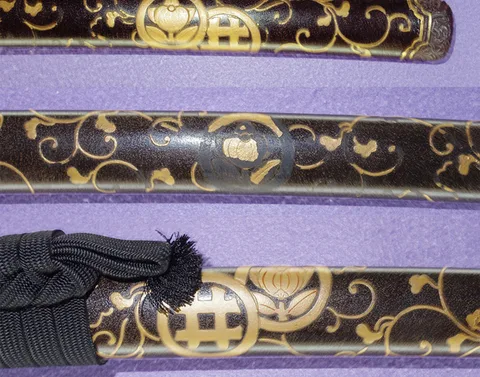
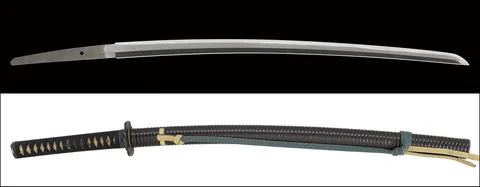

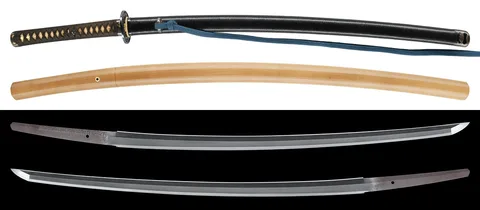
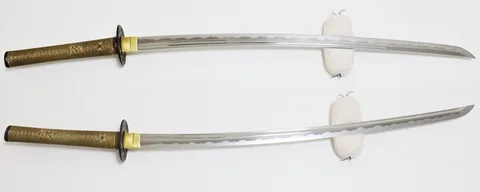

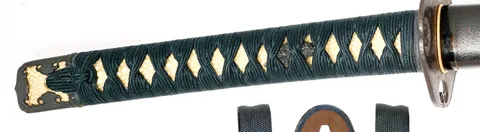
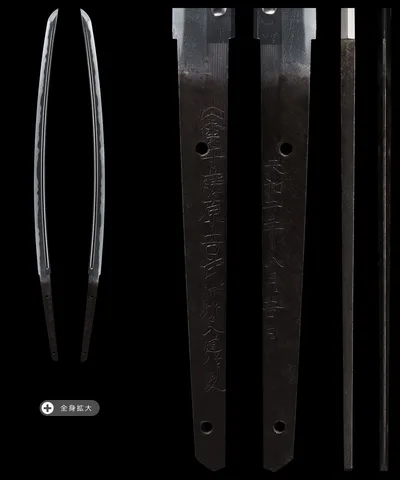
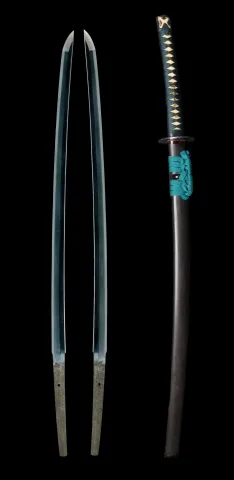
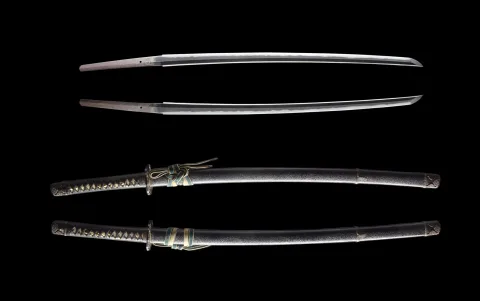
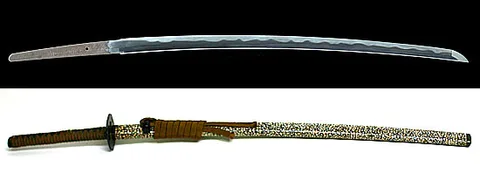
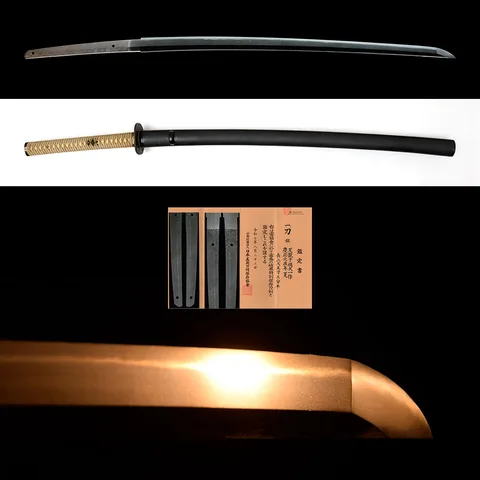


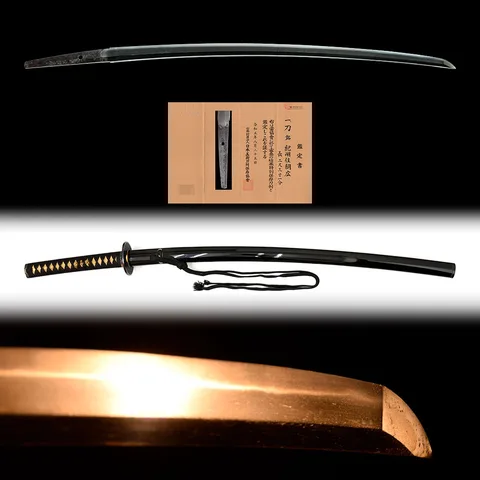
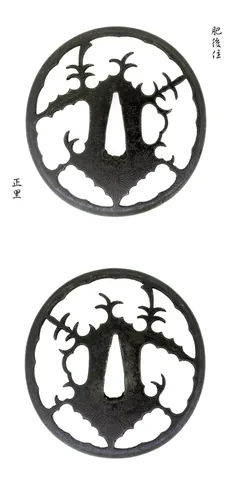
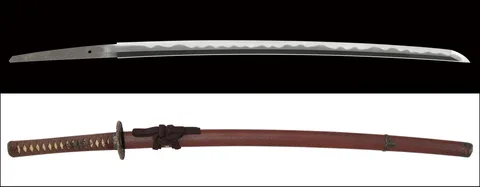
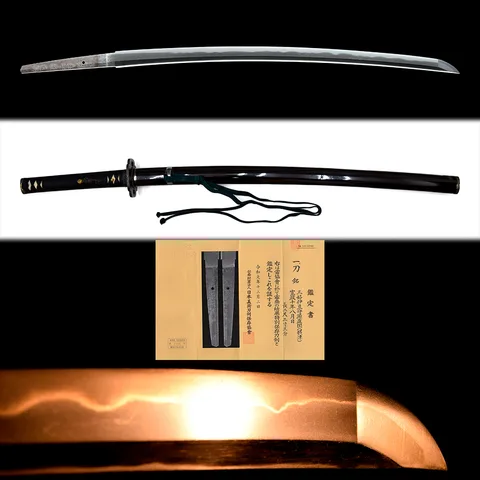
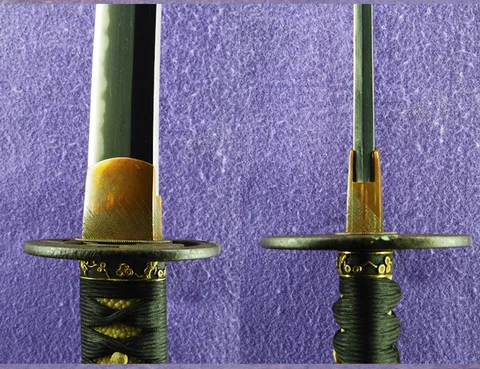
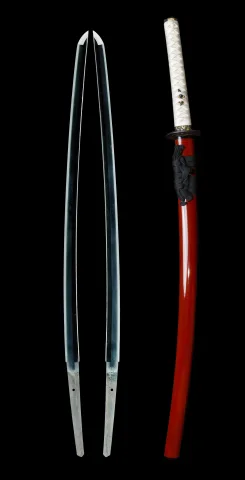
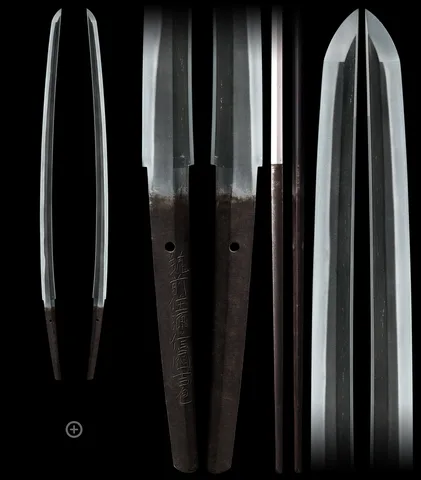

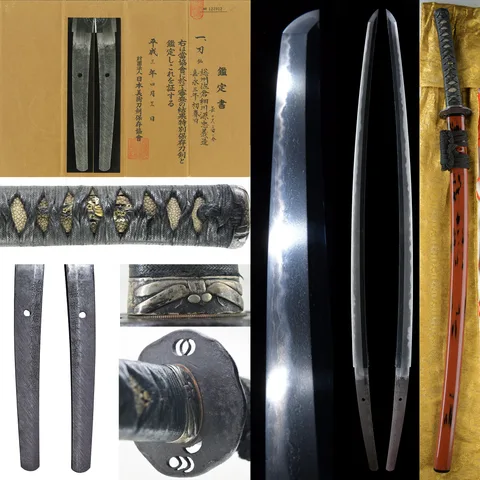
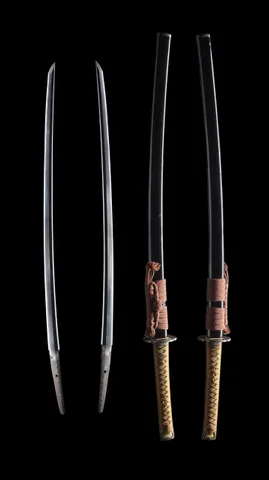
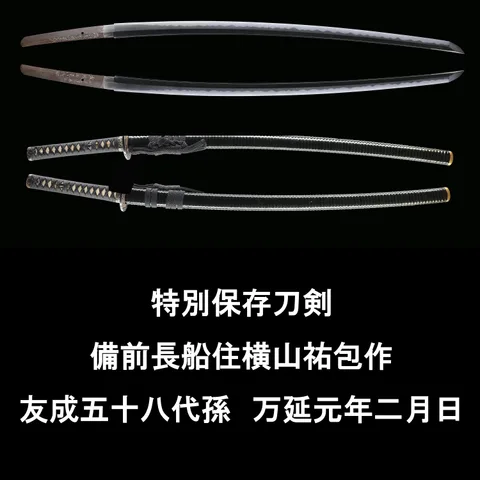
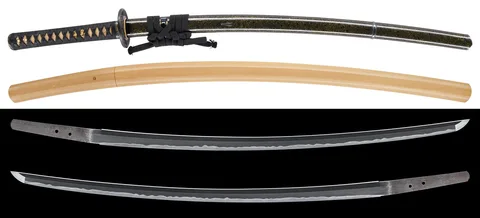
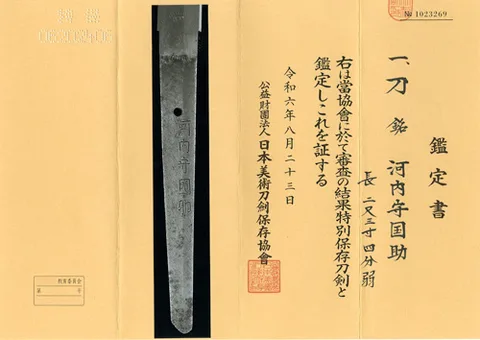
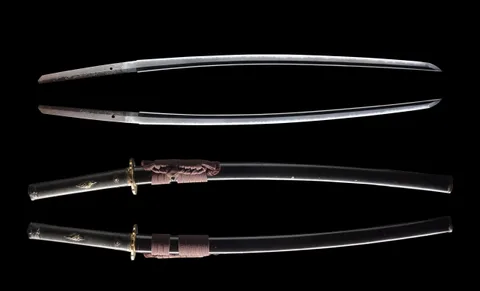


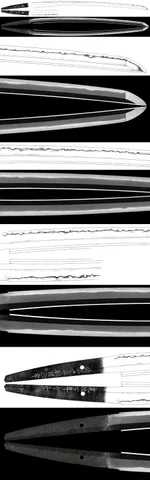

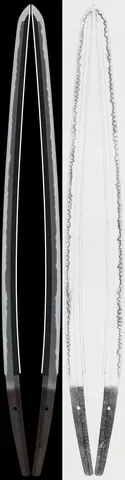
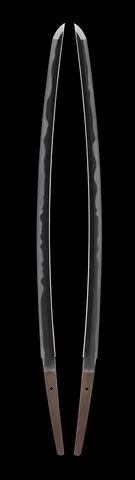

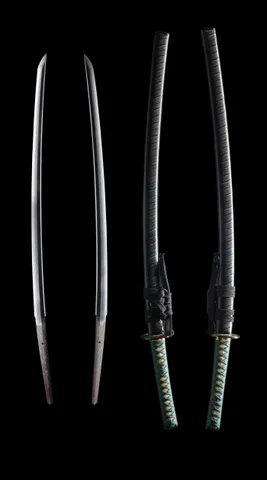
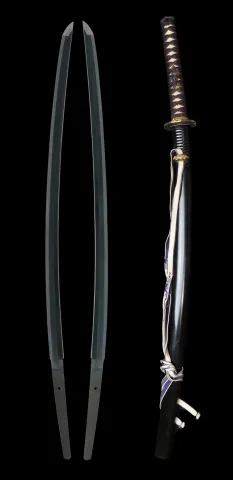



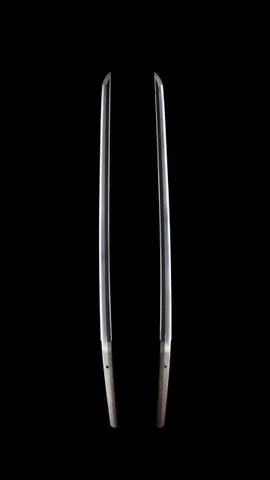

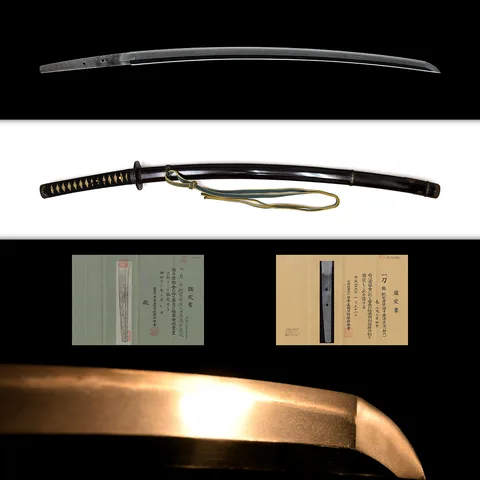
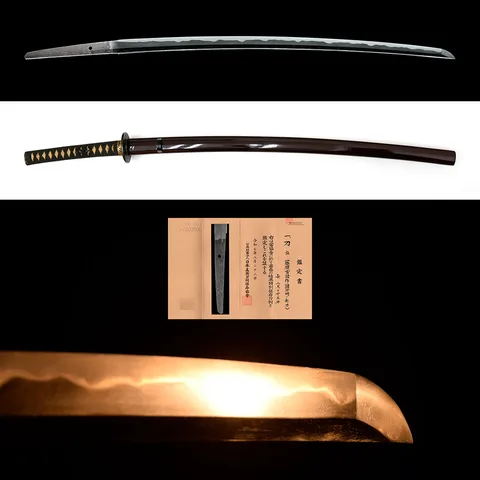
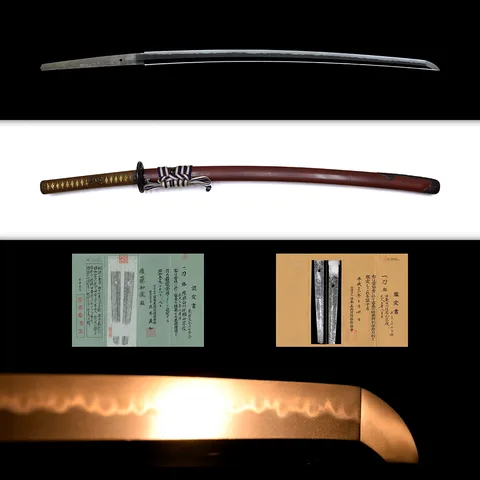
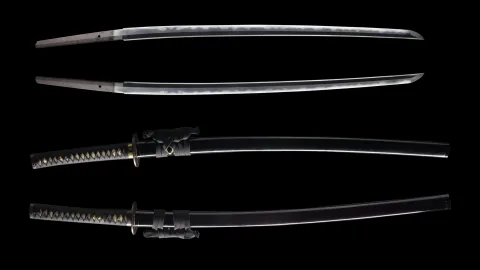

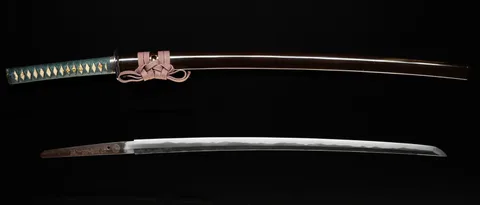
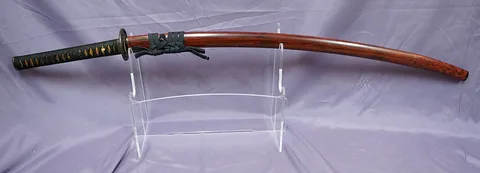
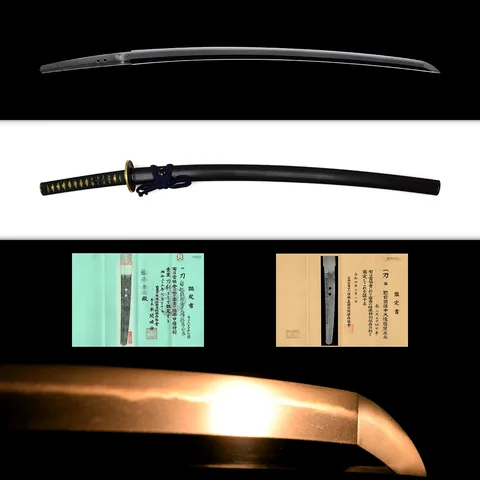
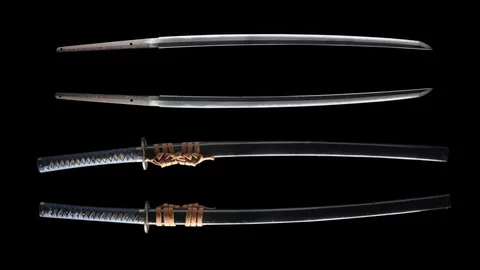

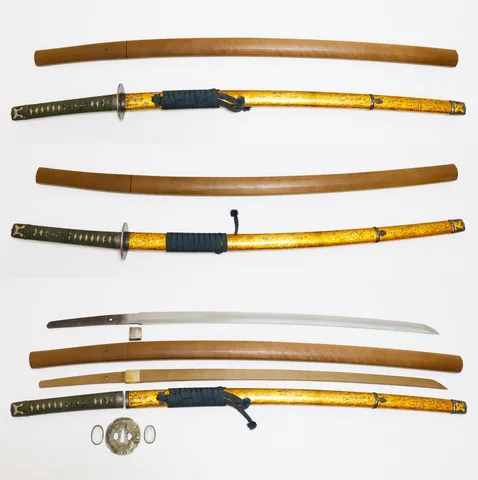

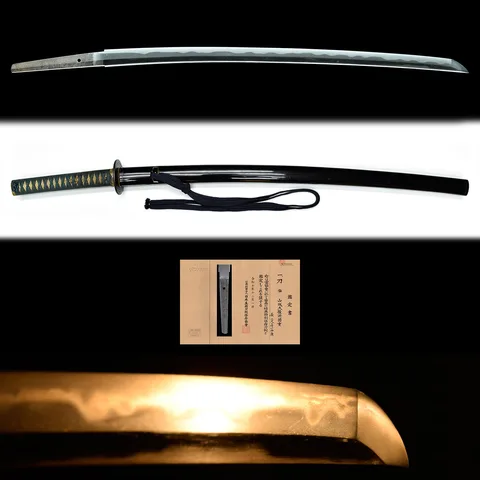
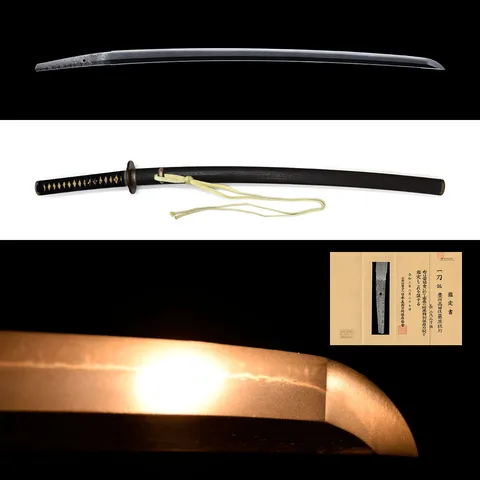

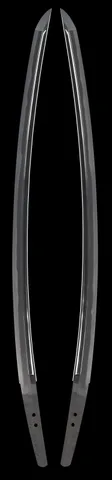
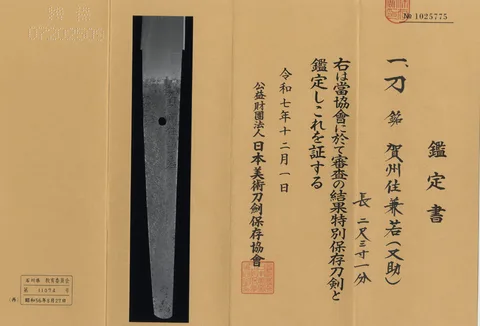
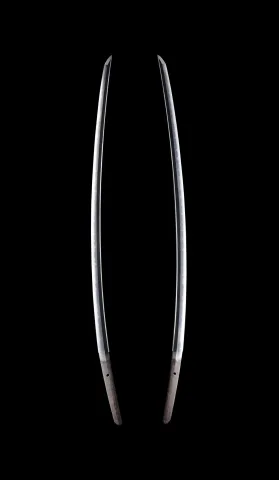
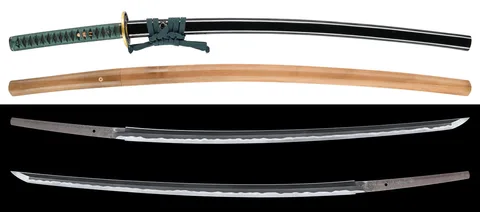
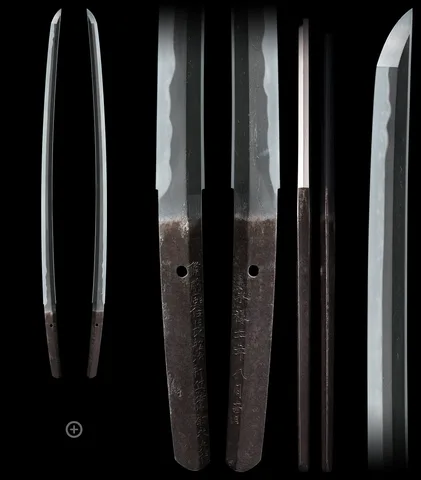
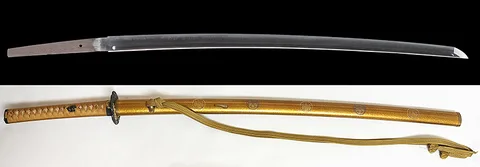




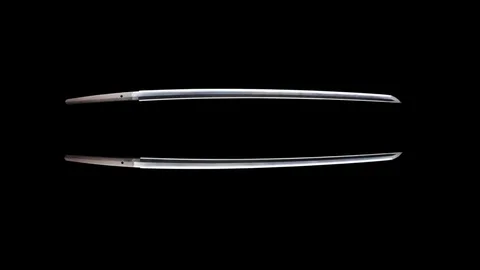
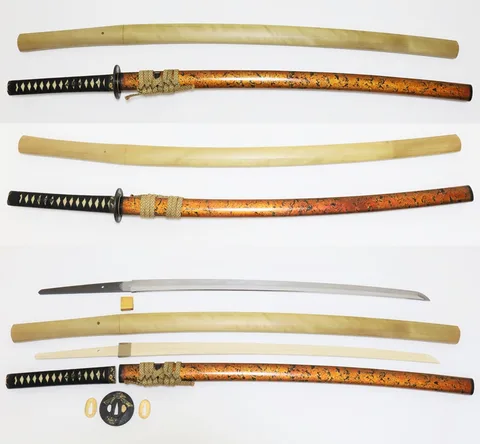
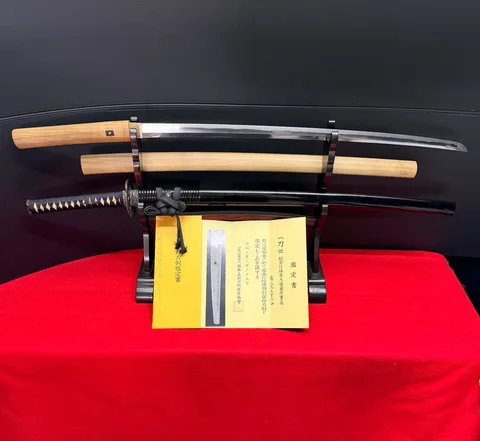





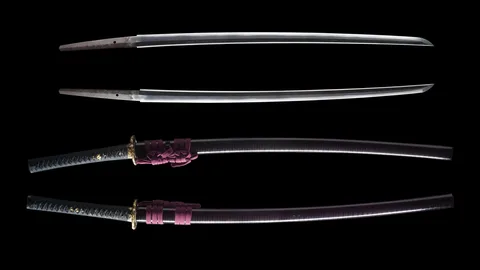




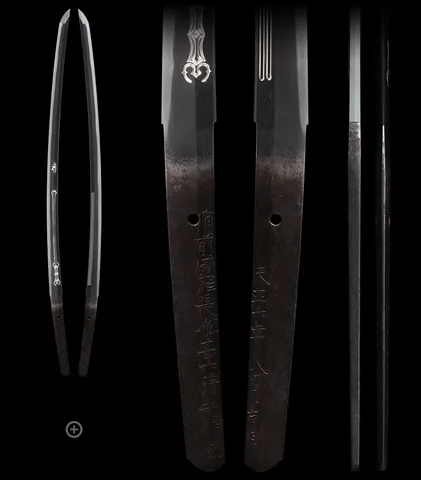

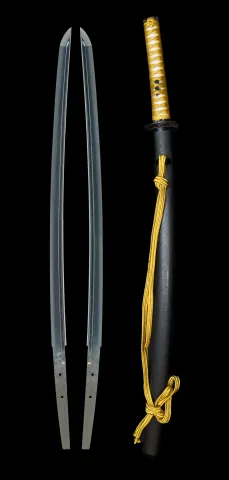

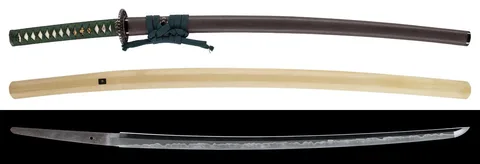

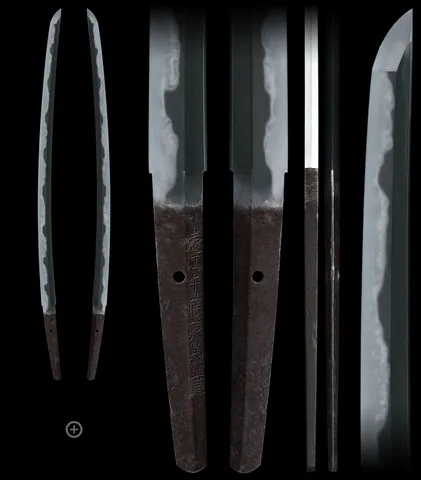
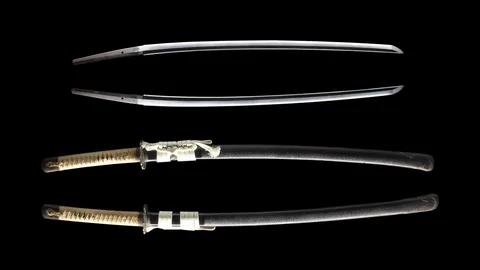
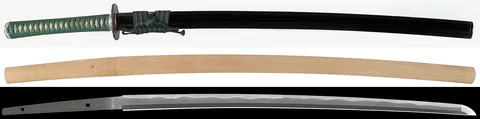
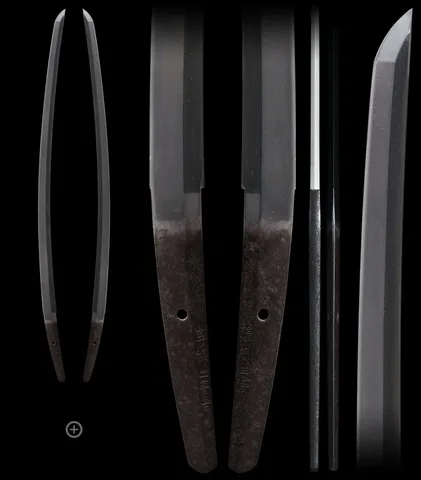
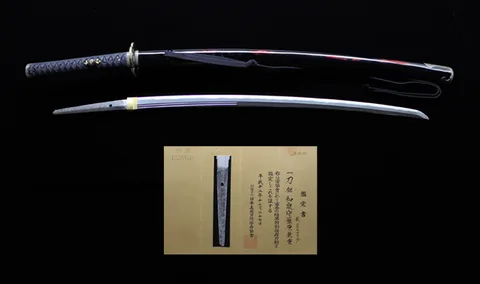
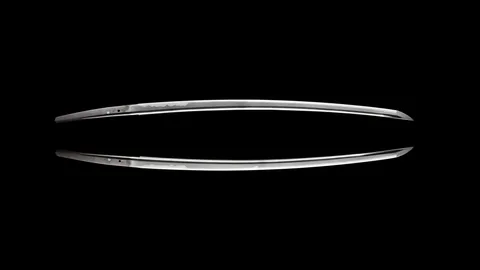
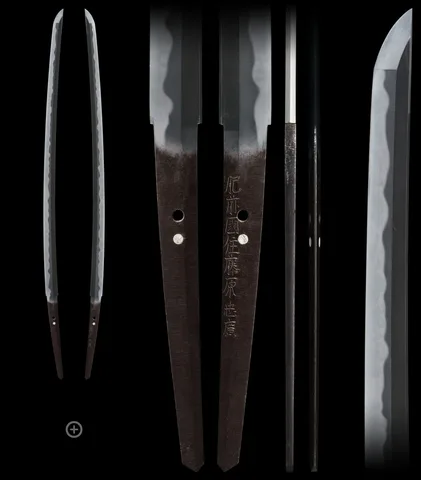
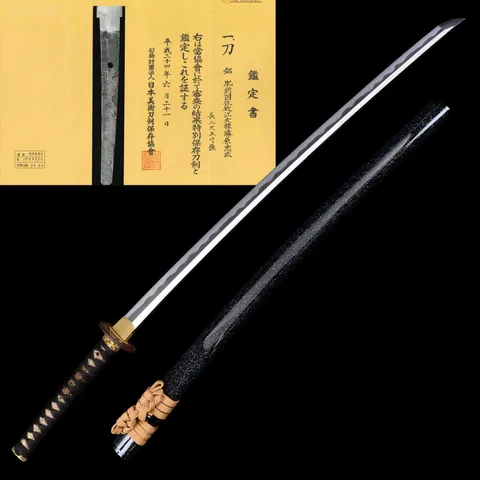
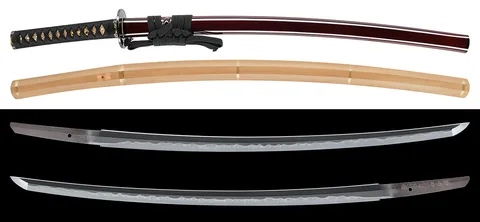



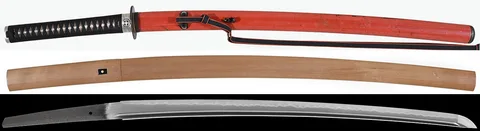
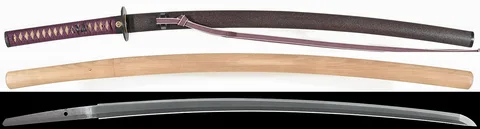
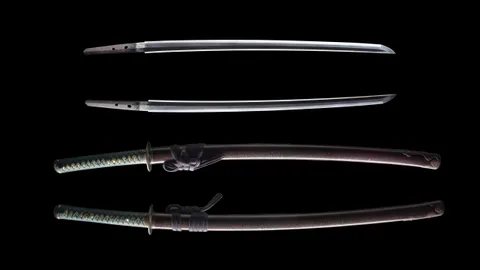

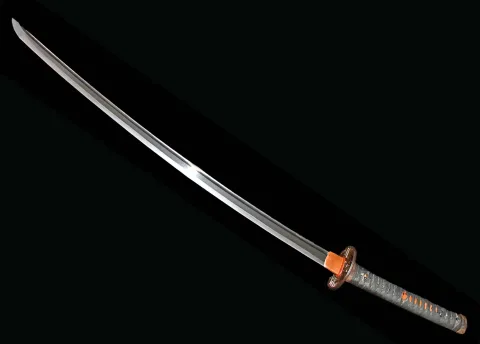

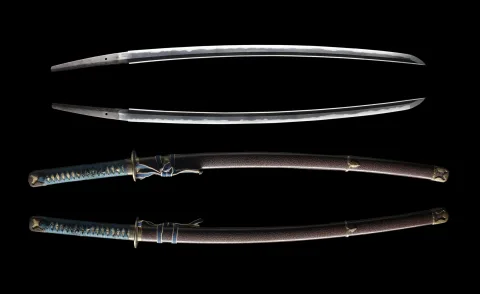
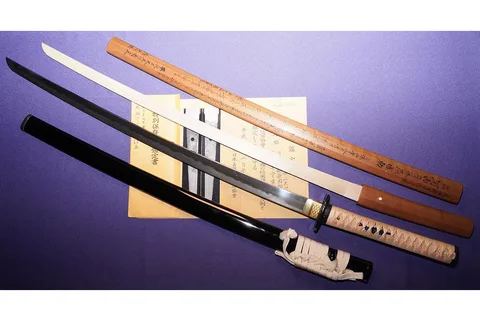
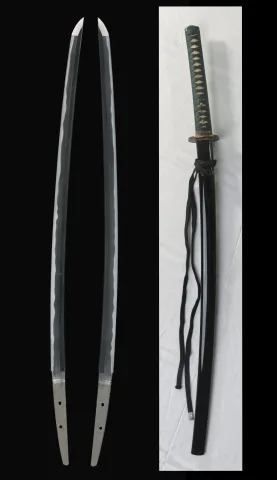


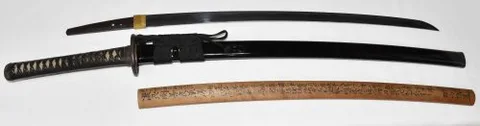
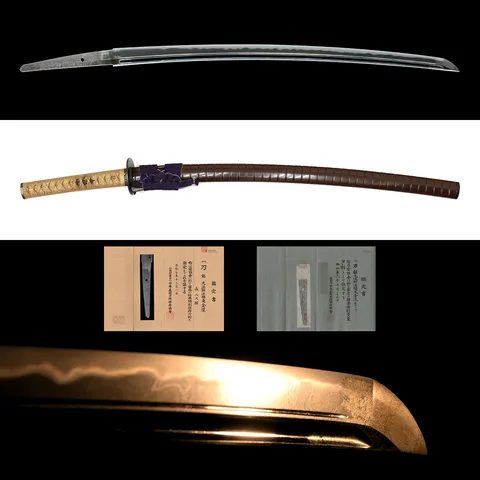

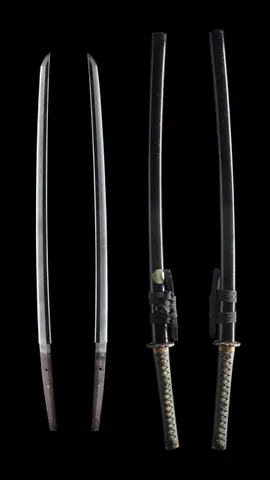
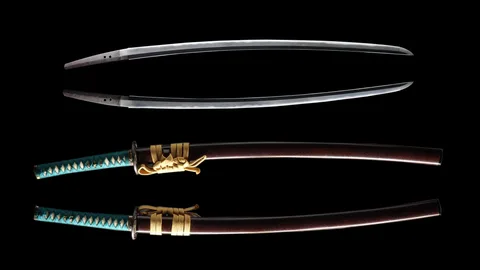
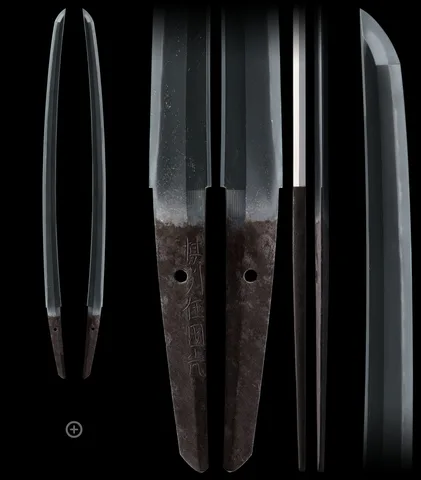
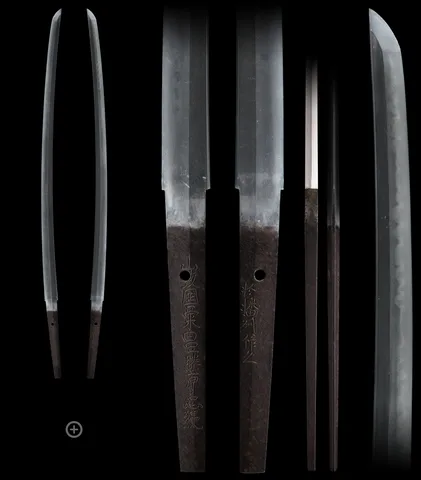
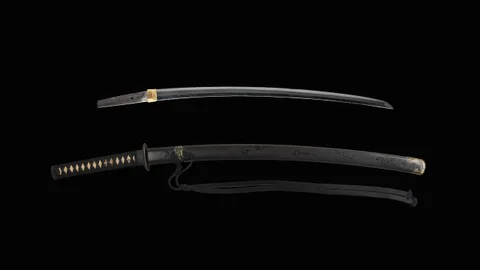
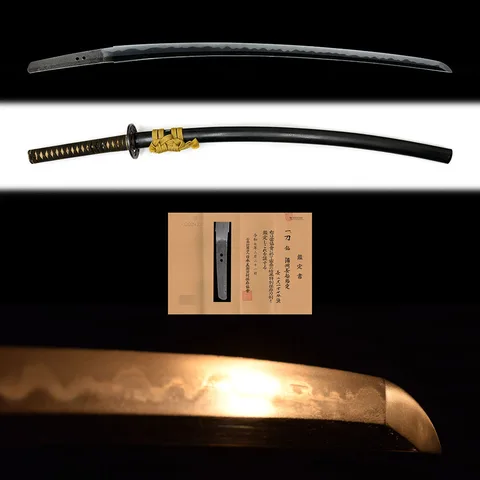

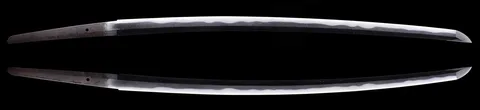
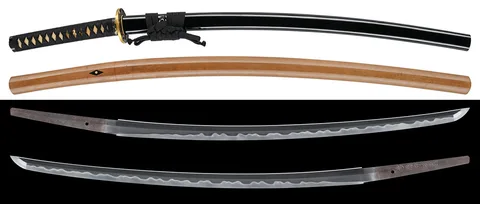




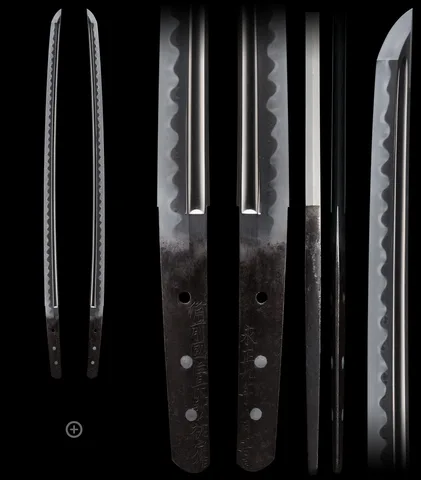
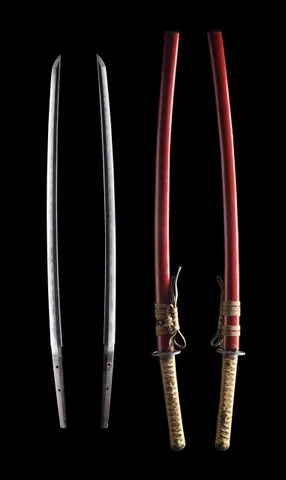
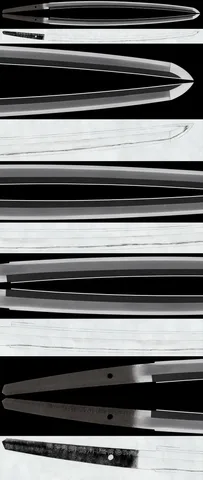


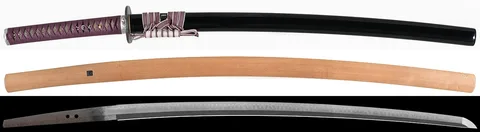
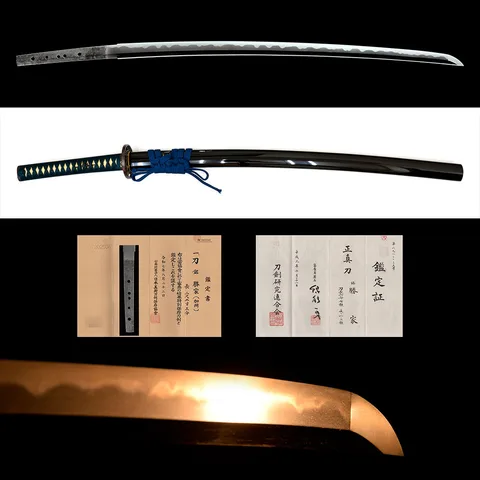
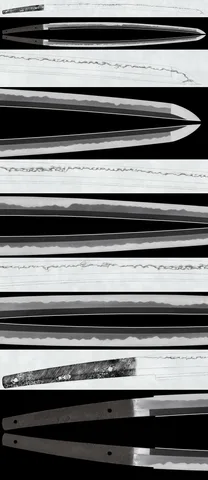
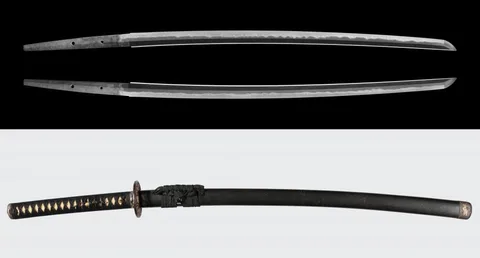
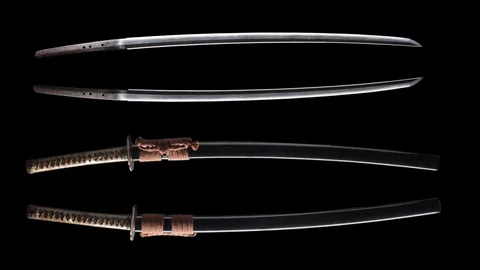
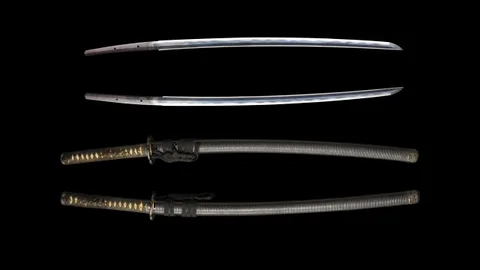
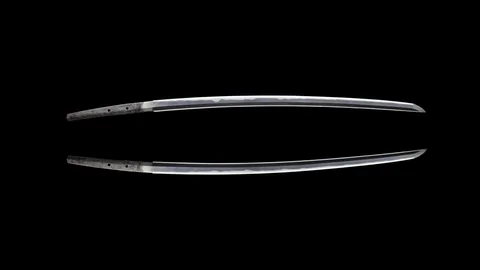
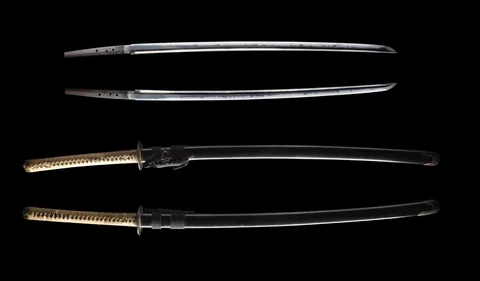

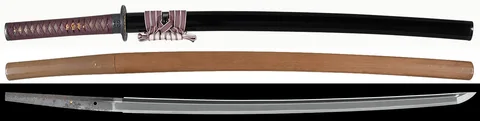




“Available” means on sale at origin at the last check. Every enquiry is confirmed before anything is committed.
0 of 4